
 Search Articles


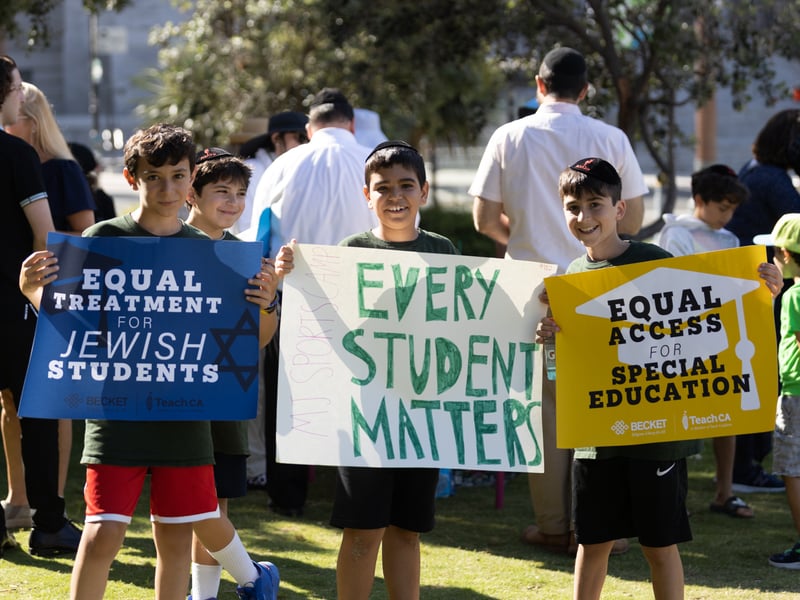
LOS ANGELES (CN) — A Ninth Circuit Court of Appeals panel ruled on Monday to reinstate a lawsuit filed by Orthodox Jewish schools and families over California’s policy of excluding religious schools from federal funding for special education programs.
“This is a massive win for Jewish families in California,” said Eric Rassbach, vice president and senior counsel of the Becket Fund for Religious Liberty, which represents the plaintiffs. “It was always wrong to cut Jewish kids off from getting disability benefits solely because they want to follow their faith. The court did the right thing by ruling against California’s bald-faced discrimination.”
Some states allow certain religious private schools to receive special education funding, but not California, a practice two Orthodox Jewish private schools in Los Angeles and three Orthodox Jewish families with children diagnosed with varying degrees of autism, called discriminatory in their complaint.
The California Department of Education has argued that the policy of not certifying religious schools to educate children with disabilities, and thus receive federal funding for it, was in line with First Amendment’s principle of “neutrality,” which says states must “be a neutral in its relations with groups of religious believers and non-believers.”
But U.S. Circuit Judge Kim Wardlaw found in her ruling, that California had failed to show the “that California’s nonsectarian requirement is narrowly tailored to serve that interest” of neutrality, and “why the applicable federal regulations that govern religious entities performing government contracts are insufficient to address the state’s neutrality concerns.”
“The California statute on its face burdens the free exercise rights of parents because it prohibits parents from advocating for a sectarian placement,” Wardlaw wrote.
The Bill Clinton appointee revived claims filed by two of the three families, based on the free exercise clause of the First Amendment and agreed that California forces them to choose between accessing the disability services and giving their children a Jewish education.
“Parent plaintiffs are required to choose between the special education benefits made available through public school enrollment (and subsequent referral to a private nonsectarian NPS) and education in an Orthodox Jewish setting,” Wardlaw wrote. “Because this presents a ’tendency to coerce’ them ‘into acting contrary to their religious beliefs,’ we find that parent plaintiffs have alleged a cognizable burden on their free exercise of religion.
However, the judges affirmed the dismissal of the claims field by the lead plaintiffs in the case, the Loffman family, finding that they had “the complaint contains insufficient factual allegations to plausibly demonstrate that the nonsectarian requirement has any effect on the Loffmans’ son,” as he has never been enrolled in a public school and a Individualized Education Program has never been created for him.
The three-judge panel also found the claims filed by Shalhevet High School and Samuel A. Fryer Yavneh Hebrew Academy would remain dismissed from the lawsuit as neither claimed they could satisfy the specialized requirements to become NPSs or “nonpublic, nonsectarian schools.”
“Shalhevet and Yavneh’s allegations suggest that they seek public funding for religious instruction — something NPSs are categorically prohibited from providing pursuant to federal regulations unchallenged here. These allegations do not plausibly suggest that these schools are ‘able and ready’ to serve in the NPS role,” Wardlaw said.
In 2023, U.S. District Judge Josephine Staton dismissed in part for lack of standing, and denied a motion for a preliminary injunction. The ruling means that the case will be remanded back to the federal court, and the judge must reconsider a motion for a preliminary injunction.
During oral arguments for the appeal, held in May, the three-judge panel appeared highly skeptical of both the ruling and of California’s policy.
“I can’t understand how the state can defend a law, which says Catholic secular schools, Jewish secular schools, Muslim secular schools, Buddhist secular schools, they just don’t qualify,” said U.S. Circuit Judge Mark Bennett, a Donald Trump appointee. “Virtually every other private school can qualify, but religious schools just don’t.”
The panel was rounded out by U.S. Circuit Judge Morgan Christen, a Barack Obama appointee.
A spokesperson for the California Department of Education, declined to comment, citing pending litigation.
 Follow @hillelaron
Subscribe to our free newsletters
Our weekly newsletter Closing Arguments offers the latest about ongoing trials, major litigation and rulings in courthouses around the U.S. and the world, while the monthly Under the Lights dishes the legal dirt from Hollywood, sports, Big Tech and the arts.