
 Search Articles


HILLSBORO, Ore. (CN) — When the Shute-Meierjurgen Farmstead was built outside Hillsboro in the 1880s, it looked out over 600 acres of pastures and orchards.
Today, fewer than four acres remain.
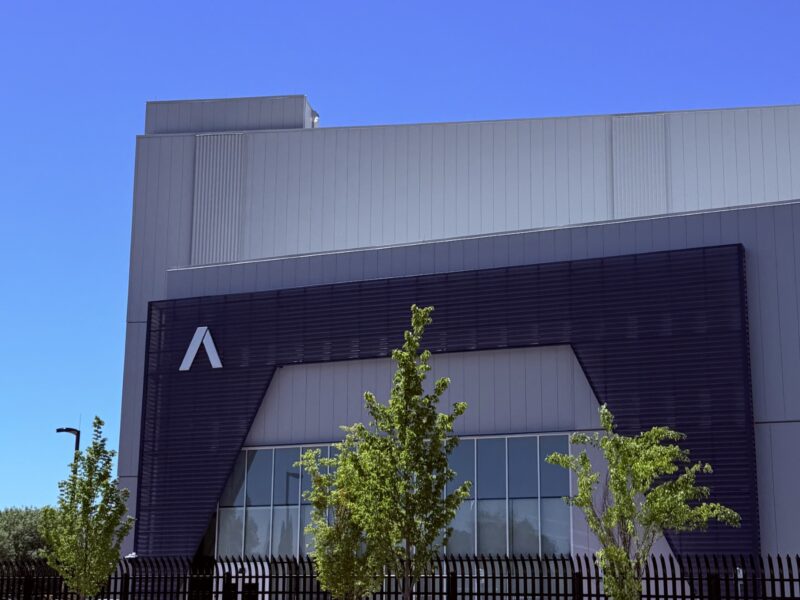
The Queen Anne-style farmhouse and its big red barn are now hemmed in on all sides by data centers and warehouses. Its inclusion on the National Register of Historic Places has helped preserve the property even as the landscape around it has changed.
Shute-Meierjurgen is now at the center of a fight over the future of Hillsboro, a western suburb of Portland.
The data economy is booming here, as is backlash against it. Protests happen regularly, and a legal fight is brewing.
Located in an area known as Silicon Forest for its high concentration of tech companies, Hillsboro sits on a prime piece of digital real estate. Here, in this former farming town in Oregon’s lush Willamette Valley, fiber-optic cables connecting the West Coast to Asia converge underground.
That location has made Hillsboro a prime location for artificial intelligence data centers.
So, too, have state tax breaks. A decades-old law meant to lure in business investment has saved data developers here around $84 million in taxes — money that might have otherwise flowed to local schools and fire departments. In March, Oregon lawmakers inadvertently set off a stampede when they passed a moratorium on these tax breaks. In the final weeks before the cutoff, officials in Hillsboro and Washington County approved 17 new data centers.
In June, land-use nonprofit 1000 Friends of Oregon sued over those deals. They argue the flurry of data centers were greenlit without adequate public notice.
“Out of public view and in a hurry, city and county staff approved those applications without the required notice and without authorization or oversight from their respective public bodies,” attorney Jesse A. Buss of Willamette Law Group, representing the plaintiffs, wrote in the complaint.
The parties in the case tell a familiar David-and-Goliath story about public unease with the dizzying expansion of tech infrastructure.
Among the defendants are some of the biggest names in American technology: Adobe, CoreWeave, Dropbox, Flexential and Nvidia. The co-plaintiffs include a City Council member, a school board member, local farmers, environmental nonprofit Tualatin Riverkeepers and the state’s largest teachers’ union.
The lawsuit — which also names Hillsboro and Washington County as defendants — challenges 17 specific enterprise zone applications, which businesses can apply for to receive tax breaks.
Underneath those claims is a bigger one: that Hillsboro, with little public notice, has given up millions in taxes and some of the world’s best farmland in a bid to attract data centers.
“It’s crazy,” said Aaron Nichols, a local farmer and a plaintiff in the case. “We have to get the city to collect the taxes that it’s owed and get corporations to pay the taxes they owe.”
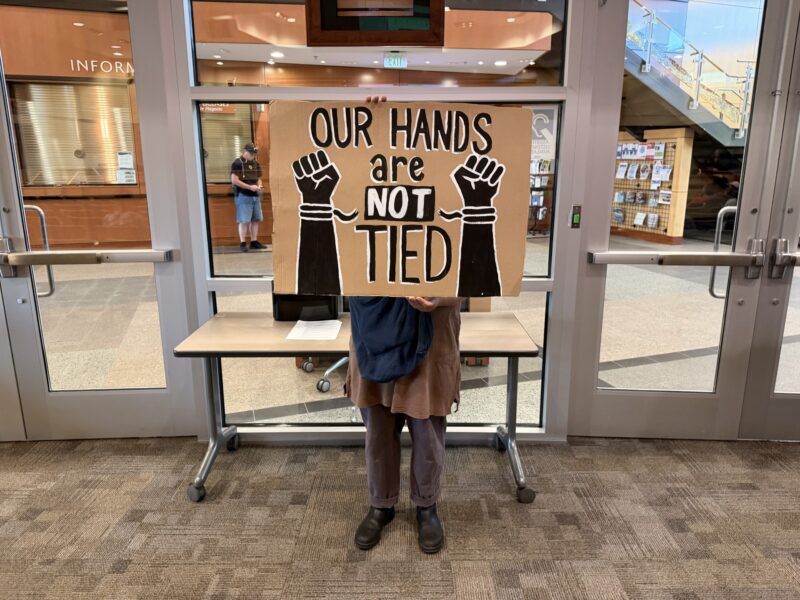
As a symbol of the region’s rural past, the Shute-Meierjurgen farm has become a gathering place for demonstrators opposed to tech overdevelopment of Hillsboro.
Although the zone approvals at the center of the lawsuit all involve data centers, critics decry what they see as an overly cozy relationship between local government and powerful tech companies. Over the years, virtually every major tech company has set up operations in Hillsboro, including Amazon, Apple, Google, Intel, Microsoft and Oracle.
Protester Simone Campbell has been on the farmhouse’s wraparound porch on numerous occasions. Looking over the crowd, past fields once tilled by Oregon Trail pioneers, she could see a seemingly endless stream of delivery vans pulling out of an Amazon warehouse. “That’s insane,” she remembers thinking, and the image has stayed with her: a quaint old farm, surrounded by the machinery of the new tech economy.

Jacob Roloff grew up watching the lands around him disappear to development.
In the 1980s, his parents bought a property in Helvetia not far from Shute-Meierjurgen. What started as a peach farm grew to include pumpkins, corn and agritourism. He still lives and works at the picturesque farm.
The rural lands around Hillsboro have disappeared over the years, making way for residential and commercial space as the Portland metro area has grown.
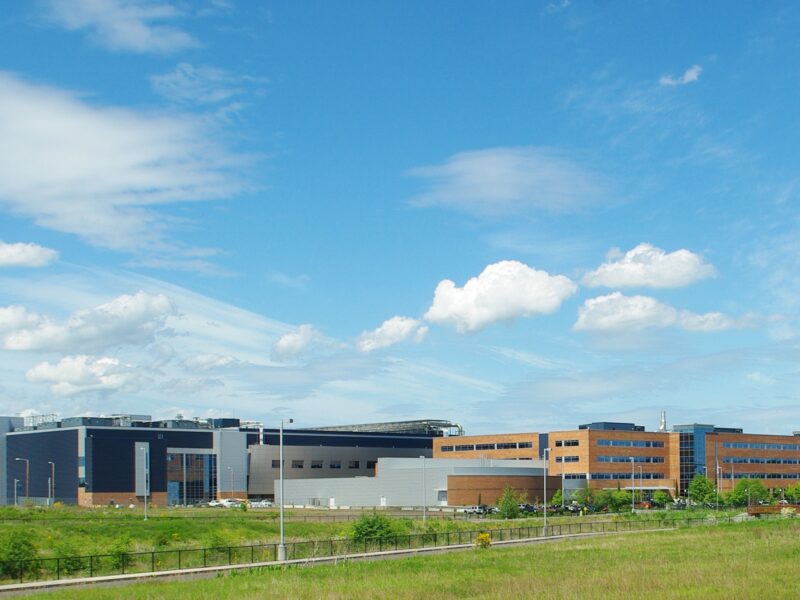
The recent boom in data centers has sped up that process exponentially. Fields were uprooted, becoming hulking, concrete-and-steel campuses with footprints in the millions of square feet.
From his family farmhouse, Roloff’s former view of forests and farmland has been replaced with monuments to progress.
He can see three data centers, as well as other signs of development. There’s a new sports stadium and a TopGolf venue, all of it illuminated throughout the night.
For a time, Roloff viewed this growth as disappointing but inevitable.
That changed last winter, when family friend Dirk Knudsen took Roloff on a drive. Knudsen founded and runs the local paper, the Hillsboro Herald. He’s also a real-estate agent — and in a bit of small-town coincidence, the same one who sold the Roloffs their farm decades ago.
Knudsen drove Roloff down Huffman Street, through the thickest cluster of data centers in the city.
“I was just kind of jaw-dropped at the scale,” Roloff said. “I could grow a lot of things in the footprint of these buildings.”
What struck him the most wasn’t any single structure but the sameness of all of them: row after row of what he called “the exact same block-building-fortress-thing,” all of them lifeless and anonymous.
“It kind of removed the fog,” he said of the drive. By spring, he’d connected with a group of data center skeptics and signed on as a plaintiff in the lawsuit.
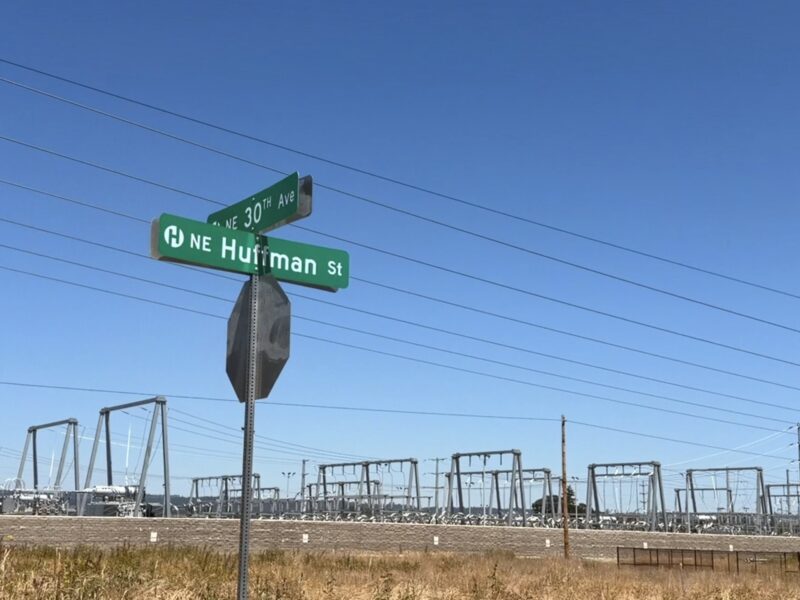
What concerns Roloff isn’t just the loss of scenery but the impacts on agriculture.
Willamette Valley soil is among some of the world’s most fertile. Enriched by Ice Age floods, the land here is so rich that one can just scatter seeds on the ground and get a crop, as farmers like to say.
Even as local farms dwindle, this region remains highly productive, producing significant amounts of wine grapes, Christmas trees and 99% of the country’s hazelnuts.
Watching the data center boom unfold in satellite imagery, Roloff watched as a former working farm was replaced by a construction footprint. The site looked like a visible scar, as crews had stripped away the topsoil and layers of earth beneath it.
“Topsoil is only a few inches, generally,” Roloff said. Dig much farther than that, “and you’re looking at just clay." These fertile soils aren’t a resource that regenerates on a human timescale. “It’s going to take too long to rehabilitate the land.”
Among farmers, concerns like this are helping animate the opposition to data centers. Nichols, who has also farmed in upstate New York, said the land he now farms is around two and a half times as productive as the stuff at his former farm out east.
“It can feed us. It can take care of us for generations, as long as we take care of the soils,” he said. “But it can’t be replaced.”
Even as farmers warn that fertile Willamette Valley soil is being lost, the land itself is becoming more pricey.
When Nichols bought his farm 12 years ago, he paid a little more than half a million dollars for 30 acres and a small farmhouse. These days, a 40-acre parcel with no structures is listed nearby for $8 million.
No working farm can make those finances work, Nichols said. The only buyers who can compete are those in the data center industry. “The result is short-term profit for a generation,” he said. He warned that “a group of people who are already quite rich” are getting more rich “at the cost to the rest of us.”
Farmers concerned about the loss of agricultural land are hardly the only ones up in arms.
Given the tax breaks, many locals argue the industry is gobbling land without adequately contributing to the community. Unlike other big industrial developments like factories, data centers usually employ just a couple dozen workers.
“These data centers [and] tech companies want to be in Hillsboro,” said Tammy Carpenter, another plaintiff in the case. In other words, they would pay good money to be here. And yet instead, she said, “we are offering them tax breaks.”
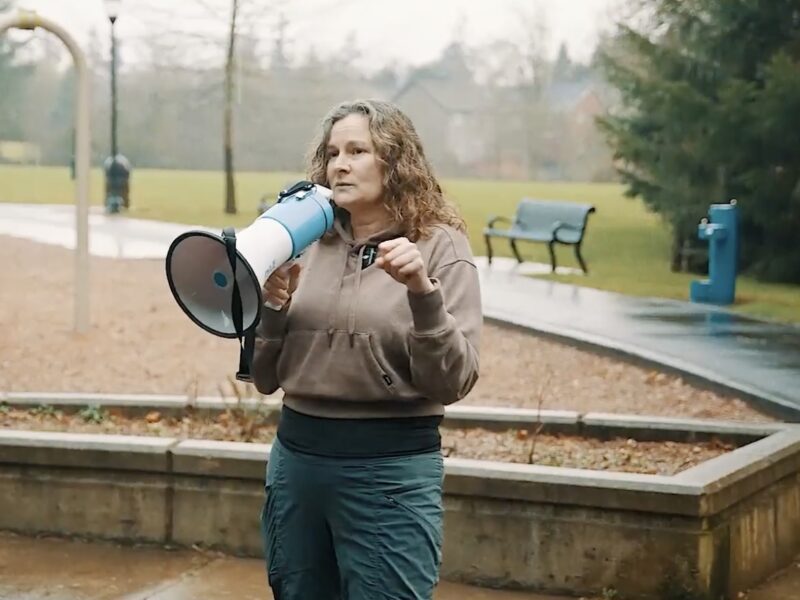
A school board member at Beaverton School District, Carpenter is now running for Oregon House District 27 as a Democrat.
Among her top campaign promises: A moratorium on data centers.
During her primary campaign, Carpenter and her volunteers knocked on tens of thousands of doors. Carpenter was struck by the number of residents who voiced concerns about data centers, often after seeing their electricity bills go up.
Carpenter argues the tax breaks are also affecting the Beaverton School District, which is facing budget shortfalls and recently cut dozens of positions. An entire school was shuttered, and class sizes are going up. She said money diverted with these subsidies could have otherwise gone into Oregon’s State School Fund.
Nichols, the farmer, said he’s also seen the impacts on schools. His children attend West Union Elementary, which he described as “right in the center of where the data centers are being built.”
Although one of his sons is autistic and is supposed to get specialized help, he says that support has rarely materialized.
“There’s just not enough money in the school system,” he said. “One of the reasons it’s underfunded is that the taxes are not being paid in a lot of the newest developments.”
“We fundraise for pencils and stuff, but, you know, the extremely rich data centers never pitch in," he said. “It’s closer to colonialism than it is economic development.” He also worries about the health impacts of having data centers so close to schools, including from air and water pollution.
For many residents, watching as some of the world’s richest companies get hefty tax breaks strikes at issues of basic fairness.
Another plaintiff, Kipperlyn Sinclair, is a current Hillsboro City Council member now running for the Washington County Commission. She has spent much of the past year focused on a technical aspect of land-use law.
Most of these data center sites, she said, are approved with a “Type 2” process, a limited administrative review with minimal public-notice requirements and no vote. She wants to instead see a “Type 3” process, which would require a public hearing and a recorded council vote.
“We are giving away our governing authority as elected officials,” Sinclair said. “We need our zoning [and] our community development codes to be amended so that we have the public and our governing bodies setting the direction.”

Sinclair and others would like to see a law like the one recently passed in New York, which imposes a moratorium on data center construction until certain conditions are met. They’d also like to see a public dashboard tracking the water use, energy consumption and job numbers of each data center.
“We have the right to understand what is happening in our community prior to policy and decisions being made,” Sinclair said. “That’s the bottom line.”
Trust has broken down to such an extent that weeks later, locals still talk about an infamous City Council meeting in June.
The chambers were packed, as they had been for months. Many residents wore T-shirts with the slogan “Recall Pace,” in reference to Mayor Beach Pace, whom many see as being missing in action during the data center controversy.
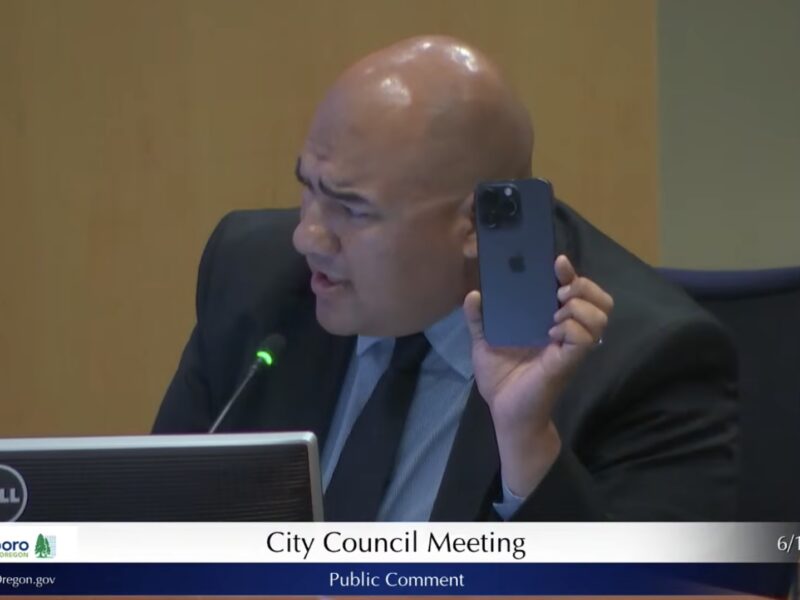
During the public comment period, Councilmember Cristian Salgado, a former Intel employee who has consistently voted to approve data center projects, mockingly filmed the audience for his social media. As one resident shouted that the community wasn’t being heard, Salgado blew her a kiss. The meeting ended early, and Salgado was later censured.
For Campbell, the failed meeting confirmed a pattern she’d watched develop for months: City government seemed to care little for the people it represented.
Data centers are a big part of that, but they’re not the only issue on which residents feel unheard. In June, a 19-year-old cyclist was killed at an intersection that residents had long complained was dangerous. The incident — which numerous residents brought up in interviews — seems to have supercharged anger against the city.
Campbell doesn’t think the data centers are going anywhere any time soon. But at the very least, she says locals deserve to have officials who listen to their concerns.
“You’ve got your city falling apart around you,” she said. “I would encourage the council to step outside their own privilege for just a moment or two and feel the weight of the feeling that’s coming from the city.”
It’s a battle with many fronts. In a Washington County courtroom, a judge has been tasked with deciding whether enterprise zone approvals can be undone.
In the court of public opinion, voters in November will weigh in an election in which data centers have become a defining issue. In Hillsboro, a slate of three City Council candidates — Myra Contreras, Diana Jackson and Kareem Delgado — are running to replace incumbents whom critics say have rubber-stamped data centers without real scrutiny.
Then there are the protests. There seems to be a new one every couple weeks. Sometimes they’re at Shute-Meierjurgen Farmstead, where a different kind of farm — a server farm — hums just across the street.
For now, data center construction continues in Washington County. But the tide may be turning, and not just in the form of this new lawsuit.
In March — around the same time state lawmakers imposed the tax break moratorium — a separate bill to expand Hillsboro’s urban growth boundaries fizzled out amid concerns about loss of prime agricultural land. And in July, just a few days before this story went to press, Hillsboro City Council unanimously approved new requirements for data centers. Any new projects will now need a full public hearing, and there will also be a 180-day pause on new agreements under the state’s Strategic Investment Program.
Changes may be also happening in the hearts and minds of Hillsboro residents. They’re tracking permit filings, reading zoning codes and getting organized. Some of them are running as good governance candidates. And some of them — including farmers, a school board member, and a county commissioner who has been battling data subsidies from inside the halls of power — are even queuing up for a court fight.
Subscribe to our free newsletters
Our weekly newsletter Closing Arguments offers the latest about ongoing trials, major litigation and rulings in courthouses around the U.S. and the world, while the monthly Under the Lights dishes the legal dirt from Hollywood, sports, Big Tech and the arts.
Additional Reads
 Boise shines in summertime July 24, 2026
 Oregon logging project clears legal challenge July 23, 2026
 Homelessness in LA is once again on the rise July 23, 2026