
 Search Articles


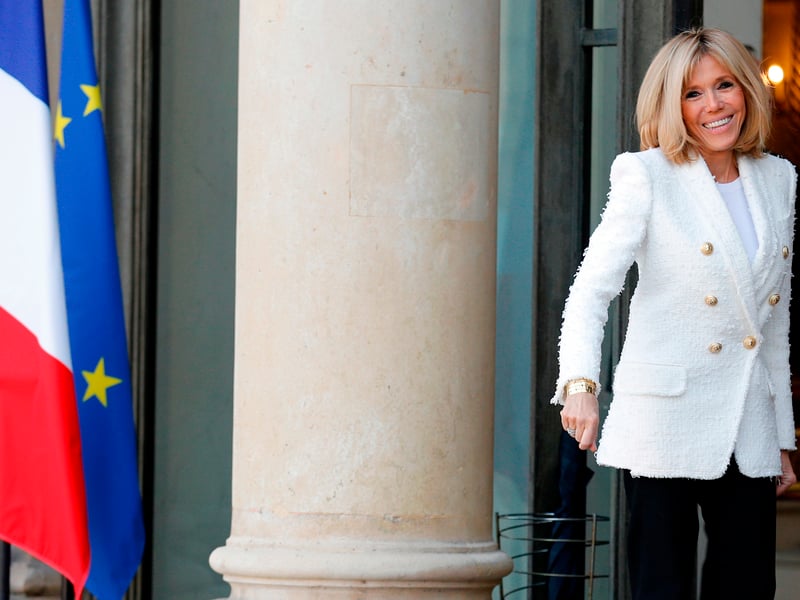
PARIS (CN) — A Paris court found 10 people guilty on Monday of harassing Brigitte Macron online amid a conspiracy theory that France’s first lady is actually a man.
Ten people — eight men and two women between the ages of 41 and 60 — went on trial for harassing Brigitte Macron online, specifically about her gender. A conspiracy theory amplified by conservative commentator Candace Owens stipulates that the first lady is really a transgender woman who was born as Jean-Michel Trogneux, who is actually her brother.
Three defendants, whom the court considered “instigators” with substantial social media followings, were handed suspended prison sentences from six to eight months. The online accounts of self-proclaimed medium Amandine Roy and influencer Zoé Sagan will also be suspended for six months.
The seven other “followers” were given more lenient sentences; one man, identified as Jean-Christophe D., will just have to attend a training course about cyberbullying awareness. The others received suspended prison sentences ranging from four to eight months.
The verdict was announced to a largely empty courtroom on Monday. Roy sat in the front row, flipping through a magazine before the announcements got underway, but most of the other defendants were not present. She was shaking her head as the sentences were read.
Prosecutors requested sentences ranging from community service to a yearlong suspended prison sentence, and up to $10,000 in fines depending on each individual case.
“I wanted to express what her life has been like since she suffered this hatred," Tiphaine Auzière, Brigitte Macron’s daughter and French President Emmanuel Macron’s stepdaughter, told a packed Paris courtroom in October. “I wouldn’t wish what she’s going through on anyone."
When Auzière took the stand, the sound of typing journalists almost drowned out her quiet voice. She said that her mother suffers from anxiety and is careful to control her appearance lest she come off as masculine, and experiences a “constant behavior of being on the alert.”
Although there were rumors about her gender identify when Macron became president in 2017, the story exploded in 2021 when Delphine Jégousse, the self-proclaimed medium and journalist known as Amandine Roy, posted a four-hour video on her YouTube channel interviewing Christelle L., another self-proclaimed journalist known as Natacha Rey. They claimed in the video Brigitte Macron’s gender was a “state lie,” the first lady had multiple surgeries and wasn’t really the mother of her three children.
It gained enough traction for Brigitte Macron to take the two to court for defamation, which she won. However, when Roy and Rey appealed in July, they were acquitted. They were both on trial alongside the group of eight others, this time for cyberharassment.
Meanwhile, Owens released an eight-part video series earlier this year called “Becoming Brigitte,” prompting the Macrons to launch a defamation lawsuit against her in the U.S. Paradoxically, this drew even more attention to the story — it’s extremely rare for heads of state to seek legal action against influencers on foreign soil.

But at trial in late October, not everyone had a big following. The first man to take the stand — identified as Jérôme A. — told the Paris courtroom that he’s made 36,000 posts on X since 2022, and regularly posts 30 per day. The court was examining roughly 10 tweets and retweets.
“At the time I had an account with 400 followers … Looking at my tweets from that time, I probably had the most views from investigators,” he said, prompting the public to burst out laughing in the trial’s retransmission room. He added that if he got 10 likes on a tweet, it was a good day.
This was a common theme throughout the first few testimonies, which largely examined people with small social media followings. Since they didn’t contact Brigitte Macron directly, or make any threats to her safety, they appeared incredulous to be on the stand in the first place.
Loïc Roccaro, a Marseille-based lawyer who often defends victims of online harassment, told Courthouse News that Brigitte Macron’s status as the first lady added a “media and state-sanctioned dimension” in comparison to typical cases.
“I think that in reality, there’s still one factor that’s necessarily key and undeniable: the status of the victim,” he said. “So I think it’s the nature of the comments, the allegations made against Ms. Brigitte Macron, that matter more than the number of forwards, shares and views.”
But Roccaro added that cyberbullying constitutes something that is “repeated, constant and insistent.” One person on the trial only wrote four tweets.
Another theme of the trial was pedophilia — Brigitte Macron met Emmanuel Macron when she was a 39-year-old teacher and he was a 15-year-old student. The two have repeatedly said that they did not get together until he was of legal age, but the story continues to draw criticism.
Jérôme C., who wrote four tweets and made a few retweets about Brigitte Macron, told the court that he has the “right to have my opinion." He read out the definition of pedophilia on the stand in October.
“Yes, she is a pedophile,” he told the court.
“So you’re an investigator, policeman, judge?” one of the judges retorted in a raised voice.
“It’s factual,” he replied.
Roccaro explained that it’s very difficult to catch cyberbullies because they often operate under fake identities and use VPNs, which could explain why these people were on trial in comparison to others with a higher volume of tweets. He hopes that this case will bring attention to the issue of online harassment.
“In our firm, we have many victims of cyberbullying, and we often find ourselves in this impasse — that is, the lack of sufficient cyber-investigators available to be able to unmask and identify the perpetrators and lead to prosecutions,” he said. “We hope that it is not reserved only for certain people.”
Courthouse News reporter Lily Radziemski is based in Paris.
 Follow @lilyradz
Subscribe to our free newsletters
Our weekly newsletter Closing Arguments offers the latest about ongoing trials, major litigation and rulings in courthouses around the U.S. and the world, while the monthly Under the Lights dishes the legal dirt from Hollywood, sports, Big Tech and the arts.