
 Search Articles


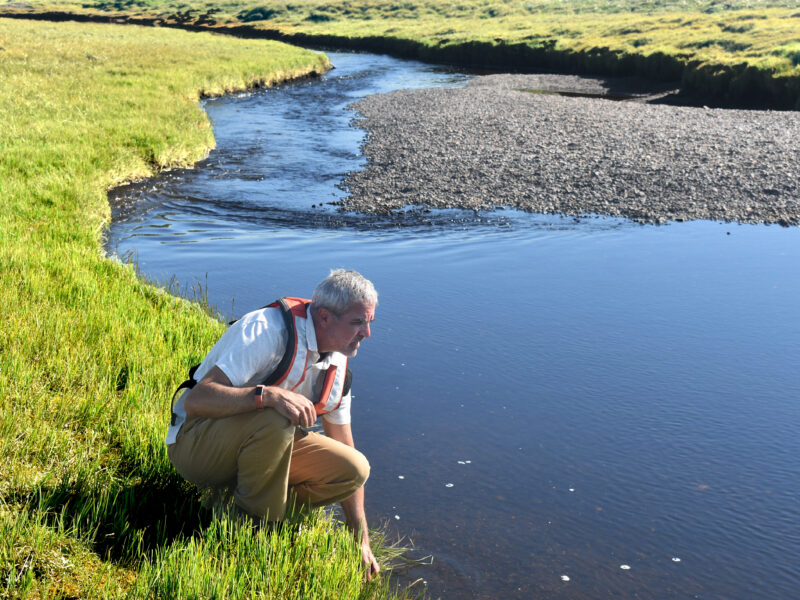
(CN) — The frozen worlds at the poles of the Earth are melting, including a layer of frozen land that can thaw and freeze annually in the Arctic, which is confusedly called permafrost.
Permafrost is frozen groundcover that remains at freezing temperatures for at least two consecutive years. It may include rocks and soil and other organic material, and it traps carbon. So, when the ground thaws, it releases greenhouse gases. And the permafrost has been thawing a lot recently, scientists say, so much that it is changing elements of the Arctic’s rivers.
New data computed by the Permafrost Water Balance Model and published in the journal Global Biogeochemical Cycles on Wednesday reveals just how much the thawing permafrost may effect the singular Arctic world.
A team of researchers at the University of Massachusetts Amherst analyzed a tract of land the size of Wisconsin and found that the runoff from thawing permafrost is increasing by large scales, in turn enlarging the “loads” of previously stored frozen carbon into northern Alaska rivers.
When it’s time for the active layer of permafrost — the layer that thaws and freezes again every year — to start thawing, it releases its carbon in the form of dissolved organic carbon and melts into rivers, which flow to the oceans. Due to increased temperatures, the active layer has deepened and more carbon is thawed and released every year.
By examining the data from the model, the researchers are beginning to understand what the increased carbon is doing to the Arctic rivers, and ultimately the oceans and beyond.
“Active layer deepening is mobilizing carbon from long frozen permafrost storage,” Mike Rawlins, a lead researcher and extension associate professor of Earth, Geographic, and Climate Sciences at the University of Massachusetts Amherst, said in an email. “Thus, some of the inert carbon on land is being mobilized and ending up in the atmosphere where it can contribute to climate warming. This process is in some ways similar to fossil fuel extraction, whereby humans are taking carbon from land, burning it, and thus allowing the carbon to become part of atmospheric greenhouse gas concentrations.”
Because direct observation of the changing landscapes in the remote Arctic is scant, Rawlins said, the Permafrost Water Balance Model fills in the gaps of data for daily river flows for a period of 44 years. Rawlins developed the model for 25 years, and it’s powered by a supercomputer at the Massachusetts Green High Performance Computing Center. It takes 10 days to crunch the numbers for each dataset.
The data shows that the deepening active layer of permafrost is causing a positive feedback loop, with a warming climate causing the thaw to extend into September and October, which brings more carbon to the river and seas.
“Some of the dissolved organic carbon in rivers is ‘outgassed’ to the atmosphere when it reaches calm coastal ocean waters,” said Rawlins. “These emissions add to the atmospheric greenhouse gas amounts and increase climate warming. So, in effect, permafrost thaw is moving carbon from Arctic lands and making it available to become part of the atmospheric carbon reservoir and thus contributing to climate warming.”
The data also shows a thaw in a region of northwest Alaska has unearthed “ancient carbon” that had been in the ground for thousands of years. And that may not be all the thaw is revealing.
According to Rawlins, scientists have reported that permafrost thaw is allowing “very old” viruses to become active.
“Some have coined the term ‘zombie viruses’ to describe the phenomena,” he said. “There is debate as to whether humans are at risk of harm from the thawed zombie viruses.”
He also mentioned that in some parts of the Arctic, rivers are turning red from active layers deepening when thaw reaches into soils that contain iron.
“Researchers call them ‘rusting rivers,’” said Rawlins. “There are concerns that the rusting is degrading water quality, making it unsafe for consumption by humans and animals.”
Overall, Rawlins said, the data shows one clear thing: The Arctic is becoming a wetter place.
The thaw and the freshwater runoff are speeding up and creating feedback loops, in a “hydrological cycle intensification,” putting more carbon into rivers and potentially altering the biogeochemistry of the Arctic’s coastal waters, including ocean salinity and sea ice formation, he said.
“Our estimates of freshwater and dissolved organic carbon making its way to the ocean in Alaskan rivers will be useful for researchers,” said Rawlins. “The data will help the researchers “better understand how coastal zones are being affected by Arctic environmental change.”
Subscribe to our free newsletters
Our weekly newsletter Closing Arguments offers the latest about ongoing trials, major litigation and rulings in courthouses around the U.S. and the world, while the monthly Under the Lights dishes the legal dirt from Hollywood, sports, Big Tech and the arts.
Additional Reads
 Decadelong fight over Yuba River dams ends in favor of feds March 31, 2026
 Feds fail to strike oil over California drilling law March 31, 2026