
 Search Articles


SAN FRANCISCO (CN) — Responding to a report finding major flaws in its wildfire-prevention work, California utility Pacific Gas and Electric on Tuesday denied purposely prioritizing inspections and tree trimming in lower fire-risk areas so it could meet state-mandated targets more easily.
“PG&E did not programmatically target low-risk line miles for work in its Enhanced Vegetation Management (EVM) program during 2019,” the company said in a court filing Tuesday.
PG&E was responding to a court-appointed monitor’s Oct. 16 letter claiming the utility focused on lower-risk areas that required little to no tree trimming so it could more quickly get those areas counted toward a state-mandated 2,455-mileage goal for inspection and remediation work.
According to PG&E, it never intended to schedule work based solely on risk ratings. The risk rating is one of several factors used to decide where to prioritize inspections and tree trimming work. Other factors include weather, permit requirements, local workforce availability, community preferences, and coordination with routine patrols and other wildfire mitigation work.
Nearly 60% of miles inspected around PG&E power lines in 2019 were in lower-risk areas, according to court-appointed monitor Mark Filip of the law firm Kirkland & Ellis.
In its response Tuesday, PG&E said it accepts and agrees with the monitor’s view that it “must give greater weight to working the riskiest areas first and must do so in a more rigorous, consistent and measurable way.”
In July, PG&E hired Sumeet Singh, a former PG&E employee who previously worked on wildfire safety, to serve as chief risk officer. In that role, Singh will be responsible for ensuring the percentage of risk eliminated by work in certain areas is measured in advance. He will work with a team of other PG&E executives and employees focused on wildfire safety. The company invited the monitor to attend weekly meetings with that group to “review and consider the plans and risk reduction targets” for its wildfire-prevention work in 2021.
PG&E said its contractors inspected over 1 million trees in 2019 and trimmed or removed more than 180,000 at a cost of $400 million. Among the trimmed or removed trees, 94,000 were in the highest fire-risk areas, according to the utility.
In its filing, PG&E also addressed concerns about its inspectors missing more potentially hazardous trees than it did late last year. One tree that PG&E failed to remove twice had leaves singed from close contact with a power line when the monitor’s team found it in mid-August.
“While PG&E does not believe the overall quality of its [enhanced vegetation management] work has regressed in 2020, the Monitor has identified issues that were missed, and the process has provided valuable feedback to PG&E and its contractor crews,” the company said.
PG&E acknowledged it prioritized enhanced climbing inspections of transmission towers in lower-risk areas this year. The company blamed a “process breakdown” that resulted from a lack of “specific guidance” given to the team responsible for those inspections.
“That decision did not align with PG&E’s intent to prioritize work in a risk-informed manner, and PG&E is examining the episode to learn from it,” the utility said.
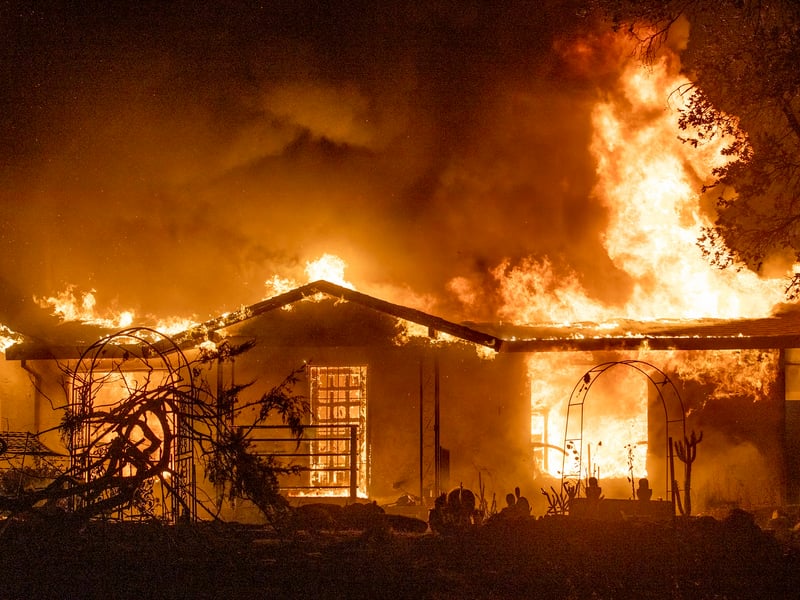
Also Tuesday, PG&E submitted a further response to U.S. District Judge William Alsup’s demand for information on its role in potentially sparking the 56,000-acre Zogg Fire that ignited on Sept. 27. The blaze killed four people in Shasta County, including a mother and her 8-year-old daughter.
In a previous court filing, PG&E said its risk model systems did not flag the area where the Zogg Fire started as a place to be considered for potential de-energization, and no one made an active decision to keep the line powered before the fire.
On Tuesday, PG&E provided data on the number of hazardous trees it flagged, trimmed or removed in the area of Zogg Mine Road and Jenny Bird Lane, north of the town of Igo, where the fire sparked, and the larger area surrounding the 117-mile, 12,000-volt Girvan Distribution Circuit that runs through the area.
PG&E says it trimmed or removed 42 trees between June 2015 and April 2020 in the area where the Zogg Fire ignited.
PG&E previously vowed to investigate why after the Carr Fire burned over 229,000 acres in 2018, it conducted only routine patrols in that area the following year instead of the enhanced patrols it typically does after wildfires.
The utility reported Tuesday that an enhanced patrol was scheduled to start in May 2019, but PG&E contractors with CN Utility Consulting (CNUC) changed the start date to Nov. 15, 2019, then later to Feb. 15, 2019, even though that date had already passed.
A routine inspection was conducted from April 10 to April 29, and it was reported as completed in PG&E’s database on April 30, 2019. A few days later, another CNUC contractor reported that an enhanced patrol for that area was completed on May 8, 2019, even though no enhanced patrol was conducted.
PG&E said it interviewed the CNUC workers involved, but none of them recalled details on the scheduling changes or database entries.
“PG&E is continuing to investigate the matter, including by pulling additional records and reviewing the role of PG&E personnel,” the company said.
The utility said it will update the court on Nov. 18 when it responds to Alsup’s demand for additional information on the Zogg Fire.
On Oct. 29, Alsup ordered PG&E explain if it considers residents’ ability to evacuate in its model for determining which power lines should be de-energized in high winds. He also asked why a large pine tree, which California fire investigators took as evidence after the Zogg Fire, was “looming” over the power line.
Alsup oversees PG&E’s criminal probation for felony convictions related to the fatal 2010 San Bruno gas pipeline explosion. The probation term expires in January 2022.
 Follow @NicholasIovino
Subscribe to our free newsletters
Our weekly newsletter Closing Arguments offers the latest about ongoing trials, major litigation and rulings in courthouses around the U.S. and the world, while the monthly Under the Lights dishes the legal dirt from Hollywood, sports, Big Tech and the arts.