
 Search Articles


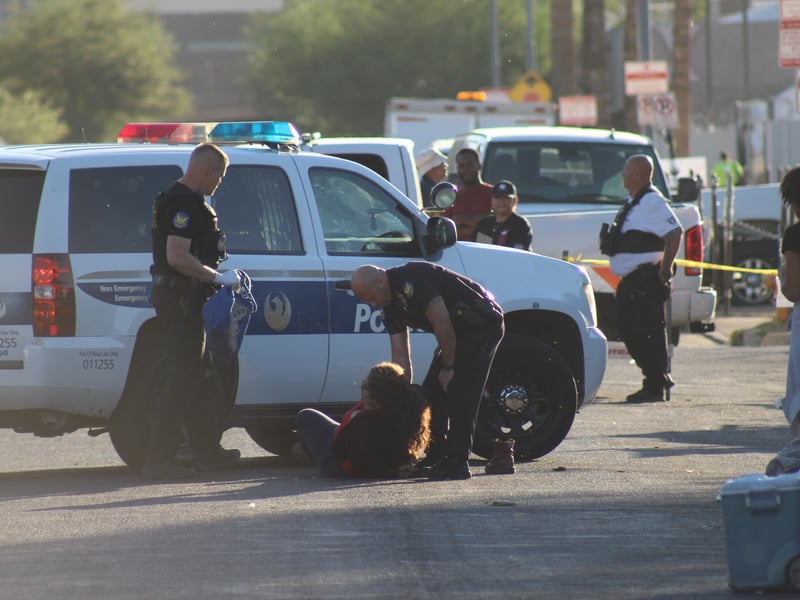
PHOENIX (CN) — After five days of trial, a jury of eight found that Lieutenant Benjamin Moore of the Phoenix Police Department did not violate the First Amendment rights of two men he ordered to be arrested at a 2019 protest.
Jorge Soria and Phil Martinez say in a lawsuit that Moore unfairly ordered their arrests for failure to follow a dispersal order while he let others who didn’t disperse walk free. They say Moore only ordered the arrests in retaliation for their constitutionally protected anti-police speech.
According to Moore, he arrested the two simply because they didn’t leave after he declared the protest an unlawful assembly. And the jury agreed.
“It was clear that Lieutenant Moore didn’t target anyone because of speech or beliefs,” defense attorney John Masterson said Wednesday afternoon, “but just because they stayed after the dispersal order."
Masterson, of Jones Skelton and Hochuli law firm, said the video jurors watched likely showed them that the protest wasn’t entirely peaceful, which may have garnered sympathy for Moore’s need to make split-second decisions.
In his closing argument, Masterson pointed to others on video who screamed profanities at officers, suggesting that if Moore arrested the two plaintiffs simply for their speech, he would have ordered the arrests of others as well.
Soria attended a protest in downtown Phoenix against the U.S. Immigration and Customs Enforcement in June 2019. He carried a large Soviet Union flag and a sign calling police “child killers.”
Moore and his officers who were called to testify said Soria was targeted for arrest because he was violently waving his flag at officers. Moore said a sergeant reported an aggravated assault to him, prompting him to order Soria’s arrest.
But that sergeant, Douglas McBride, testified last week that he never saw Soria violently wave the flag, and never reported an aggravated assault. Harris played more than an hour of video for the jury, and police couldn’t identify the supposed violence in any of the videos. Moore said he must have seen the assault in a different video that wasn’t entered into evidence.
“It’s very disappointing and discouraging,” Soria said outside the federal courtroom in Phoenix. “But I’m gonna continue. It’s not enough to stop me. If anything, it gives me more incentive to keep on, because I know we were denied justice."
Martinez, a well-known critic of the Phoenix Police Department, was riding the light rail through the area when officers forced him to get off and walk along the sidewalk to the next stop because of the disruption. Walking past police officers, Martinez scoffed at their helmets and riot gear, calling them “fucking pussies.”
He was standing near Soria, recording with his phone, when police arrested them simultaneously.
After Martinez’s arrest, officers claimed he was targeted not for his speech, but for throwing a “hammer fist punch” at one of them while he was being apprehended. But Moore and other officers couldn’t identify the punch in the video evidence, either.
But whether police lied about the violence, or whether it occurred, seemed immaterial to the jury, which apparently was persuaded by defense attorneys’ repeated refrain: “All they had to do was leave.”
Martinez, who was called to activism after a Phoenix police officer shot and killed his cousin in 2015, said he’s undeterred.
“I’m not gonna stop doing what I do,” he said. “I get up every morning and I go and help people in my community. It’s discouraging to see how a jury of my peers responds.”
Masterson and other defense counsel spent much of their time focused on other negative encounters Martinez has had with police since the 2019 protests, painting him as an agitator who got what was coming to him.
“I did object to that because it was all after Lights for Liberty, so I didn’t think it was important to the case,” Harris said. The Pittsburgh Trial Law Firm attorney said the argument may have swayed the minds of some jurors.
The trial began seven months after the U.S. Department of Justice declared the Phoenix Police Department engaged in patterns of civil rights violations and excessive force. While the plaintiffs presented the full investigation to the jury, certain parts, such as the finding that officers unlawfully restrict free speech and expression, were redacted from the jury’s view to maintain neutrality.
Harris said the redactions probably didn’t affect things too much, since the judge permitted the sections that discussed the case specifically. Still, he said the redactions may be subject to appeal, which Harris said may follow the judge’s rulings on other pending motions.
Jurors declined interview requests as they left the building.
 Follow @JournalistJoeAZ
Subscribe to our free newsletters
Our weekly newsletter Closing Arguments offers the latest about ongoing trials, major litigation and rulings in courthouses around the U.S. and the world, while the monthly Under the Lights dishes the legal dirt from Hollywood, sports, Big Tech and the arts.