
 Search Articles


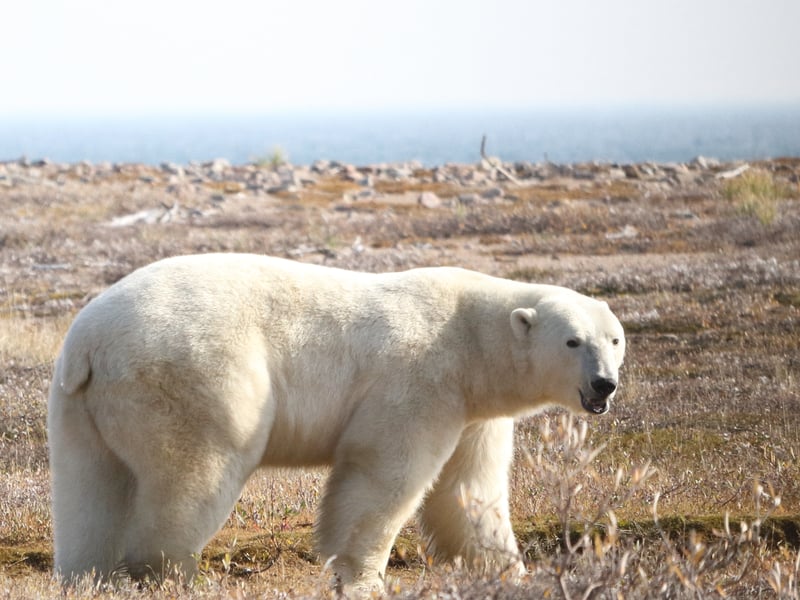
(CN) — As summers get longer, polar bears — the largest bears in the world — will likely struggle to find enough food in order to sustain themselves.
A team of scientists tracked 20 polar bears in Canada, attaching to them collar-mounted cameras and GPS tracking devices, in the southernmost part of the Hudson Bay region, where the polar bear population has already declined by about 30%. The researchers wanted to know what strategies the bears, which typically hunt for seals on ice sheets, would employ when forced to live on land. Those strategies, as it turned out, were mostly losing ones.
“As polar bears are forced on land earlier, it cuts into the period that they normally acquire the majority of the energy they need to survive,” said Anthony Pagano, a wildlife biologist with the U.S. Geological Survey Polar Bear Research Program and lead author of the study published on Tuesday in Nature Communications. “With increased land use, the expectation is that we’ll likely see increases in starvation, particularly with adolescents and females with cubs.”
Life as a predatory animal isn’t all romping thorough the wilderness, pillaging at will. Like a grocery shopper on a budget, most predators are constantly calculating: will eating this animal make up for all the calories it’s going to take to hunt it down?
During much of the year, polar bears — massive beasts that can weigh up to 1,500 pounds — hunt ringed seals and bearded seals using a method called “still hunting.” They find breathing holes in the ice, and lie down next to them, patiently waiting for a seal to pop up for air. They then gorge upon the seal’s blubber, often ignoring the muscle. During the spring and early summer, polar bears typically gain enough weight from eating seal fat to sustain themselves for the entire year. There are, in other words, months of feast, spent on the ice, and months of famine, spent on land.
Climate change has meant that those months of famine are becoming longer. According to Pagano, the amount of time polar bears spend on land has increased by an average of three weeks since the 1980s — from 100 days to 130 days. Computer modeling suggests that number will continue to increase by five to 10 days every decade.
“It’s really a matter of how long they survive on the land while that increases,” said Pagano.
The 20 bears Pagano and his team studied tried different “behavioral strategies.” Two stayed mostly sedentary, resting about 98% of the time. The rest were highly active, foraging for anything they could find. Some ate berries. Others found caribou carcasses, bird carcasses, grass, seaweed — “pretty much anything they could find that was edible,” said Pagano. Three bears went for long swims. One swam for more than 100 miles.
Regardless of the strategy, nearly all the bears lost weight during the three-week study. All but one, in fact. One lucky bear happened upon a dead animal, likely a seal or beluga whale (this particular polar bear’s collar camera stopped working, so it’s unclear what exactly it ate). That bear gained about 66 pounds in three weeks. Every other polar bear lost about two pounds a day. Hunting or foraging wasn’t any better than lazing on the ground.
“Neither strategy will allow polar bears to exist on land beyond a certain amount of time," Charles Robbins, director of the Washington State University Bear Center and coauthor of the study, said in a press statement. “Even those bears that were foraging lost body weight at the same rate as those that laid down.”
 Follow @hillelaron
Subscribe to our free newsletters
Our weekly newsletter Closing Arguments offers the latest about ongoing trials, major litigation and rulings in courthouses around the U.S. and the world, while the monthly Under the Lights dishes the legal dirt from Hollywood, sports, Big Tech and the arts.