
 Search Articles


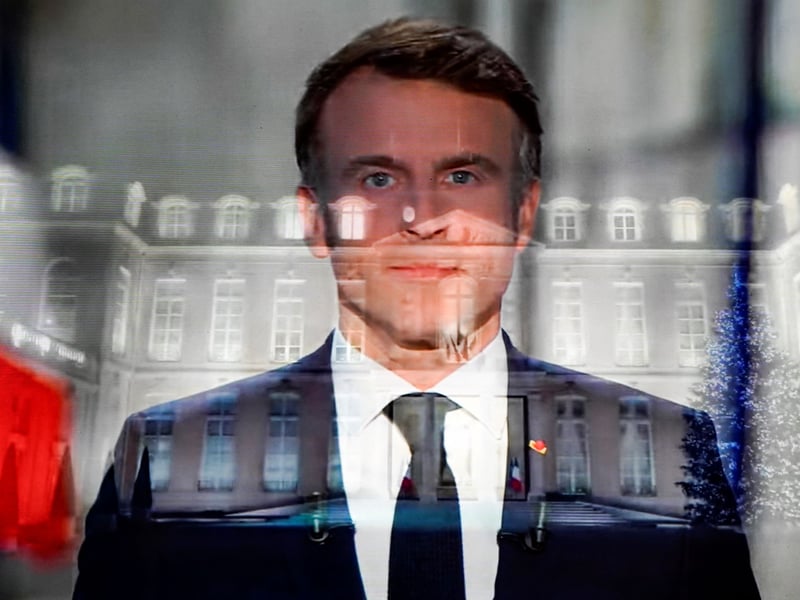
PARIS (CN) — The high-profile AI Action Summit has officially kicked off in Paris. But as world leaders and tech giants gather to charter the course of artificial intelligence governance, French President Emmanuel Macron appeared determined to steal the show before it even began.
Abishur Prakash is a manager at the geopolitical advisory firm The Geopolitical Business Inc. He explained that a few years ago, Macron proposed the idea of a “third pole” in the world: a European pole situated alongside the U.S. and China.
“Today, Macron is moving forward with this, creating a “third AI pole” that will coexist with what Washington and Beijing are leading,” Prakash told Courthouse News. “Surrounding this is a new push, by France, to hold the “AI torch” for all of Europe and drive a new era of European competitiveness.”
On Sunday, Macron announced plans to invest 109 billion euros into France’s AI sector, which will include contributions from foreign investment funds and defense groups.
“Europe is going to speed up, France is going to speed up,” Macron told the French TV channel France 2, adding that the funds represent “exactly the equivalent for France of what the United States announced with Stargate — $500 billion — it’s the same ratio" to the countries’ populations.”
The president broke the news on the eve of the AI Action Summit, co-hosted by Macron and Indian Prime Minister Narendra Modi. Roughly 1,500 invitees gathered under the rain across Paris, with the main stage anchored at the Grand Palais, a historic exhibition hall on the banks of the Seine.

On Monday, Macron stressed his enthusiasm about France working with American and Asian partners and officially declared Europe as “back in the race” on AI.
Prakash said Europe’s limited role in AI compared to the U.S., China, Israel, Japan, South Korea and others has left the country “deeply worried” about two things: “First, foreign AI systems will dominate France and Europe, eroding sovereignty and challenging economic success. Second, without a local AI ecosystem, France could be forced to align around a particular superpower instead of maintaining its own autonomy.”
The summit welcomed heads of state from all over the world.
U.S. Vice President JD Vance traveled for the event in his first foreign trip in the role; Canadian Prime Minister Justin Trudeau and Chinese Vice Premier Zhang Guoqing will also be in attendance. On the tech side,Elon Musk is notably absent.

On Monday, military personnel and defense companies gathered at the École Militaire to address the role of AI in the armed forces, where the Russia-Ukraine War was one of the big points of discussion. Outside, army personnel ran drills on horseback as military personnel stood on guard.
Pierre Vandier, the Supreme Allied Commander for Transformation at NATO, talked about the evolution of the war in a conference room nestled in the courtyard of the complex.
“The ability to adapt to a course of an enemy course of action is really important, and you see that in Ukraine,” Vandier said. “It’s a question of life — if you don’t adapt at speed and at scale, then you die.”
Vandier explained that technology is much more lethal now: Whereas before, war began with thousands of shells, one drone today can make the same impact.
“So the ability to outpace the enemy is really crucial,” he continued. “[AI] is bad and good at the same time — it’s the use you make of it which is relevant.
The use of AI in a military capacity raises its own ethical concerns including how AI flags its targets, how it separates these targets from civilians, and what kind of “human controls” should be handed over to AI, according to Prakash. There are no clear answers.
“Surrounding all of these is geopolitics — there is no clarity on whose AI rules the world should use,” Prakash explained. “Should it be American? Chinese? European? Indian? Without clear rules, nations will create their own or gravitate towards their preference, fragmenting the globe around AI ethics.”
 Follow @lilyradz
Subscribe to our free newsletters
Our weekly newsletter Closing Arguments offers the latest about ongoing trials, major litigation and rulings in courthouses around the U.S. and the world, while the monthly Under the Lights dishes the legal dirt from Hollywood, sports, Big Tech and the arts.