
 Search Articles


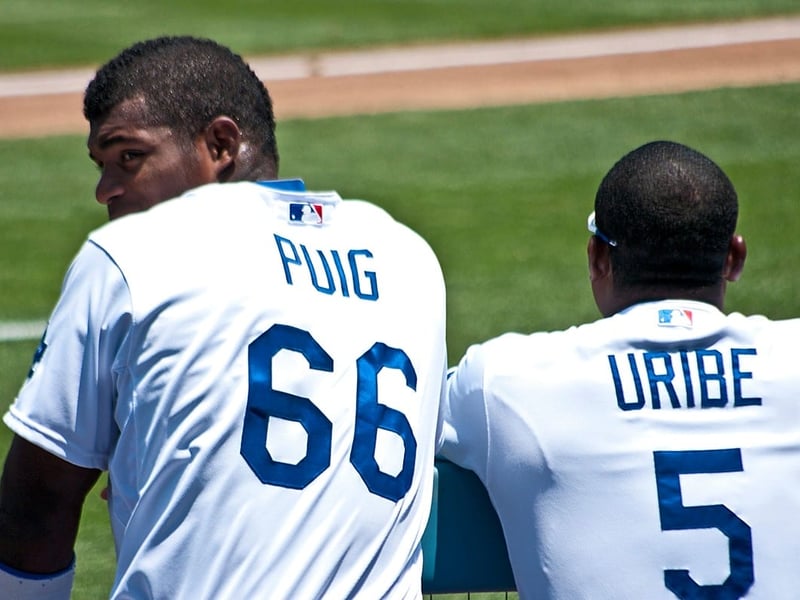
PASADENA, Calif. (CN) — Federal prosecutors went before a Ninth Circuit panel on Monday to argue that they should be allowed to use former Los Angeles Dodgers slugger’s Yasiel Puig’s admissions from a since-retracted plea agreement when they put him on trial over his reported involvement with an illegal sports betting ring.
The three-judge appellate panel didn’t indicate at the hearing in Pasadena, California, whether they were inclined to overturn a federal judge’s decision last year that Puig didn’t breach a binding plea agreement when he declined to enter a guilty plea to the charge that he lied to federal investigators about the sports betting operation.
Puig’s plea agreement included a waiver that permitted the government to use the so-called factual basis included in that agreement, detailing his purportedly unlawful actions as evidence against him at trial in case he knowingly breached the plea deal.
However, the judge last year agreed with Puig’s lawyers that since he never entered a guilty plea in open court, the agreement he signed with the prosecution wasn’t binding and therefore wasn’t breached. This meant that the waiver that would have opened the door to his admissions being used against him at trial can’t be enforced.
“As seven other circuits have recognized, these waivers are equally enforceable when they appear in plea agreements,” Rajesh Srinivasan, a lawyer with the U.S. Attorney’s office in Los Angeles, told the panel. “This court should join those circuits and reverse the district court’s contrary ruling.”
U.S. Circuit Judge Daniel Collins, a Donald Trump appointee, was willing to concede that, under U.S. Supreme Court precedent, a defendant can waive certain evidentiary challenges as part of a plea agreement, but that didn’t answer the question whether there was a binding plea agreement to start with if a federal judge hadn’t accepted a guilty plea.
In response to Srinivasan’s argument that a plea agreement is a private contract between a defendant and the government, and “not tied to the taking of the guilty plea,” Collins observed that there are a substantial number of appellate court cases where the government has successfully argued that it isn’t bound by a plea agreement and can walk away from it, before the plea is entered, if it has changed its mind.
“Is it your position that we should reject those cases as wrongfully decided?” Collins asked.
If so, Collins said, there will be a split whichever way the panel ruled in the Puig case because there are several cases in other appellate circuits where the courts have allowed the government to back out of plea agreements before the plea was accepted by a judge.
In those cases, prosecutors argued that until a plea was entered in court, the plea agreement wasn’t enforceable, according to the judge.
“To the extent that those decisions say that the government is not bound by plea agreements, we would disagree with those cases,” Srinivasan said. “That is important because defendants should be able to depend on the government’s promises.”
Elliott Averett, Puig’s attorney, pointed out that, for decades, the Ninth Circuit has held that a plea agreement that hasn’t been entered and accepted by a federal judge doesn’t bind the government or a defendant.
Moreover, according to Averett, Puig’s plea agreement does not unambiguously say that the included waiver of evidentiary challenges was enforceable prior to entering and acceptance of his plea.
This, Collins noted, to be contradicted by the fact that plea agreement actually says that it is effective once it has been signed by all the specified parties.
Likewise, U.S. Circuit Judge Anthony Johnstone, a Joe Biden appointee, wondered where in the plea agreement it says explicitly that the agreement between Puig and the prosecution is contingent on it being accepted by a federal judge.
“This is a background principle against which the parties are bargaining,” Averett said, comparing it to the covenant of good faith and fair dealing that is implied in any contract. “Absent some clear statement, I don’t think it falls out of the agreement.”
The third judge on the panel was U.S. Circuit Judge Holly Thomas, also a Joe Biden appointee.
Puig, 33, played for the Los Angeles Dodgers from 2013 to 2018, and his purported involvement with the illegal betting business started in 2019, after he had been traded to the Cincinnati Reds. There were no accusations in his plea agreement that he betted on games in which he participated.
According to Puig’s plea agreement, he was questioned by Homeland Security investigators in 2022 and lied about discussing gambling with an unidentified agent for an illegal sports betting operation. The truth, according to the government, was that Puig and this agent had communicated hundreds of times over the phone and through text messages about betting on games.
The operator of the illegal sports betting business, Wayne Nix, pleaded guilty in 2022. Nix began operating a bookmaking business about 20 years ago and, through his contacts in the sports world, developed a client list that included current and former professional athletes. He employed three former professional baseball players to assist with the business.
 Follow @edpettersson
Subscribe to our free newsletters
Our weekly newsletter Closing Arguments offers the latest about ongoing trials, major litigation and rulings in courthouses around the U.S. and the world, while the monthly Under the Lights dishes the legal dirt from Hollywood, sports, Big Tech and the arts.