
 Search Articles



WASHINGTON (CN) — As President Donald Trump made an unprecedented appearance at the U.S. Supreme Court Wednesday morning, a sea of protesters just steps away railed against his administration’s efforts to overturn birthright citizenship and stood behind longstanding legal protections for the children of immigrants.
The high court is weighing the legality of a 2025 White House executive order in which the president declared that people born to parents without permanent legal status were not entitled to citizenship under the 14th Amendment. The U.S. has for more than a century granted citizen status to the children of noncitizens, following a landmark Supreme Court ruling in the 1898 case United States v. Wong Kim Ark.
While the justices heard oral arguments Wednesday morning in Trump’s own case against birthright citizenship, demonstrators on the Supreme Court steps argued that the Constitution’s protections for the children of immigrants were crystal clear.
“The 14th Amendment speaks for itself,” said California Senator Alex Padilla, who addressed a crowd of hundreds of protesters from a lectern while holding a sign displaying the same message. “That shouldn’t be up for debate — but if they want to debate it, we will, and we will win.”
Padilla, a top Democrat on the Senate Judiciary Committee, argued that the Trump administration aimed to decide who “counts” in U.S. democracy.
“It’s wrong, it’s un-American and it’s dangerous,” said the California senator. “This is about upholding the Constitution. It’s about respecting the rule of law and keeping the promise that the 14th Amendment has held for 150 years.”
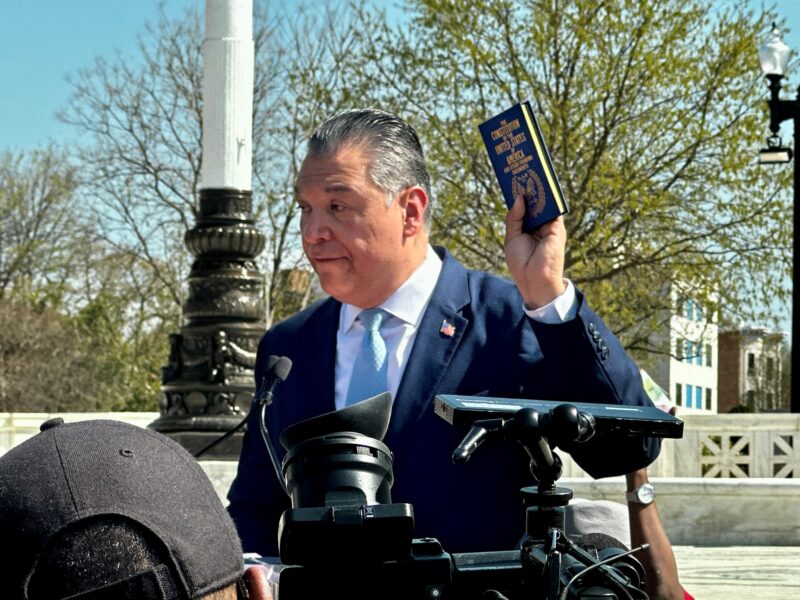
Janai Nelson, president and director counsel of the Legal Defense Fund, concurred with Padilla that the Constitution’s approach to birthright citizenship “could not be clearer,” reading directly from the 14th Amendment’s language.
“We will not let someone who peddles replacement theory, someone who believes that only white males should have power … or his administration to rewrite the Constitution,” she said.
The Trump administration has argued that the framers of the country’s founding document never intended for all children born on U.S. soil to be granted citizenship. The White House has pointed to the Supreme Court’s 1857 ruling in Dred Scott v. Sandford as evidence, citing the infamous slavery-era ruling’s central thesis that former slaves and their children were not U.S. citizens.
The high court decision in Wong Kim Ark, however, has for more than 100 years set a legal precedent under which the children of immigrants are entitled to citizenship and legal protections under the 14th Amendment.
Joining demonstrators Wednesday morning was Norman Wong, great-grandson of the 1898 case’s eponymous Wong Kim Ark.
Wong said that for much of his life he’d been unaware of his connection to the landmark birthright citizenship case, but that over time he had come to embrace his family legacy. “His fight was not just his own — it was for me and for generations to come,” he argued.
Wong pointed out that birthright citizenship was more than a “legal principle” on which protections for the children of immigrants are founded.
“It’s a statement about who we are as a nation,” he said. “This is my legacy, and now it is our responsibility to protect it so our children continue to live up to that promise.”

Despite the divisive nature of the president’s executive order, there were few people outside the court who appeared to support efforts to overturn birthright citizenship.
One woman, clad in red and sporting a megaphone, attempted to shout down the protest’s speakers, chanting “freed men stand with President Trump” and calling demonstrators “liars.” But the lone counterprotester found herself surrounded by pro-birthright citizenship signage and flanked by federal police officers working security at the event.
Demonstration leaders largely ignored the disruption, though some of them couldn’t resist throwing a quick jab at the one person present who appeared to back the White House’s immigration agenda.
“I don’t know how much you’ve got to get paid to sell your people out,” quipped DaMareo Cooper, co-executive director of the Center for Popular Democracy, as the crowd cheered. “I don’t know what the cost of that is.”
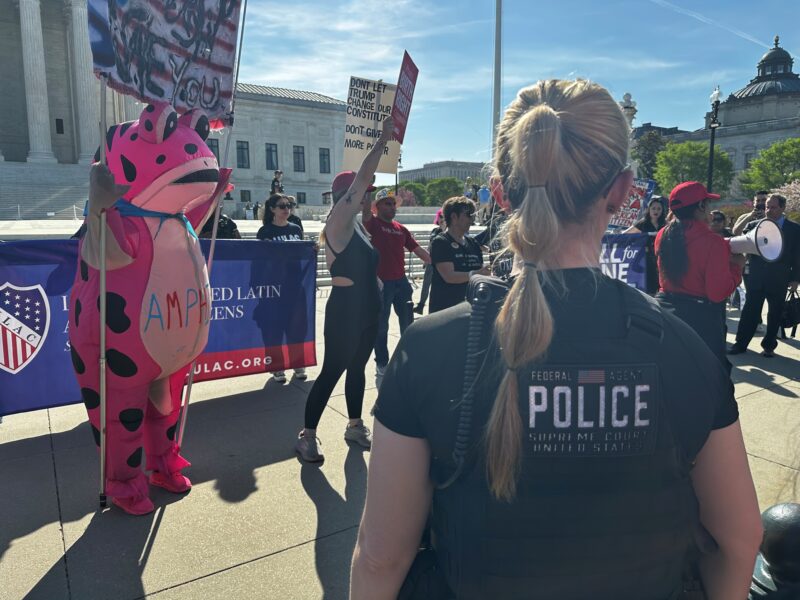
Inside the Supreme Court, the justices appeared skeptical of the Trump administration’s legal argument for significantly restricting birthright citizenship, suggesting the White House had offered weak justification for its plan to clamp down on constitutional protections.
The president, for his part, sat in the front row inside the court chamber as oral arguments began, alongside Attorney General Pam Bondi. It was an unprecedented move for a sitting president — none have ever attended arguments at the high court. But Trump’s visit to the Supreme Court was brief, and the president left the building a little over an hour after he arrived.
 Follow @BenjaminSWeiss
Subscribe to our free newsletters
Our weekly newsletter Closing Arguments offers the latest about ongoing trials, major litigation and rulings in courthouses around the U.S. and the world, while the monthly Under the Lights dishes the legal dirt from Hollywood, sports, Big Tech and the arts.
Additional Reads
 Lawsuits fly as Florida governor signs new elections law April 1, 2026
 Arizona repeals Cesar Chavez Day amid rape accusations April 1, 2026