
 Search Articles


These could be words from one of my columns, but they’re not.
“The government has imposed a blanket fiat banning Courthouse News.
“Lawyers can use the information obtained from Officer of the Court Remote Access to assist in performing their professional duties, such as writing briefs and making legal arguments. But news services cannot use OCRA to perform their professional duties: to report on the news.”
Judge Roger Gregory on the Fourth Circuit bench wrote those words.
But he wrote them without the support of another judge. His apt description of the situation in Virginia courts was written in dissent.
The majority OK’d the commonwealth’s non-public access system where lawyers and government officials can look over state court records by tapping on a phone or clicking on a work computer.
The press and everyone else must drive all around Virginia — courthouse to courthouse — in order to see the same thing. The majority on the Fourth Circuit panel framed the issue around a single courthouse and concluded that because the press could go to that courthouse and see the same records, no constitutional harm, no First Amendment foul.
In essence, the majority is saying, ‘These special folks can see the public documents right now and you folks in the press can travel, no matter how long it takes.’
The issue is a bit tricky because it can easily be recast as a demand for remote access. But it’s not.
We are saying that once a state sets up a remote access system — not unusual in these strange electronic times, and in fact the prevailing form of public access in state and federal courts — then a state cannot fence it off from journalists and the public. Some form of control is fine, such as registration and a modest fee.
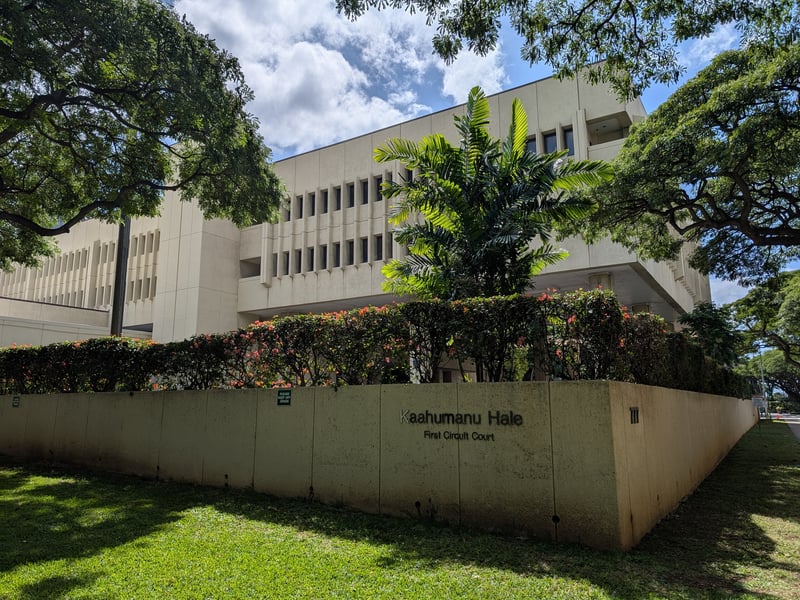
In all our struggles on this matter of access to the courts, I keep coming back to Hawaii. Partly, probably, because it is a nice scene that unfolds in my mind as I remember visiting the courts in their island settings. The old courthouse in Kealakekua, near Kona, was a former hospital stretched out along a lush hillside that, if memory serves, looked out over the ocean.
But mainly I remember the courts of Hawaii because each of the five island courts put new filings out on the counter as soon as they came in. The policy was so uniform that at one point we tried to find its source. There was no court rule, and the spokesman for the courts said simply that the new pleadings were public documents and that was all there was to it.
And then, when the island courts switched to electronic documents and filing, they did what most state courts did not do. They continued the traditional policy of on-receipt public access to paper-filed court documents and applied it to electronically-filed documents as they came across the virtual counter.
There too we tried to find the history of that decision. But we could not. It simply flowed — as it should — from the traditional access that preceded it. So we can see the new e-filed cases in Hawaii as soon as they are received, without ever having had to ask for it.
And we can see them remotely.
Hawaii asks for a username and password as well as a modest yearly fee. All quite reasonable. The U.S. Court in Honolulu follows the same policy of on-receipt access, remote access with a username, password and a modest fee.
Virginia is the other end of the scale, hardcore opposition to public access at every stage. In addition to delaying access, the subject of an earlier First Amendment action and ruling in favor of Courthouse News, Virginia’s written policy also prevents lawyers from providing a journalist with a court filing — a classic prior restraint.
But that too was allowed by the majority opinion. So Courthouse News has asked for en banc review.
“Under the opinion,” said the en banc petition, “the public may never learn of litigation in much of Virginia because all media — not just Courthouse News Service — must travel many miles to review records in courts across the Commonwealth, and counsel with access online cannot tell the press about them.”
The matter of public access is now in the hands of the full Fourth Circuit.
Subscribe to our free newsletters
Our weekly newsletter Closing Arguments offers the latest about ongoing trials, major litigation and rulings in courthouses around the U.S. and the world, while the monthly Under the Lights dishes the legal dirt from Hollywood, sports, Big Tech and the arts.