
 Search Articles


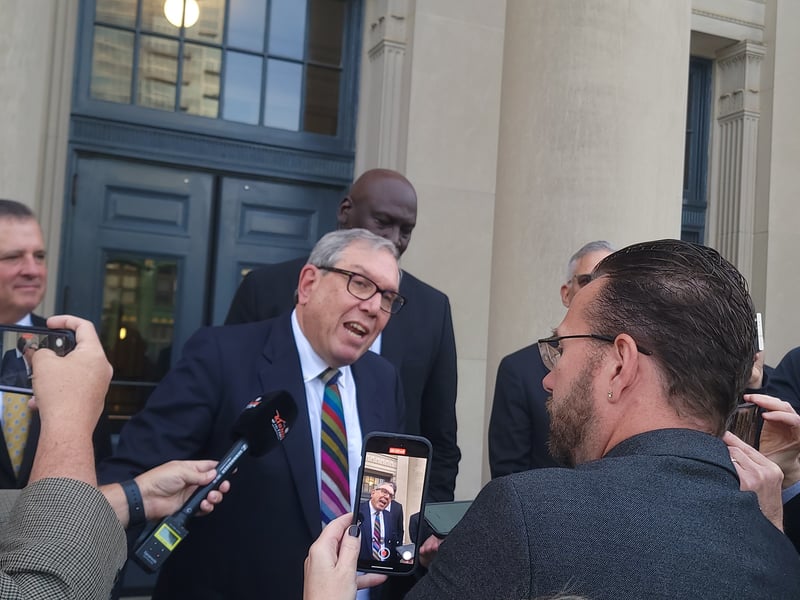
CHARLOTTE, N.C. (CN) — Front Row Motorsports and 23XI Racing called a NASCAR executive to the stand of their antitrust trial against the stock car racing giant Tuesday, grilling him on his text messages and NASCAR’s decision to lock down tracks from hosting other races.
Plaintiff attorney Jeffrey Kessler presented files that Scott Prime, NASCAR’s executive vice president and chief strategy officer, worked on detailing NASCAR’s plans if the 15 stock car racing teams walked away from the charter renewal process. The charters, NASCAR’s version of a franchise agreement, provide teams guaranteed compensation and race entry.
Front Row and 23XI Racing — which is partially owned by basketball legend Michael Jordan — argue that the proposed 2025 charter agreements, which they did not sign, are anticompetitive. Teams would be much more profitable if there was competition in the industry, they’ve argued, and many teams are losing money racing each year.
In text messages introduced by the teams, Prime said that they “have a point” in their complaints about NASCAR’s revenue division, because Formula 1 teams earn 50% of total revenue, while the Cup Series teams get a cut of 20 to 25%.
“We at NASCAR have all the leverage and the teams will almost have to sign whatever we put in front of them,” he said in a message introduced as an exhibit.
The teams did not get any of the major items they were bargaining for, Kessler said, pushing Prime to identify concessions NASCAR made with the teams in the two and a half year negotiating process before the teams were presented with a take it or leave it offer.
“You kept all the power,” Kessler said.
In exhibits, NASCAR, to head up the possibility of a competing series, proposed expanding its exclusivity agreements with Speedway Motorsports, which owns major tracks, in order to prevent a third party from using the tracks to race.
NASCAR eventually signed 2-year exclusivity agreements with Speedway that went past the length of the 2-year contract and prevented it from hosting races into 2026.
NASCAR also weighed the “Gold Code:” the possibility of eliminating the charter system and creating and running their own teams.
But this was only a contingency plan, Prime said, to be used if the teams were to wash their hands of the charter system.
Denny Hamlin, co-owner of 23XI and driver for Joe Gibbs Racing, continuing his testimony from Monday, said that sponsors — not NASCAR — keep the teams in business. 23XI’s 2021 to 2024 profit was 2.26%, he said, adding that losing a sponsor could put the team in the red.
“Every seven years I have to fight to keep my business alive and the only way I can is if I agree to their terms,” he said, calling the 2025 charter agreement a “death certificate” for his business.
Lawrence Buterman, attorney for NASCAR and CEO Jim France, pointed out the teams require their drivers to enter into exclusivity agreements, just as the terms of the 2025 charter prevent the teams from competing with NASCAR. 23XI previously also only paid drivers 22% of its revenue, he added, which is a lower percentage than NASCAR pays the teams.
“You’re a monopoly,” Hamlin said. “When a person has options, it’s okay to have an exclusivity agreement.”
“You’re seeking a 900% return on your investment,” Buterman challenged, asking Hamlin to disclose his driver salary — $14 million — and emphasizing that the teams have benefited from the charter system that is now in question.
The jury in the case is tasked with determining if NASCAR maintained its monopsony — when there is only one buyer of services — over the premium stock car racing market by using anticompetitive conduct, and if so, if the teams were injured by that behavior.
Before the trial began, U.S. District Judge Kenneth Bell, a Donald Trump appointee, issued a judgment affirming that NASCAR has a 100% market share in premier stock car racing. NASCAR has and exercises monopsony power over the racing market, Bell said.
Bell also ended NASCAR’s counterclaims against the teams in October, saying that it hadn’t proved the teams restrained the stock car racing market or that it had suffered an antitrust injury. NASCAR had also asked to dismiss the teams’ suit, which he denied, smacking down their arguments about the statute of limitations having expired over a handful of racing track contracts.
The parties previously tried to settle, but failed to agree on terms.
The teams sued NASCAR in October 2024, claiming NASCAR has a monopsony on the premium stock car racing industry and is forcing teams to sign anticompetitive contracts. They claimed they were pressured to sign the 2025 charter in a night after years of unsuccessful negotiations, and that doing so would have required them to release claims against NASCAR.
Counsel for NASCAR declined to comment after the hearing.
“See you tomorrow,” Jordan told reporters.
The trial is expected to last two weeks.
 Follow @SKHaulenbeek
 Follow @shaulenbeek.bsky.social
Subscribe to our free newsletters
Our weekly newsletter Closing Arguments offers the latest about ongoing trials, major litigation and rulings in courthouses around the U.S. and the world, while the monthly Under the Lights dishes the legal dirt from Hollywood, sports, Big Tech and the arts.