
 Search Articles


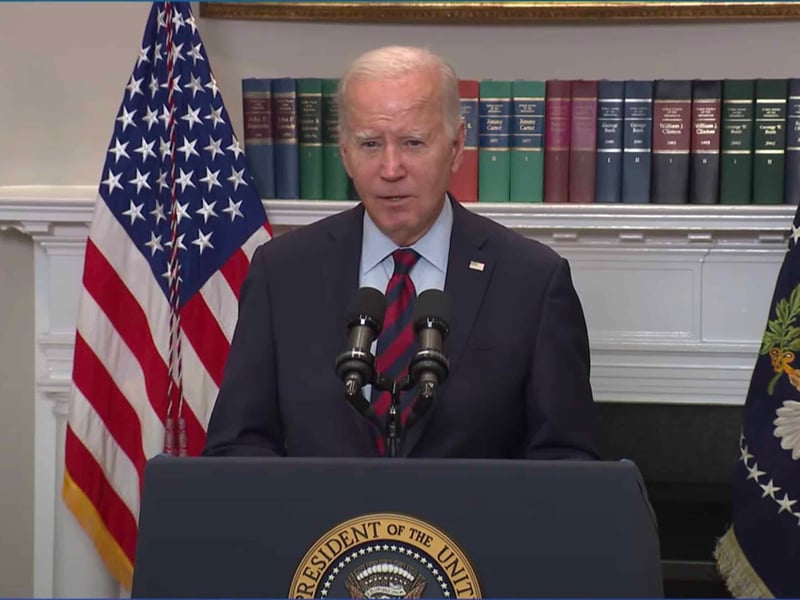
WASHINGTON (CN) — Conservative states asked the Supreme Court on Tuesday to further hamstring President Joe Biden’s student debt relief efforts, filing an emergency application to prevent the administration from enacting a plan to lower loan payments.
“Due to the administration’s intransigence, the court must unfortunately step in again,” South Carolina assistant deputy solicitor general Joseph Spate wrote in the states’ emergency application.
South Carolina, Alaska and Texas called on the justices to prevent Biden from launching an element of the Saving on Valuable Education program in August, arguing that the administration was skirting the justices’ prior ruling on Biden’s loan forgiveness plan.
“Taking the president’s words as marching orders, the Department of Education has sought to cancel $475 billion of student debt, regardless of what Congress or this court has said about the matter,” Spate wrote. “This current attempt to unilaterally cancel debt is every bit as unlawful as the first 12-digit effort this court rejected in Nebraska.”
The court rejected Biden’s plan to wipe out up to $20,000 in loans for certain borrowers in a 6-3 ruling last year. Despite the loss, Biden promised to find other avenues for student debt relief.
Under the plan known as SAVE, the administration tied student loan payments to borrowers’ income and household size. The program cuts payments in half for some undergraduate borrowers, reducing monthly payments from 10% to 5% of income above 225% of the federal poverty line.
The plan also cancels loans for borrowers with a principal at or below $12,000 after ten years of payments.
In March, a group of 11 states asked a federal judge in Kansas to block the plan. After initially finding that only three states — Alaska, South Carolina and Texas — had standing to sue the administration, the lower court issued a preliminary injunction.
Following the path of Biden’s first debt forgiveness case, the court found that the plan triggered the major questions doctrine, which prevents administrations from making “major” rules without congressional authorization.
Moving for a cease-fire amid the ongoing legal battle, the Department of Education asked the 10th Circuit to block the injunction and paused payments and interest charges for 3 million borrowers. The appeals court granted the administration’s stay request.
The conservative states urged the Supreme Court to reverse the appeals court’s ruling. They claim provisions in the program are unlawful and will cost the public hundreds of billions of dollars.
“As Congress has done nothing in the intervening 12 months to authorize the administration to write off nearly half a trillion dollars of loans, if the 10th Circuit were to vacate the district court’s preliminary injunction, it will ‘ha[ve] decided an important federal question in a way that conflicts with [a] relevant decision[] of this court,’” Spate wrote.
Beyond blocking the 10th Circuit’s stay, the states want the court to use this opportunity to vacate the plan under the 2023 student loan ruling or agree to hear arguments in this case next term.
The states say their case is clear-cut since the court already ruled that the Biden administration’s prior effort to spend billions of dollars of taxpayer money on loan forgiveness justified intervention.
“The legality of a program that costs taxpayers $45 billion more than the program the court considered and rejected in Nebraska is clearly ‘a question of great significance’ for this court’s resolution,” Spate wrote.
Requesting a quick response, the states say the court needs to act by the end of the month.
 Follow @KelseyReichmann
 Follow @kelseyreichmann.bsky.social
Subscribe to our free newsletters
Our weekly newsletter Closing Arguments offers the latest about ongoing trials, major litigation and rulings in courthouses around the U.S. and the world, while the monthly Under the Lights dishes the legal dirt from Hollywood, sports, Big Tech and the arts.