
 Search Articles


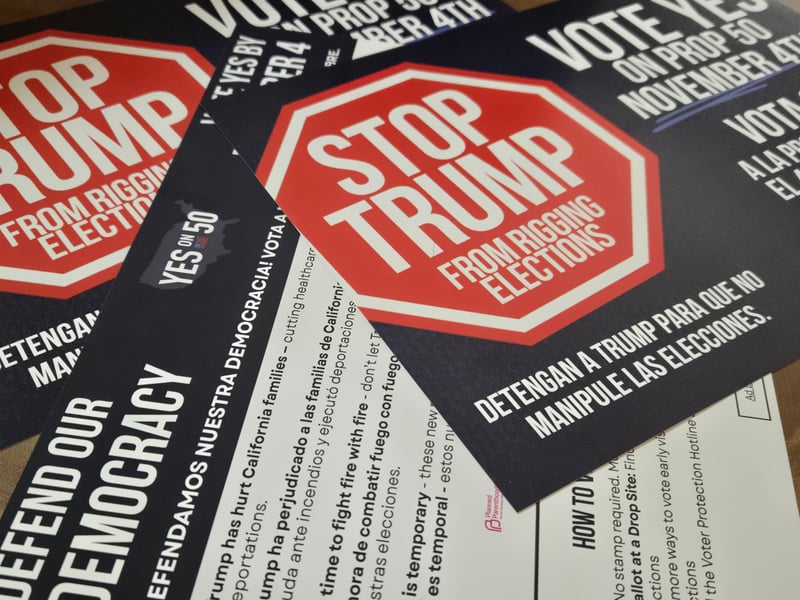
LOS ANGELES (CN) — The California Republican Party’s lawsuit to block the state’s new, voter-approved congressional district map may be doomed by the unwillingness of the the U.S. Supreme Court’s conservative majority to get involved in partisan gerrymandering.
In their complaint — filed the day after California voters approved Prop 50 and joined Thursday by the U.S. Department of Justice — Republican politicians and voters argue that the state’s Democratic lawmakers engaged in unlawful racial gerrymandering to benefit Latino voters.
“California’s redistricting scheme is a brazen power grab that tramples on civil rights and mocks the democratic process,” U.S. Attorney General Pamela Bondi said in a statement announcing the Trump administration’s request to join the California lawsuit as a plaintiff. “Governor Newsom’s attempt to entrench one-party rule and silence millions of Californians will not stand.”
But Republicans may face an uphill battle convincing the judge that the redistricting measure was anything other than a political reaction to Texas redrawing its voting map to benefit Republicans.
“The bottom line is that the first thing plaintiffs need to show in a racial gerrymandering case is that race predominated in drawing district lines,” said Rick Hasen, a law professor at UCLA. “It seems far more likely that courts will view partisanship as the predominant factor.”
And if the plaintiffs can’t make their racial gerrymandering argument stick, they’ll be left facing a split 2019 U.S. Supreme Court decision in which Chief Justice John Roberts wrote for the conservative majority that partisan gerrymandering claims involve political questions that shouldn’t be decided by federal courts.
As Roberts noted in Rucho v. Common Cause , partisan gerrymandering goes back to colonial times and the frustration with this practice is usually related to the absence of proportional representation in the U.S. electoral system.
The Supreme Court’s Rucho decision opened the door to states making no secret of their partisan objectives in redrawing electoral voting maps, Michael Li, senior counsel with the Brennan Center for Justice, said last month during a webinar of UCLA’s Safeguarding Democracy Project.
On top of this, Li noted, President Donald Trump has been blatantly demanding from state lawmakers that they provide him with more seats in the House of Representatives.
“In Texas, he said, I want five more seats, and lo and behold, you have a map that’s got five more seats,” Li said.
So, to prevail in their lawsuit against California’s new congressional districts, the Republican plaintiffs have to make a compelling case that the changes weren’t prompted by political objectives but by racial considerations that run afoul of the U.S. Constitution.
They base their argument on statements by the consultant who drew the electoral map as well as by California lawmakers that the map creates two new districts to “empower Latino voters" and that the new total of 16 majority-Latino districts, out of 52 state districts, are “Voting Rights Act districts” that are specifically designed to favor one race or ethnicity over another.
The problem with this, according to the Republicans, is that there were no Voting Rights Act violations in California prohibiting Latino voters from electing their preferred candidates to justify any racial gerrymandering, in part because Latinos are the largest segment of the state’s population.
“Hispanics have had fantastic success in electing candidates of their choice,” Mike Columbo, an attorney for the Republican politicians and voters said at a Nov. 5 press conference announcing the lawsuit.
To succeed on their 14th Amendment equal protection claim, Republicans first will have to prove that “race was the predominant factor motivating the Legislature’s decision to place a significant number of voters within or without a particular district.”
But the public statements by the redistricting consultant who was hired by California to redraw the electoral map is only part of the story and might not be enough for the Republican to win on that point, according to Hasen.
“The mapmakers in California were race conscious so that they would not face liability under Section 2 of the Voting Rights Act, but such consciousness is likely insufficient to show racial predominance,” he said.
Proposition 50, coined the the Election Rigging Response Act, was specifically put on the ballot to counter what California Democrats say is Trump’s scheme to rig next year’s congressional election.
“Proposition 50 is a direct response to a Republican power grab orchestrated by President Trump and state leaders in Texas, who redrew Congressional district lines to gain five more seats in the U.S. House of Representatives,” the California Democratic Party said in urging voters to approve the measure.
Republicans may have a chance as soon as next week to argue that, notwithstanding these statements, the redistricting measure was racially motivated. They have asked for an expedited schedule on their request for a preliminary injunction, and they want their case to be heard by a panel of three federal judges instead of the customary single judge.
The clock is ticking for prospective candidates, according to the Republicans, because Dec. 19 is the first day for people who want to run for Congress to gather signatures to qualify as a candidate in lieu of paying a filing fee. As such, they must know the boundaries for these new districts before that date.
The lawsuit has been assigned to U.S. District Judge Josephine Staton, a Barack Obama appointee, and as of Thursday the judge hasn’t ruled on the request for a hearing as early as Nov. 18.
The anticipated U.S. Supreme Court decision in Louisiana v. Callais — a constitutional challenge to Louisiana’s addition of a second majority-Black district to the state’s voting maps — may shed further light on how federal courts will tackle race-based challenges to redistricting efforts.
 Follow @edpettersson
Subscribe to our free newsletters
Our weekly newsletter Closing Arguments offers the latest about ongoing trials, major litigation and rulings in courthouses around the U.S. and the world, while the monthly Under the Lights dishes the legal dirt from Hollywood, sports, Big Tech and the arts.