
 Search Articles


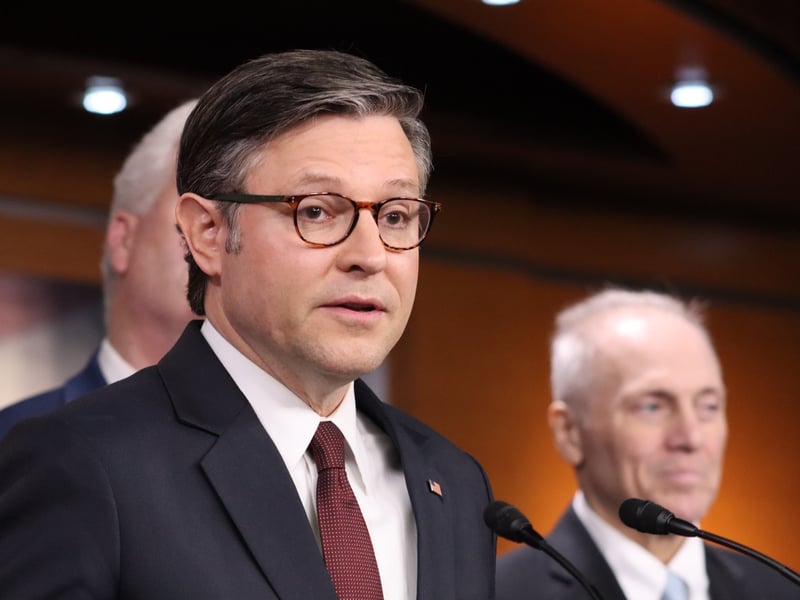
WASHINGTON (CN) — House Speaker Mike Johnson on Wednesday denied that the White House is trampling on congressional authority as it eyes shuttering certain federal agencies without input from lawmakers.
“I think there’s a gross overreaction in the media to what is happening,” Johnson told reporters during a news conference Wednesday morning. “It looks radical — it’s not. I call it stewardship.”
Congressional Republicans have faced questions this week about the possibility that President Donald Trump’s administration could unilaterally close the U.S. Agency for International Development as billionaire Elon Musk’s Department of Government Efficiency reviews its expenditures.
Musk’s probe of USAID has gone beyond accessing the agency’s information, though. The organization’s employees worldwide were informed this week that they will be placed on administrative leave come Friday, save for personnel with “mission-critical functions” and core leadership teams. USAID’s Washington headquarters has been closed, and the agency’s website redirects to a message for employees.
But while federal law dictates that the authority to shut down USAID lies with Congress, top lawmakers from the Republican majority argue that Trump and Musk’s actions so far do not threaten the powers dictated to them under Article I of the U.S. Constitution.
“I’m a fierce advocate and defender of Article I, I mean that,” Johnson said Wednesday. “There’s a reason the founding fathers put the Congress, the legislative branch, as the first article in the Constitution, and we’re going to vigorously defend that.”
However, the House speaker argued that the executive branch has a right to “evaluate” the operations of agencies under its jurisdiction, adding that the White House was merely “putting a pause on some of these agencies” to complete audits which he framed as long overdue.
“We don’t see this as a threat to Article I at all,” Johnson continued. “We see this as an active, engaged, committed executive branch doing what the executive branch should do.”
But the Louisiana Republican did not directly address whether a move from the White House to shutter USAID would pose a threat to Congress’ constitutional authority.
And he criticized questions from reporters about whether the GOP’s lukewarm response to Musk — an unelected adviser to the president — belied an inconsistency in Republicans’ longstanding criticism of “unelected bureaucrats” driving policy decisions under the Joe Biden administration.
“I’ve got to challenge the premise of the question,” Johnson said. “I think they’re doing right by the American taxpayer, and we support that principle.”
Johnson’s comments mirrored ones made Tuesday by Senate Majority Leader John Thune, who told Courthouse News during a news conference that he did not believe the Trump administration was angling to close the agency but that the White House had the right to “review funding.”
“It’s in need of reform,” Thune said of USAID. “It’s in need of transparency and greater accountability, and I think that’s what the administration is trying to achieve.”
The Senate Republican leader similarly did not directly say whether he believed the Trump administration could unilaterally close the agency without congressional approval.
Musk, who has called the government’s international aid distributor a “criminal organization,” has said that he and his aides are putting USAID through a “wood chipper” and has signaled that the agency should be shut down.
According to a Monday report from the nonpartisan Congressional Research Service, the president does not have sole authority to abolish, move or consolidate USAID. Though the agency was created by executive order in 1961, Congress established it as an independent organization under the 1998 Foreign Affairs Reform and Restructuring Act. That law gave the White House temporary authority to reorganize USAID, but the provision extending that power expired in 1999.
“Congress has not granted the president further authority to abolish, move or consolidate USAID since,” the report said.
However, the Congressional Research Service noted that the agency’s internal organization is not codified in statute, meaning that the president could change it to reflect the White House’s foreign policy priorities. But the administration is required in those cases to consult with “appropriate congressional committees.”
The report recommended that lawmakers in both the House and Senate seek more information about the Trump administration’s actions through hearings, letters and other communications.
Meanwhile, the Trump administration is reportedly considering undertaking a separate action to eliminate the U.S. Department of Education — another federal agency created by an act of Congress which would need to be formally shut down by lawmakers.
Asked on Wednesday whether Congress would back an effort from the White House to close the Education Department, Johnson did not answer directly, instead telling reporters that the issue has long been “a discussion point and a priority” for Republicans.
“We believe in the core principle that education is best handled by the people closest to kids,” the House speaker said. “Like everything else, you have got to wait for more details to be laid out — but you’re going to see a lot of support among the House and Senate Republicans for the general idea of pushing these decisions back down to the local level.”
 Follow @BenjaminSWeiss
Subscribe to our free newsletters
Our weekly newsletter Closing Arguments offers the latest about ongoing trials, major litigation and rulings in courthouses around the U.S. and the world, while the monthly Under the Lights dishes the legal dirt from Hollywood, sports, Big Tech and the arts.