
 Search Articles


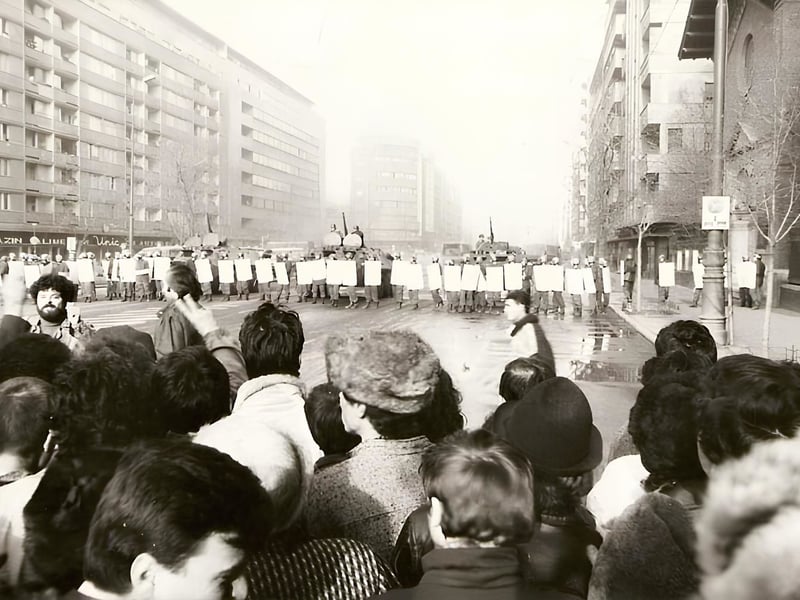
(CN) — Thirty-six years after crowds overthrew Romanian Communist leader Nicolae Ceaușescu in a violent revolution, Europe’s top human rights court said Tuesday the country never got to the bottom of how one protester was beaten and dragged off the streets.
The European Court of Human Rights delivered a sharp verdict on Romania’s handling of the case. Judges said the criminal inquiry into the abuse of Tiberiu Cantemir — a protester detained and beaten in Bucharest on Dec. 21, 1989 — didn’t meet Europe’s standards. They concluded there wasn’t an effective investigation and unanimously found that Romania had failed in its basic duty to protect people from torture and other inhuman treatment.
Cantemir, born in 1964 and still living in Bucharest, was among the crowds at University Square with his wife when military forces stopped them, beat them and forced them onto a bus to the Central Police Station.
The abuse continued through the night. The blows were so harsh they broke his teeth; he was left bleeding from binding ropes. For hours he had no idea what had happened to his wife. He was later moved to Jilava prison, where he finally received medical attention, and was released the following afternoon — just as Ceaușescu fled the capital by helicopter.
Romania’s military prosecutors opened an inquiry in 1990 and questioned Cantemir as an injured party. But for nearly three decades, the case stalled with delays, repeated procedural errors and little transparency. In 2019, prosecutors closed the file for hundreds of victims, including Cantemir, leaving only a handful of former top officials under investigation — a course the judges in Strasbourg, France, said left him with lasting “distress and frustration.”
Philip Leach, professor of human rights law at Middlesex University, said the case drives home a simple point. When protesters are beaten by police or soldiers, authorities have a duty to investigate fairly and without delay.
“More than three decades later, the European Court of Human Rights has underlined how badly defective the investigation was,” Leach said.
By December 1989, Ceaușescu’s grip on power was slipping but his regime still relied on censorship, a ruthless secret police and violent crackdowns.
Anger had been building for years over food and fuel shortages, strict rationing and a suffocating cult of personality built around Ceaușescu and his wife, Elena. The feared Securitate — Romania’s secret police, infamous for its informant network and heavy-handed tactics — kept watch on nearly everyone. Dissent was crushed.
By 1989, the economy was in freefall. GDP shrank by nearly 6%, industrial output faltered and shortages became the norm.
A spark in one city spread through factories, universities and neighborhoods, setting Romania on the road to revolution. Crowds grew bolder, scrawling devil horns onto images of the dictator’s face.
Ceaușescu, in power since 1965, misread the rage. On Dec. 21, at a mass rally broadcast live from Bucharest, cameras captured boos and whistles he could not control. That evening, thousands filled University Square, standing their ground against soldiers, tanks and armored vehicles.
The tide turned the next day, when parts of the military broke ranks and protesters surged into the Communist Party headquarters. Ceaușescu and his wife fled, were captured and faced a swift military trial on Christmas Day that ended with their execution by firing squad.
During those days, more than 1,100 people died and over 3,000 were injured, making Romania’s upheaval the deadliest of the 1989 revolutions that swept away communist regimes across Eastern Europe.
Cantemir’s story was one among thousands. Romania eventually labeled him a “combatant for the victory of the Romanian Revolution” in the category of “arrested combatant,” but that official recognition never brought real justice.
Nearly three decades on, Cantemir was still being summoned to give statements about his detention and beatings. By 2018, exhausted by the endless delays, he stopped taking part in the case.
But the Strasbourg judges made clear that Romania still carried the weight of its long inaction, writing that “notwithstanding the applicant’s decision not to pursue his participation in the criminal proceedings twenty-eight and a half years after the beginning of the investigation, the court holds that the criminal investigation in the present case did not meet the required procedural standards.”
Lavinia Stan, a political science professor at St. Francis Xavier University, said there are deeper problems.
“This delay shows the chronic political inability, even utter unwillingness, that has affected this case ever since it was lodged in the Romanian courts,” she said, adding that the survival of old structures after 1989 allowed leaders to stall accountability for years.
“He was in his 20s during the regime change, now he is close to retirement age,” she noted, pointing out that he spent most of his working life waiting for justice and ultimately had to seek it in an international court. She called the case a stark example of how many Romanians still struggle to see the abuses of the communist era fully addressed.
Romania has been told to pay Cantemir 12,500 euros ($14,769) in compensation within three months, with interest added if it misses the deadline. The judgment won’t reopen cases at home, but either side can ask for it to be sent up to the Grand Chamber, the court’s higher bench. If no request is made, or if the judges turn it down, the decision becomes final and binding.
The Romanian government did not immediately respond to a request for comment. Cantemir’s representative was not immediately reachable.
Courthouse News reporter Eunseo Hong is based in the Netherlands.
Subscribe to our free newsletters
Our weekly newsletter Closing Arguments offers the latest about ongoing trials, major litigation and rulings in courthouses around the U.S. and the world, while the monthly Under the Lights dishes the legal dirt from Hollywood, sports, Big Tech and the arts.