
 Search Articles


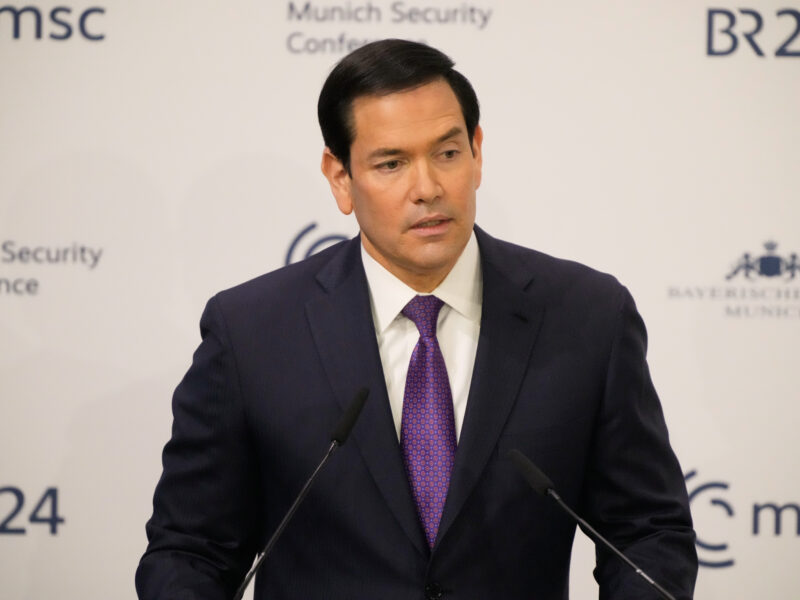
(CN) — Secretary of State Marco Rubio told European leaders Saturday that the U.S. and Europe “belong together,” offering a softer tone than last year’s scathing address by Vice President JD Vance — but Europeans made clear they’re no longer waiting on Washington to chart their own course.
“We want Europe to be strong. We believe that Europe must survive,” Rubio told the Munich Security Conference, the annual gathering of Western defense officials and diplomats. Calling the United States “Europe’s child,” he said the two blocs’ futures were “intertwined,” drawing applause from an audience that had braced for another bruising.
The speech marked a deliberate shift from Vance’s appearance last year, when he attacked Europe’s “fundamental values” and warned the real threat came not from Russia but “from within,” remarks that deepened transatlantic tensions.
While acknowledging the U.S. can be “direct and urgent” in its counsel, Rubio sought to reassure leaders that the administration remains committed to the transatlantic alliance.
European Commission President Ursula von der Leyen was reassured by Rubio’s tone but made clear the damage had been done. “I was very much reassured by the speech,” she said, while acknowledging that “some in the administration have a harsher tone on these topics.” Later, she said Europe’s awakening on defense had required “some shock therapy” — but “some lines have been crossed that cannot be uncrossed.”
The day before, French President Emmanuel Macron had offered a pointed rejoinder to U.S. criticism, saying Europe “has been vilified.”
“We did a lot and we will do more,” he said. “But we have to be respected.”
Former House Speaker Nancy Pelosi, attending as a member of the conference’s advisory council, offered a measured assessment: “They were happy compared to Vice President Vance’s speech last year, which was really insulting. This was much better.”
Pelosi said the address was “a little bit condescending to Europeans — ‘We’re willing to be with you as long as we agree on certain things.’”
Despite the warmer tone, Rubio’s speech echoed familiar Trump administration themes, dismissing climate policy as appeasing “a climate cult” and warning of “civilizational erasure” driven by mass migration.
Rubio said Europe must shoulder more responsibility for its own security. “We want allies who can defend themselves so no adversaries will feel inclined to challenge our collective strength,” he said.
He also criticized the post-World War II international order, calling it a “dangerous delusion” to think all countries follow its rules, and criticized the United Nations for having “no answers” and playing “virtually no role” in resolving current conflicts.
On Ukraine, Rubio said the administration would keep pushing to end the war but questioned Moscow’s intentions. “We don’t know if the Russians are serious about ending the war,” he said.
Ukrainian President Volodymyr Zelenskyy, speaking later Saturday, said he felt “a little bit” of pressure from President Trump to move toward peace talks with Russia. He called for strong security guarantees, warning Russian President Vladimir Putin “cannot let go of the idea of war.”
Von der Leyen said European defense spending has risen nearly 80% since Russia’s invasion of Ukraine and is on track to surpass U.S. investment by 2028. “Europe must become more independent,” she said. “There is no other choice.”
British Prime Minister Keir Starmer cautioned against reading too much into Rubio’s reassurances. “We shouldn’t get in the warm bath of complacency and think that all we’re really doing is reasserting the continuation of what we’ve had for the last 80 years,” he said. “That would be a mistake.”
European leaders responded by outlining their own course. Von der Leyen urged activating the EU’s mutual defense clause, saying the bloc must be ready to defend itself. “As they say in Ukraine, you change or die,” she said. “We must adopt this mantra too.”
Starmer echoed the call, pushing for a “more European NATO” and greater investment in “hard power.” “We must be able to deter aggression, and yes, if necessary, we must be ready to fight,” he said.
But if Europe is finally doing what Washington has long demanded — spending more on defense and taking greater responsibility for its own security — the outcome may not be what Trump envisioned. A more self-reliant Europe would also be one less dependent on U.S. arms, technology and security guarantees.
European leaders telegraphed as much Thursday at an EU summit in Belgium: If they’re going to spend more on defense, they’d rather the money stay in Europe.
But there are limits to the rapprochement. German Chancellor Friedrich Merz, in his opening speech Friday, drew a clear line: “The culture war of the MAGA movement is not ours. Freedom of speech ends here with us when that speech goes against human dignity and the constitution. We do not believe in tariffs and protectionism, but in free trade.”
The trust deficit runs deep. Trump’s threats to annex Greenland, his unpredictable approach to alliances and his administration’s open support for European populist parties have left many capitals on edge.
Even Republicans remain split over Greenland. Senator Lindsey Graham dismissed concerns Friday, saying, “who gives a shit who owns Greenland?” Senator Thom Tillis shot back Saturday: “The 85,000 indigenous people in Greenland give a shit. And at the end of the day, we need to show respect.”
Rubio’s appearance offered a degree of reassurance — but also underscored that the relationship now comes with explicit conditions attached.
Whether Rubio’s softer tone marks a lasting shift or a brief reprieve, the Pentagon’s “NATO 3.0” has made the direction clear: Europe is on its own. Europeans aren’t waiting to be told twice.
Courthouse News correspondent Yuval Molina is based in Brussels, Belgium.
Subscribe to our free newsletters
Our weekly newsletter Closing Arguments offers the latest about ongoing trials, major litigation and rulings in courthouses around the U.S. and the world, while the monthly Under the Lights dishes the legal dirt from Hollywood, sports, Big Tech and the arts.