
 Search Articles


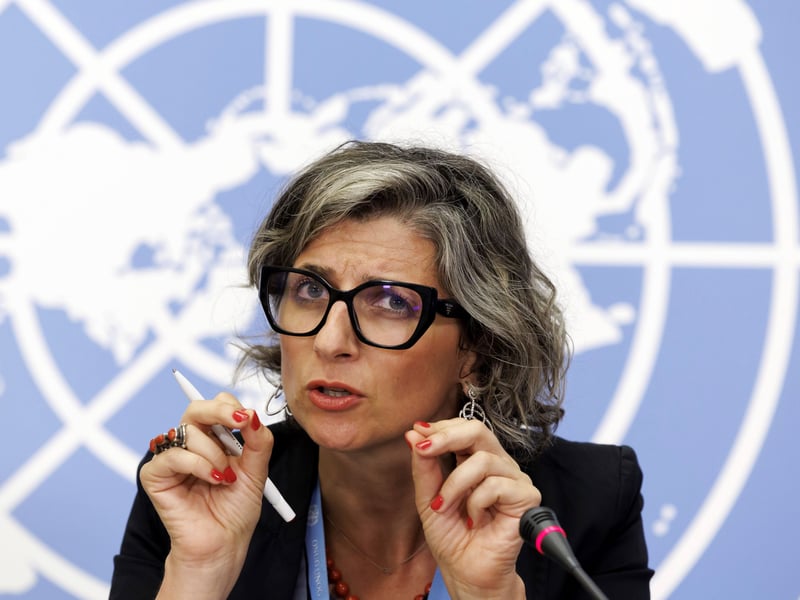
(CN) — The Trump administration has slapped sanctions on Francesca Albanese, a United Nations special rapporteur investigating and denouncing Israeli war crimes against Palestinians.
U.S. Secretary of State Marco Rubio announced the sanctions late Wednesday, claiming Albanese had engaged in a “campaign of political and economic warfare against the United States and Israel.”
He accused her of “biased and malicious activities” and said she “spewed unabashed antisemitism, expressed support for terrorism, and open contempt for the United States, Israel, and the West.”
Albanese, a special rapporteur over Palestinian territories for the Geneva-based U.N. Human Rights Office, is an outspoken critic of Israel, accusing it of apartheid and genocide in the Gaza Strip in the wake of the Oct. 7, 2023, attack by Hamas militants on Israel. Most recently, Albanese issued ascathing report blasting Israeli, American and European corporations for profiting from an “economy of genocide.”
The U.S. added Albanese to a set of sanctions President Donald Trump imposed in February on the International Criminal Court. Last month, the U.S. targeted four ICC judges with sanctions.
Toward the end of his first White House term, Trump also hit the ICC with sanctions after its chief prosecutor sought to open probes into possible American war crimes in Afghanistan.
Many legal and human rights experts denounce the U.S. sanctions against the ICC and now Albanese as a serious attack on the system of international law established after World War II, in large part under American leadership.
Cedric Ryngaert, an expert on international law at the Utrecht University School of Law in the Netherlands, said the U.S. sanctions against the ICC and anyone who works with it were “breathtaking and unheard of.”
“That means that you cannot provide services to the ICC or to any of these sanctioned persons, meaning that you cannot provide banking services or IT services and in that way you can obviously cripple the ICC,” he said, speaking by telephone. “These sanctions have real-life consequences for these people.”
He said Rubio’s reasons for sanctioning Albanese were political and had no grounding in international law.
“The actual basis of course is that she criticizes Israel, let’s face it,” he said. “It’s not about international law.”
Luca Pasquet, an international law expert at the Utrecht University School of Law, noted Albanese enjoys immunity under the U.N. convention, which the U.S. has signed onto.
“These sanctions are incompatible with the legal obligation of the U.S. (a member of the U.N.) to respect this immunity,” he said in an email.
Sanctions are justified when they have the aim of strengthening international law, Ryngaert said. For example, sanctions against Russia were rightfully imposed to punish it for its invasion of Ukraine.
“But in this case, they are imposing sanctions on those who are upholding international law,” Ryngaert said.
“The U.S. has always been a defender of international law, including international criminal justice,” he said. “It’s so unfortunate that the U.S. is now turning against the very institutions that it has helped establish.”
In February, Trump triggered sanctions against the ICC in retaliation for it issuing arrest warrants for war crimes against Israeli Prime Minister Benjamin Netanyahu and former Defense Minister Yoav Gallant. Trump also blasted the court for opening “preliminary investigations” into the actions of American soldiers.
The White House argues the ICC has no jurisdiction over the U.S. and Israel because neither state is a party to the Rome Statute, a treaty that established the court.
But Palestinian authorities have signed the Rome Statute, and the court claims jurisdiction over crimes committed in the occupied Palestinian territories, which comprise the West Bank and the Gaza Strip.
On Thursday, the U.N.’s human rights chief, Volker Turk, called on Washington to revoke its sanctions against Albanese.
“Attacks and threats against Special Procedures mandate holders, as well as key institutions like the International Criminal Court, must stop,” Turk said in a statement. “The solution is not less, but more, debate and dialogue on the very real human rights concerns they address.”
During a visit to Slovenia, Albanese said the sanctions were designed “to weaken my mission.”
“I will continue to do what I have to do,” she told reporters, as reported by AFP, a French news agency.
Albanese, who is Italian, has served as the special rapporteur since 2022. U.N. special rapporteurs are independent experts who are appointed by the U.N. rights council, but they do not speak on behalf of the U.N.
She is a frequent guest on news programs around the world, and she has become a leading critic of Israel’s actions. Most recently, she urged the ICC to investigate whether corporate entities were implicated in possible war crimes committed by Israel.
Her office and the U.N. Human Rights Office did not respond to queries from Courthouse News.
In a statement, the European Union said it “regrets” the U.S. sanctions.
“The EU is a firm supporter of the U.N. human rights system,” an EU spokesperson said in an email Thursday. “The EU regrets the decision to impose sanctions on Francesca Albanese.”
The EU has the power to protect EU companies and individuals that work with the ICC from being hit by the U.S. sanctions, but so far, Brussels apparently has not done so.
The European Commission did not reply to a query from Courthouse News about whether it has activated its so-called “blocking statute” against the U.S. sanctions.
The commission said it would be “monitoring the implications” of the U.S. sanctions and “will assess possible further steps.”
Unless the EU blocks the sanctions, Ryngaert said Europeans will be wary of collaborating with the ICC for fear of running afoul of the U.S. sanctions.
“If you’re an EU-based company, then you have to make a choice,” he said. “Do you want to do business in the United States or do you want to do business with the ICC? You cannot have it both ways.”
On Wednesday, Israel commended the U.S. for sanctioning the special rapporteur.
“Albanese has consistently undermined the credibility of the U.N. Human Rights Council by promoting false narratives and pushing for illegitimate legal actions that ignore the realities on the ground,” Israel U.N. Ambassador Danny Danon said.
Courthouse News reporter Cain Burdeau is based in the European Union.
 Follow @cainburdeau
Subscribe to our free newsletters
Our weekly newsletter Closing Arguments offers the latest about ongoing trials, major litigation and rulings in courthouses around the U.S. and the world, while the monthly Under the Lights dishes the legal dirt from Hollywood, sports, Big Tech and the arts.