
 Search Articles


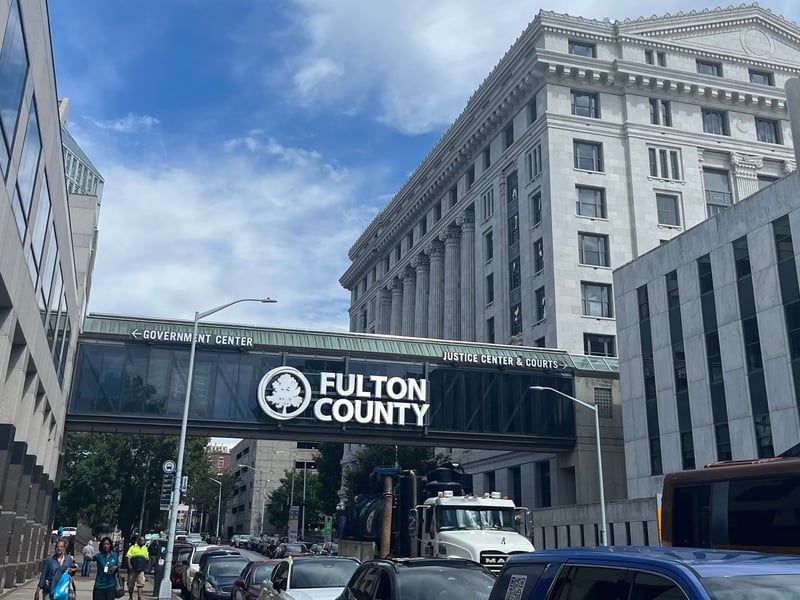
ATLANTA (CN) — A state judge held a bench trial Tuesday over whether a flurry of recent rule changes from the Donald Trump-backed Georgia election board conflict with state law requiring local election boards to certify election results.
In a 44-page lawsuit filed in August against the State Election Board, the Democratic National Committee, the Democratic Party of Georgia and county election board members claim the rule changes “invite chaos by establishing new processes at odds with existing statutory duties.”
The suit asks the judge to declare that election certification is a mandatory duty of county boards and to throw out state election board rules that conflict with Georgia certification laws.
“If you are a voter, the election must be certified by Nov. 12 at 5 p.m. So, other than the people who have to do the work to do the certification, I’m wondering what’s the legal uncertainty?” Fulton County Superior Court Judge Robert McBurney asked.
The plaintiffs’ attorney Kurk Kastorf argued the rules could lead to disputes over the vote count and potentially delay certification.
Under the new rules, county election boards must make a “reasonable inquiry” into discrepancies before certifying elections, without defining what’s reasonable or what the inquiry would involve.
McBurney questioned how the board plans to execute its three-strikes rule against county board officials who fail to conduct a “reasonable inquiry,” which would then allow the state election board to “take over” their election operations.
“What is the risk that the state board levels a strike against me and my board because I didn’t meet their expectation of reasonable inquiry when there’s no definition of it?” McBurney asked.
The election board’s attorney argued that the concerns raised in the suit are hypothetical. Attorney Elizabeth Young said it should be assumed that county superintendents will act in good faith, and those who don’t would refuse to certify results with or without the new rules.
But the judge said that there are real-life examples of board officials refusing to certify. During a subsequent trial over a related suit, a Republican member of the Fulton County election board, Julie Adams, argued she is not duty bound to certify election results.
“Not certifying doesn’t seem to be an option,” McBurney said. “I don’t think a superintendent has that discretion.”
Adams refused to certify this year’s presidential primary because she wanted to review voter sign-in lists, ballot records and other election process documentation.
One of the new rules passed by the state election board at issue allows county election board members to examine all election-related documents, but the board did not specify what type of documentation must be provided.
McBurney said he has not identified where that specific rule is inconsistent with state law, but that the documents must be reviewed within the certification deadline.
He did, however, question why the board is making continuous last-minute election changes, while courts are instructed not to change election rules just before an election.
Joining the state election board, the Republican National Committee and Republican Party of Georgia argued the rules are in compliance with state law, which requires election officials to certify results by 5 p.m., six days after Election Day.
Attorney Baxter Drennon said that any allegations of fraud or election misconduct are to still only be raised after certification through challenges filed in court, as the law requires.
In addition, the rule calls for county election boards to hold a meeting to verify results on the Friday after Election Day, before the deadline for the return of overseas and military ballots.
“A delay or failure to certify at the county level would run headlong into the Secretary of State’s own certification obligations, potentially interfering with binding federal deadlines, and could result in the Secretary certifying results without counting ballots from the affected county,” the Democrats wrote in their lawsuit.
After the county superintendents certify their returns, the secretary of state must immediately undertake his own tabulation, computation, and canvassing process, and must then certify the votes to the governor.
In August, Republican Secretary of State Brad Raffensperger issued a press release denouncing “the eleventh-hour effort” by the board “to impose new activist rulemaking that would undermine key provisions of” Georgia law.
The state election board’s recent rule changes have drawn national scrutiny as former President Donald Trump faces charges for falsely claiming the 2020 election was stolen from him in Georgia where he lost by fewer than 12,000 votes.
Many of Trump’s supporters believe his claims, despite audits confirming the results and state election investigations dismissing allegations of any widespread fraud.
Just five weeks before Election Day, the former president is ahead of Vice President Kamala Harris in Georgia, according to Quinnipiac University Poll released Tuesday.
After Trump publicly praised the three Republican election board members spearheading the last-minute rule changes as “pit bulls fighting for honesty, transparency and victory," concerns arose from election integrity organizations over their impartiality and motivations.
One of those board members, Janice Johnston, attended Tuesday’s trial.
Conservative supporters of the election rules said they’ll help prevent a repeat of the 2020 election by ensuring that votes are counted accurately before election boards certify the results on Nov. 12.
The board’s one Democratic member and nonpartisan chair opposed the rules, including one passed last month requiring a hand-count of ballots.
 Follow @Megwiththenews
Subscribe to our free newsletters
Our weekly newsletter Closing Arguments offers the latest about ongoing trials, major litigation and rulings in courthouses around the U.S. and the world, while the monthly Under the Lights dishes the legal dirt from Hollywood, sports, Big Tech and the arts.