
 Search Articles


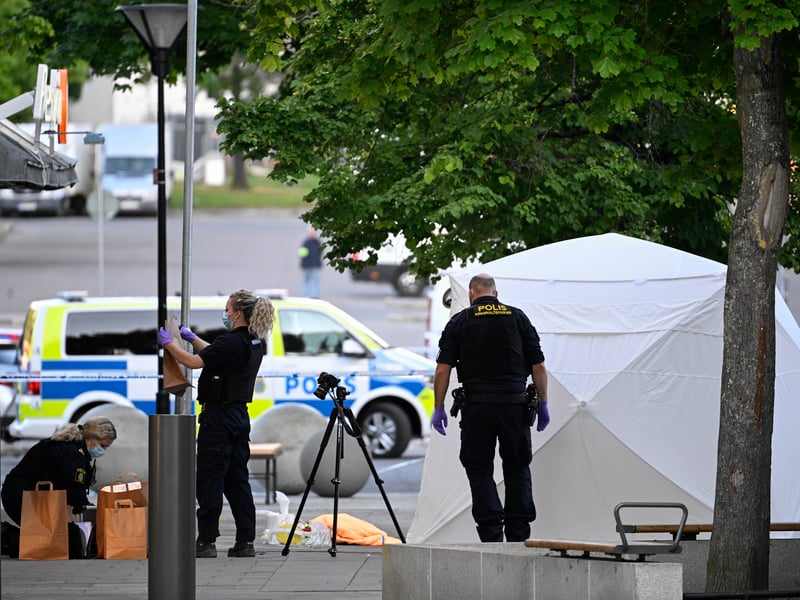
(CN) — Sweden has been grappling with an uptick in gang violence for years, and fresh statistics for shootings, explosions and gun-related killings show no sign of flatlining.
This year, 34 people have been killed by guns in 202 shooting incidents across Sweden, according to Swedish media Kvartal’s live statistics overview. The numbers align with those published by Swedish police in early September.
Because of the trend the Nordic country has the highest gun violence per capita in the European Union in recent years.
Statistics show Swedish gang-related violence has increased potently in neighboring Denmark, too, where Danish gangs in at least 25 instances since April have hired Swedish “hitmen” and “child soldiers” for criminal activities, said Danish Minister of Justice Peter Hummelgaard to broadcaster TV2 back in August.
David Sausdal, criminologist and associate professor at Lunds University in Sweden, spoke about the trend of Swedish hitmen moving internationally in an interview with Courthouse News. “This is basically a new concept,” he said.
“Although, it is not like gangs and criminal organizations haven’t worked across borders before,” Sausdal added. “Just take a look at the illegal substances that are distributed internationally.”
Swedish gangs are notorious for using minors to do their dirty work. Scandinavian media has frequently described cases where kids under 15 years old — the minimum age for criminal prosecution — were tasked with holding firearms and explosives and even killing targets in Sweden.
Over the summer, Denmark experienced a surge of Swedish teens committing gang-related crimes. This led politicians from both Denmark and Norway to point fingers at their neighbor for failing to hinder the the spread of violence across borders.
Those fingers eventually turned into handshakes and mutual understanding in a need to strengthen police cooperation between all three countries in recent months.
In mid-August, Stockholm announced an initiative to establish a Nordic police hub in Sweden that includes officers from Denmark, Norway and Finland to fight the spreading gang-related violence in the region.
And last week, the Copenhagen police department hosted a regional meeting between Danish and Swedish police forces to strengthen future collaboration to counter gang crime.
Authorities working cross-border in an international effort is key to combating large-scale gang-related crime, Sausdal said.
“There is no doubt that cooperation between the Scandinavian countries is the right way moving forward,” he said, “but there’s a need to do more.”
Back in 2015, the Danish nationals voted no to scrap an EU referendum that has exempted the Nordic country from integral parts of the EU’s criminal justice and home affairs system since 1993, making it difficult for Denmark to smoothly access Europol, Europe’s crime and intelligence-sharing agency.
“Gangs are working more across borders. That’s why it’s a pity that Denmark is not an integral part of Europol and the privileges it provides,” Sausdal said. “It’s a gift for criminality in a global world if nation authorities only focus on themselves."
Another facet politicians can address is the matter of criminal penalties. Danish Minister of Justice Peter Hummelgaard and his Swedish counterpart Gunnar Strömmer both displayed political will towards introducing harder punishments in an effort to halt gang crime during a late August joint press conference.
With an increase in teens and minors following orders from gangs, for instance, Hummelgaard has kept open the possibility of Denmark lowering the minimum age for criminal prosecution. The current limit of 15 years old spans across all three countries in Scandinavia.
The suggestion sparked criticism from the Danish Crime Prevention Council in late August; the group cited past experiences when Denmark decreased the minimum age to 14 years in 2010, before setting it back to 15 years just two years later. Last year, Swedish Minister of Justice Gunnar Strömmer also aired the idea of decreasing the criminal minimum age in Sweden to somewhere between 12 and 15 years old.
Britt Østergaard Larsen, a senior researcher at The Danish Center for Social Science Research, disagrees that lowering the minimum age would solve gang violence.
“Harder punishments do not have the preventive and deterrent effect on crimes, that the politicians desire when implementing these laws,” Larsen said.
Her 2018 study showed that 14-year-olds convicted of crimes in Denmark between 2010 and 2012 were not afraid to break the law, in contrast to politicians’ aim of youth crime prevention. Instead, some of the convicted 14-year-olds who resurfaced in the judicial system were at higher risk of committing new crimes.
“Children do not assess the consequences of their actions in the same manner as adults,” Larsen explained. “They are more impulsive, risk-prone and susceptible to peer influence because their brains are not fully developed. These developmental factors entail that minors can be held responsible to a lesser extent and should be sentenced more leniently than adults.”
It’s a trend that research has proved evident in the United States.
“The U.S. Supreme Court has stated that minors should be punished differently from adults in the criminal justice system based on neurological and psychosocial research documenting juveniles’ developmental immaturity,” Larsen said.
 Follow @LasseSrensen13
Subscribe to our free newsletters
Our weekly newsletter Closing Arguments offers the latest about ongoing trials, major litigation and rulings in courthouses around the U.S. and the world, while the monthly Under the Lights dishes the legal dirt from Hollywood, sports, Big Tech and the arts.