Search Articles


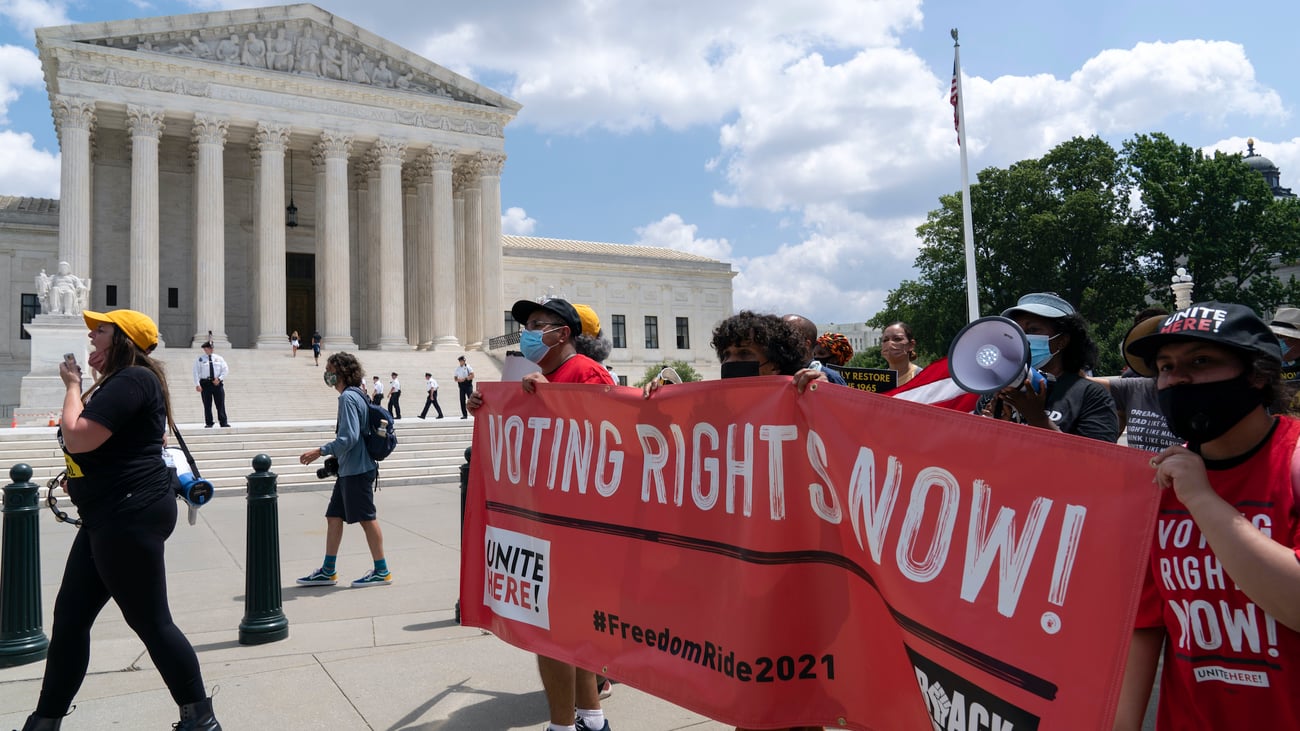
ATLANTA (CN) — Just days after the Supreme Court’s landmark ruling allowed Republicans in Louisiana to redraw favorable congressional districts, other southern states quickly followed suit.
But not without major mobilization efforts by voting rights activists, who are working quickly to inform voters about election changes being swiftly enacted by Republican lawmakers in areas with some of the nation’s highest percentages of Black residents.
Friday, in Alabama, a bill moved closer to passage that would allow the state to use a congressional map previously blocked by courts that found it discriminated against Black voters.
Republicans backing the bill are preparing for the possibility that the Supreme Court will grant Attorney General Steve Marshall’s request to lift the 2023 injunction.
The bill also would void the results of the May 19 primary and require a summer special election in four congressional districts with redrawn boundaries.
“What is happening right now across the south is not by happenstance. It is a coordinated escalation around political power,” Executive Director of Alabama Values and Alabama Values Progress Anneshia Hardy said.
Hardy leads messaging, research and digital strategies aimed at strengthening community civic engagement and is working to inform voters about the redistricting impacts. She hopes efforts to reshape the Voting Rights Act and dismantle Black-majority districts will motivate voter participation rather than discourage it.
“Attacks on voting rights have often activated stronger political participation,” Hardy said.
“People are still living today who fought for the Voting Rights Act,” she added.
In Louisiana, nearly 500 residents showed up at the state’s Capitol Friday for public hearings on the creation of new congressional districts.
While Louisiana currently has two Black-majority districts, proposed maps would eliminate one and create five majority-White Republican districts.
The redistricting effort follows the justices’ rare order to fast-track the implementation of their landmark ruling in Louisiana v. Callais, which struck down the state’s congressional maps.
A day after the ruling, Louisiana Governor Jeff Landry issued an executive order delaying the state’s May 16 primary until July to give lawmakers time to draw a new map. The move came days before early voting was set to begin and after 42,000 absentee ballots had already been cast, according to reports.
“This is a power grab to erase Black voices and representation, particularly here in the south,” Devante Lewis, who works with the Power Coalition for Equity and Justice to educate voters, said.
Live from the Capitol, Lewis, who also serves as the public service commissioner for Louisiana’s Third District, condemned the order as a misuse of power. He said state law allows elections to be suspended only if an electoral emergency exists, as was the case in 2004, when Hurricane Katrina struck.
Meanwhile, the legislature has still not passed the state budget, one of its primary duties, Lewis said.
Landry’s order is also being challenged in a lawsuit filed by a group of Louisiana voters and a Democratic primary candidate.
Over in Tennessee, a new congressional map was approved just a week after the ruling, as state lawmakers immediately returned to the state capitol for a special session.
The newly drawn districts split the state’s 9th Congressional District and divide Tennessee’s only majority-Black congressional seat into three districts, two stretching from Memphis to Williamson County outside Nashville. Nashville and its surrounding counties were also split into five districts, up from four.
The state’s Republican-led majority also adopted special-session rules limiting public comment and shortening the time available for the public to review proposed U.S. House maps, even as hundreds of protesters gathered at the Capitol.
Executive Director of Civic Tennessee, Matia Powell, said elections were already underway, with Friday marking the first day voters could request absentee ballots. About 1.4 million residents are now in new districts.
With fewer than 70 days until early voting, Powell said the new map will create challenges and confusion as officials work to inform voters about changes to their districts and ballots.
“We’re pivoting towards education and understanding,” Powell said.
“This wasn’t the will of the people. It was the President. So, we have to spend our time to educate voters and prepare them for the ballot,” she added.
Southeastern states, including South Carolina and Indiana, are facing renewed pressure from President Donald Trump to redraw their congressional maps before the midterms as he seeks to maintain Republican control.
Amir Badat, a voting rights attorney with Fair Fight Action, is calling on voters in Mississippi to show up for a special session set for May 20 to redraw state supreme court districts. It will take place in the old Capitol building, where Mississippi lawmakers met in 1861 and voted to secede from the Union in an effort to continue enslaving people.
Badat said he fears up to 130 majority-Black districts could be wiped out across the country if redistricting efforts continue.
Just hours after the Supreme Court’s decision on April 29, Florida lawmakers passed a new, highly contested congressional map designed to boost Republican seats.
Georgia’s Governor Brian Kemp is one of the few Republican southern leaders who have said he will not move to redraw the state’s congressional boundaries or suspend voting in the May 19 primary, which is already underway. He did, however, praise the ruling and indicated that Georgia will adopt new electoral maps before the 2028 election cycle.
 Follow @Megwiththenews
Subscribe to our free newsletters
Our weekly newsletter Closing Arguments offers the latest about ongoing trials, major litigation and rulings in courthouses around the U.S. and the world, while the monthly Under the Lights dishes the legal dirt from Hollywood, sports, Big Tech and the arts.