
 Search Articles


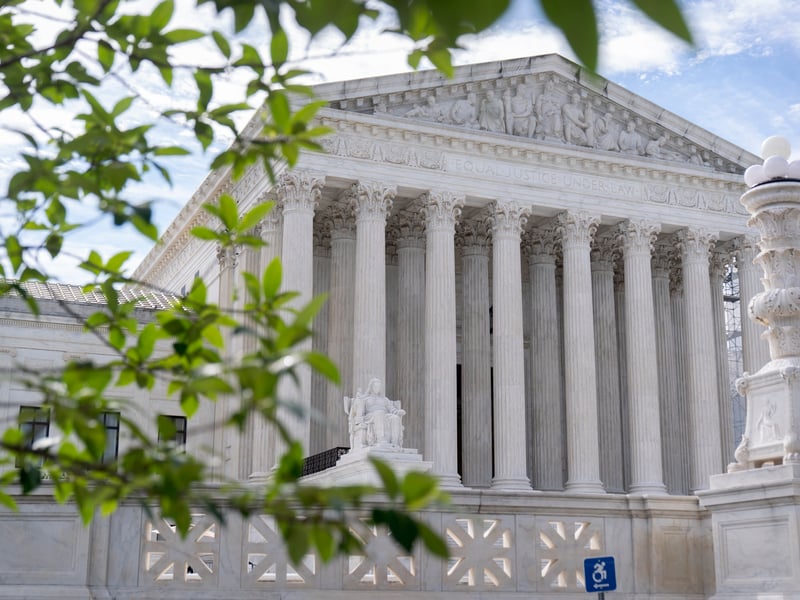
WASHINGTON (CN) — Despite a call from several states to review the constitutionality of evolving decency standards, the Supreme Court on Monday refused to take up Alabama’s fight to reinstate a death sentence for a mentally disabled man.
The high court instead vacated the 11th Circuit Court of Appeals’ opinion affirming a lower court’s decision to lift the sentence, finding the judges’ ruling unclear as to how they analyzed the man’s various IQ scores, which ranged between 72 and 78.
The justices remanded the case to the appellate court to clarify the analysis and suggested they would review the case following a renewed decision.
In the per curiam opinion, the high court explained that the 11th Circuit’s analysis could be read two ways.
On one hand, the appellate court seemingly gave Joseph Clifton Smith’s lowest score, 72, “conclusive weight” toward affirming the lifted death sentence, because it fell within the margin of error for a score below 70, the indicator of mental disability in the scoring method.
On the other hand, the 11th Circuit also approved the lower court’s finding that Smith’s lowest score was not an outlier when considered with his higher scores, suggesting a holistic approach to the multiple scores.
According to the opinion, Justices Clarence Thomas and Neil Gorsuch suggested the high court take up the case and set oral arguments.
The Alabama Department of Corrections asked the high court to review a set of precedents that prohibit the execution of mentally disabled people. Over two decades ago, the court ruled that carrying out death sentences on people with intellectual disabilities violated the Eighth Amendment’s ban on cruel and unusual punishments.
While Atkins v. Virginia barred states from enforcing these punishments, the justices left the states to set the bar for who could be considered intellectually disabled. In two subsequent cases, the court created a road map for states to follow when making these decisions.
In Hall v. Florida , the court rejected a bright line rule setting an IQ score requirement. Then two years later in 2017, the court unanimously struck down the state’s criteria in Moore v. Texas for using outdated medical standards.
John Hamm v. Joseph Clifton Smith asked the court to overrule *Hall * and *Moore * or clarify which IQ scores states can consider.
“The court’s dubious methodology subjects states not to the fixed and objective strictures of the Constitution’s original meaning but to the ‘judgment’ of other states about ‘the dignity of man’ and to changing ‘clinical definitions’ offered by professional organizations,” Edmund LaCour Jr., Alabama’s solicitor general, wrote in the petition.
Smith was sentenced to death for the 1997 murder of Durk Van Dam, who Smith beat to death with a hammer to steal $140, his boots and tools.
After losing sentence appeals at the state level, Smith turned to the federal courts with an *Atkins * claim.
Smith’s school records reflected little progress after first grade. He was placed in special education classes after third grade. At that time, Smith had a full-scale IQ score of 75.
After being held back in sixth grade, Smith was enrolled in “educable mentally retarded” classes for his final two years in school.
During a 2021 hearing on Smith’s *Atkins * claim, a doctor testified that Smith’s school records indicated a diagnosis of mild intellectual disability. A neuropsychologist told the court that Smith’s academic struggles led to behavioral problems consistent with someone who has intellectual functioning deficits.
Another doctor said Smith had a full scale IQ of 72 — above the mental disability range — but noted that there is a standard of error measurement of 3 to 4 points, meaning Smith’s IQ could be as high as 75 or as low as 69.
Looking at the combination of Smith’s IQ scores and doctor and family testimony, the lower court found Smith had significant intellectual deficits. The 11th Circuit upheld the ruling on appeal.
The Alabama Department of Corrections claims that the lower courts erred by ignoring all but Smith’s lowest IQ score. The department said the courts further erred by assuming Smith’s true IQ lies at the bottom of the score’s error range.
“Both errors wrongly distort the *Atkins * inquiry by placing a thumb on the scale in favor of capital offenders,” LaCour wrote. “Both errors trample over the state’s discretion to define intellectual disability and set burdens of proof in capital punishment cases.”
Smith’s attorney says that the state wants an exact formula when the court has previously ruled against viewing a single factor as definitive of an individual’s intellectual assessment.
“What the commissioner seeks is a precise math equation to determine an *Atkins * case: IQ measure + adaptive functioning + developmental period = *Atkins * relief,” Kacey Keeton, an assistant federal defender representing Smith, wrote. “While that is the general formula, Hall, Moore, and other *Atkins * precedent, as well as mental health professionals, have taught us that the determination of whether an individual is intellectually disabled is not precise math.”
Led by Idaho, 14 Republican-led states urged the court to review Alabama’s appeal, arguing that Eighth Amendment jurisprudence has progressively worsened.
“The court used to treat the amendment as a focused protection against cruel and unusual punishments,” the states wrote in an amicus brief. “But it has become a potent tool to judicially impose policy preferences and revisit settled constitutional conclusions.”
The states claim that overlaying the Eighth Amendment with evolving standards of decency has led courts to strike down laws against public encampments, imposing death for rape cases, and removing voting rights from felons.
“About the only thing clear with the amendment these days is that amici states’ criminal laws are at the mercy of a constitutional test with no limiting principle,” the states wrote.
 Follow @Ryan_Knappy
Subscribe to our free newsletters
Our weekly newsletter Closing Arguments offers the latest about ongoing trials, major litigation and rulings in courthouses around the U.S. and the world, while the monthly Under the Lights dishes the legal dirt from Hollywood, sports, Big Tech and the arts.