
 Search Articles


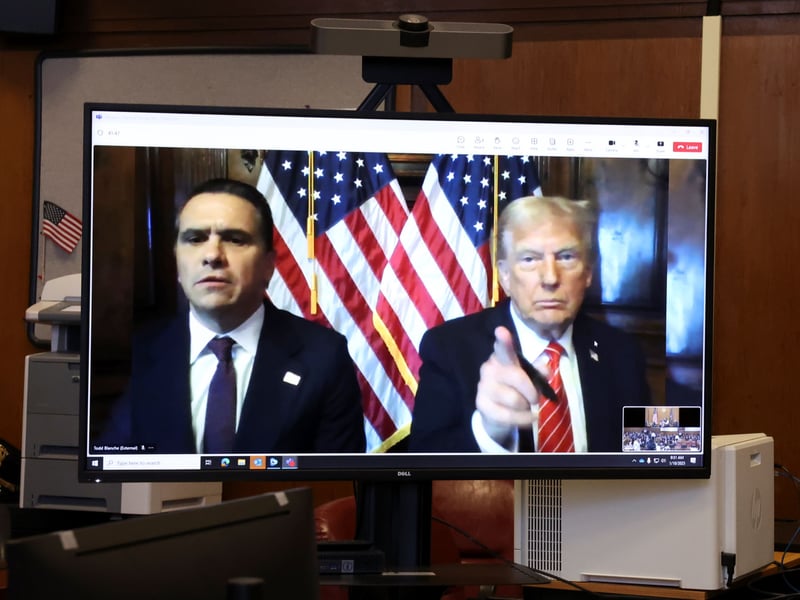
MANHATTAN (CN) — A federal appeals court on Thursday revived President Donald Trump’s bid to fight his 2024 criminal conviction, ruling that Trump should be able to present immunity arguments to a judge in the Southern District of New York.
A panel of three Second Circuit judges sent the case back to U.S. District Judge Alvin Hellerstein, a federal judge in Manhattan, finding that Hellerstein should address whether Trump’s conviction ran afoul of the Supreme Court’s recent ruling for broad presidential immunity.
They stopped short of telling Hellerstein, a Bill Clinton appointee, how he should rule, however.
“We leave it to the able and experienced district judge to decide whether to solicit further briefing from the parties or hold a hearing to help it resolve these issues,” the judges wrote in a 28-page opinion. “We express no view and ‘neither rule nor imply’ that the district court should resolve Trump’s motion for leave to file a second removal notice in any particular way.”
A Manhattan jury convicted Trump last year on 34 felony counts of falsifying business records, which stemmed from a sweeping and salacious hush money scheme aimed at quelling bad press during his 2016 presidential campaign.
The jury found that Trump orchestrated his former personal attorney and “fixer” Michael Cohen to pay $130,000 to adult film star Stormy Daniels, who Trump was concerned would share details from their 2006 sexual encounter at an inopportune time during the election. When repaying Cohen, Trump disguised the payments as standard legal fees, sometimes signing those illicit checks from the Oval Office during his first presidential term, witnesses testified.
Trump now argues that the jury should never have heard some of the trial testimony due to presidential immunity. Thursday’s ruling gives him another chance to move the state case to federal court to address the issue, while he’s simultaneously appealing the conviction on similar grounds in a New York appellate court.
Prior to the Supreme Court’s immunity ruling, Hellerstein ruled that Trump should not be allowed to move the case to federal court because the hush money payments were “private unofficial acts.” Trump tried again after the ruling came down, but Hellerstein denied that motion, too.
“We cannot be confident that … the district court adequately considered issues relevant to the good cause inquiry so as to enable meaningful appellate review,” the Second Circuit ruled Thursday, requiring that Hellerstein give the case one more look.
“For example, the district court did not consider whether certain evidence admitted during the state court trial relates to immunized official acts or, if so, whether evidentiary immunity transformed the state’s case into one that relates to acts under color of the presidency,” the judges added.
The Manhattan District Attorney’s Office, which brought the case against Trump, argues that it’s too late to bring the case to federal court. The trial is long over, and Trump has already been convicted and sentenced to unconditional discharge, “the most lenient sentence possible in light of the conviction,” as described by the circuit court on Thursday.
The three-judge panel behind the ruling included two Barack Obama appointees in U.S. Circuit Judge Raymond Lohier and U.S. Circuit Judge Susan Carney, as well as U.S. Circuit Judge Myrna Perez, a Joe Biden appointee.
Trump has repeatedly decried the case against him as a purely political one. A spokesman for his legal team said in a statement Thursday that he will “keep defeating Democrat weaponization at every turn.”
“President Trump continues to win in his fight against radical Democrat lawfare,” the spokesman said. “The Supreme Court’s historic decision on Immunity, the federal and New York State constitutions, and other established legal precedent mandate that the witch hunt perpetrated by the Manhattan DA be immediately overturned and dismissed.”
The Manhattan District Attorney’s Office declined to comment.
Trump’s historic conviction made him the first president, current or former, to be found guilty of a felony. Despite getting no formal punishment from his sentence of unconditional discharge, the president is continuing a relentless bid to overturn the verdict.
Last week, he argued to a New York appeals court that his case “should never have seen the inside of a courtroom, let alone resulted in a conviction."
“This is the most politically charged prosecution in our nation’s history,” Trump claimed in the 111-page filing, a formal appeal of the conviction that remains pending.
 Follow @Uebey
 Follow @uebey.bsky.social
Subscribe to our free newsletters
Our weekly newsletter Closing Arguments offers the latest about ongoing trials, major litigation and rulings in courthouses around the U.S. and the world, while the monthly Under the Lights dishes the legal dirt from Hollywood, sports, Big Tech and the arts.