Search Articles


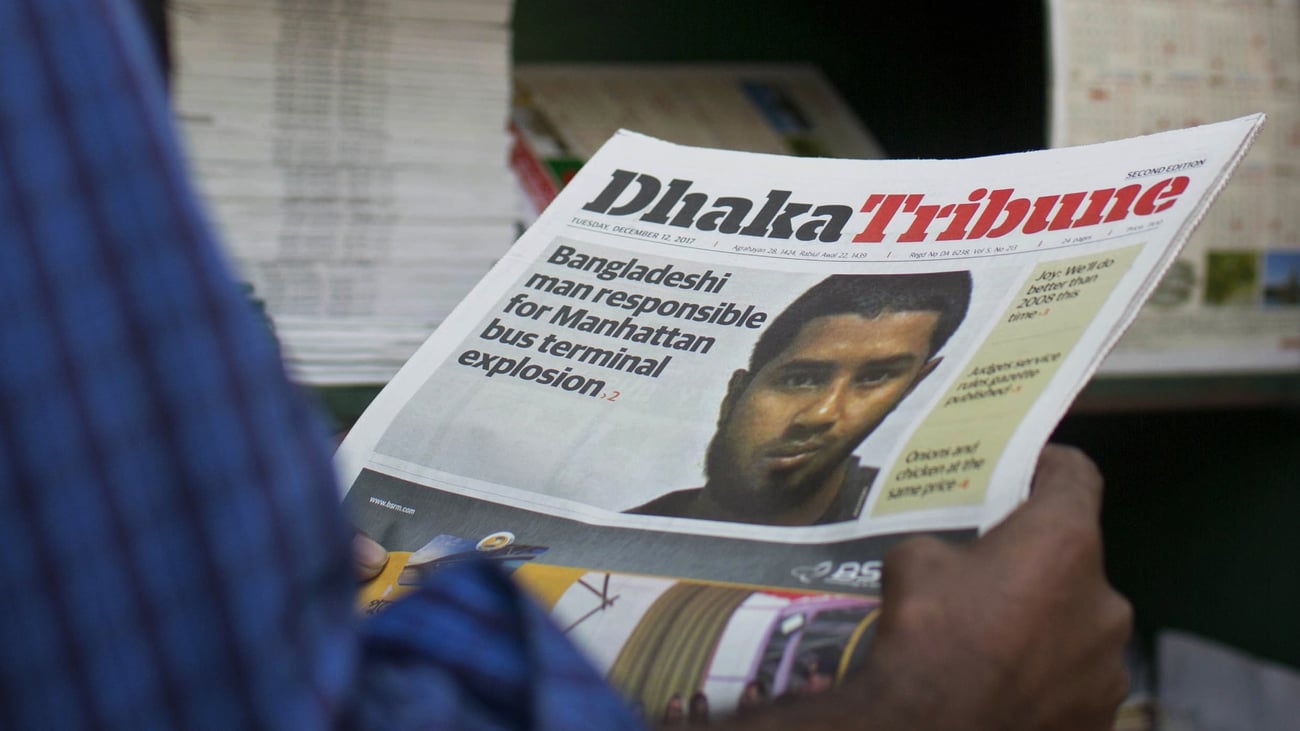
MANHATTAN (CN) — The Second Circuit on Tuesday affirmed three concurrent life sentences for the man behind an ISIS-inspired attempted pipe bomb attack between the Times Square subway station and the Port Authority bus terminal in December 2017, while reversing one conviction based on a narrow reading of the material support statute.
Akayed Ullah, a Muslim immigrant from Bangladesh living in Brooklyn’s Kensington enclave, partially detonated an improvised pipe bomb strapped to his chest with plastic zip ties in the underground tunnel between the two stations during the morning commute.
The homemade bomb — packed with metal screws and rigged with Christmas tree lights — ultimately malfunctioned and failed to fully explode, leaving him with serious burns. The nonfatal detonation spread panic but caused only minor injuries to those near him.
He was 27 at the time of the attack and sentenced in Manhattan federal court four years later to multiple life sentences on his jury convictions on all counts.
While the three-judge Second Circuit panel upheld Ullah’s life sentences, the majority reversed one count of his indictment for providing material support to a foreign terrorist organization because it concluded, despite the plot being motivated by the Islamic State of Iraq and al-Sham, he acted entirely independently of ISIS preparing for and carrying out the terrorist attack.
“That defendant subjectively conceived of himself as a soldier of ISIS does not establish that ISIS did, in fact, control or direct his actions,” U.S. Circuit Judge Myrna Pérez wrote in the majority opinion.
“While defendant was inspired by a general online exhortation by a foreign terrorist organization, the evidence did not prove that he worked or attempted to ‘work under [the] direction or control’ of that organization or coordinated with the organization in any way, as would be required to prove a violation of § 2339B under either of the government’s theories,” the Second Circuit judges added later in the opinion.
Pérez, a Joe Biden appointee, was joined in the majority by Senior U.S. District Judge Jed Rakoff, a Bill Clinton appointee in the Southern District of New York sitting by designation on the Second Circuit panel.
The majority acknowledged that nothing in the reversal of Ullah’s conviction on count one “should or will reduce his sentence below his well-deserved life imprisonment.”
At trial, federal prosecutors claimed Ullah, who lived in a Bangladeshi enclave in the Kensington neighborhood of South Brooklyn, began his radicalization by extremist Islamic terrorist ideology in 2014.
After the attack, Ullah spoke with detectives while he was in the hospital being treated for his injuries. He told detectives he carried out the attack “on behalf of the Islamic State” and “for Allah.”
While in custody at the Metropolitan Correctional Center later in December 2017 after his arrest, Ullah reportedly began chanting “more is coming” at a correctional officer and then told the officer: “You started this war, we will finish it. More is coming, you’ll see.”
U.S. Circuit Judge Steven Menashi penned a dissenting opinion, in which he said the majority’s conclusion was “gravely mistaken,” and disregarded evidence presented to the jury at trial.
“The Second Circuit holds today that Ullah did not violate the material-support statute when he set off a bomb in the subway on behalf of ISIS,” the Donald Trump appointee wrote in his dissent. “To reach that erroneous conclusion, the majority misconstrues § 2339B(h) and disregards the rational conclusion of the jury that Ullah provided or attempted to provide material support to ISIS.”
At trial, prosecutors showed jurors Ullah’s post-arrest statements and social media comments, including when he taunted President Donald Trump on Facebook before the attack.
Hours after Ullah’s bombing attempt, Trump, then in his first term in office, derided the immigration system that had allowed Ullah — and multitudes of law-abiding Bangladeshis — to enter the U.S.
Ullah got an entry visa in 2011 because he had an uncle who was already a U.S. citizen. Trump said allowing foreigners to follow relatives to the U.S. was “incompatible with national security.”
His defense attorney Amy Gallicchio described the tunnel explosion as a suicide attempt by a “mentally unstable man, who, unlike the rest of us, could not turn off the noise in his head.”
“He wanted to die; he wanted to take his own life and only his own life," she argued at trial.
Gallicchio insisted the minimal injuries and lack of any casualties resulting from the bomb’s smoky detonation were evidence of suicide rather than terrorism. As an electrician, she said Ullah could have constructed a bigger bomb if he wanted. Instead, “he didn’t build a bomb big enough to even kill himself,” Gallicchio added.
Ullah is currently serving out his sentence in ADX Florence, a federal supermax prison located in central Colorado.
 Follow @jruss_jruss
Subscribe to our free newsletters
Our weekly newsletter Closing Arguments offers the latest about ongoing trials, major litigation and rulings in courthouses around the U.S. and the world, while the monthly Under the Lights dishes the legal dirt from Hollywood, sports, Big Tech and the arts.