
 Search Articles


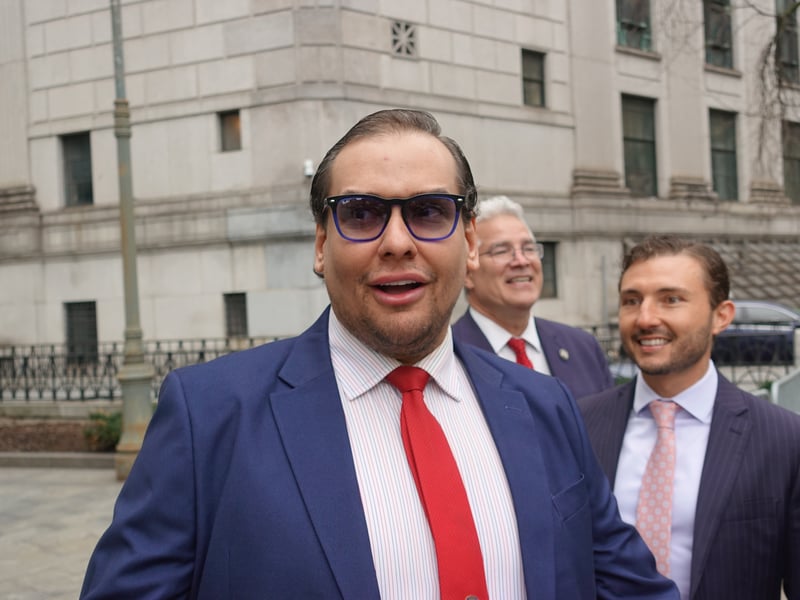
MANHATTAN (CN) — Former Republican congressman and convicted fraudster George Santos can’t bring a copyright lawsuit against ABC’s Jimmy Kimmel over the “Will Santos Say It?” late-night segment, a federal appeals court ruled Monday.
Santos sued last year after Kimmel created fake profiles on Cameo, a short-form video platform that lets users buy personalized videos from celebrities, to request outlandish clips from Santos and airing them on “Jimmy Kimmel Live!”
In affirming a lower court’s dismissal of the case, a Second Circuit panel rejected Santos’ argument that Kimmel acted in bad faith, thus nullifying his ability to publish the clips as fair use.
“It is true that ‘[f]air use presupposes good faith and fair dealing,’” the three-judge panel wrote in a 10-page ruling. “But Santos’ complaint contradicts any claim of a purpose on the defendants’ part to ‘supplant’ Santos’ ‘commercially valuable right in the videos.’”
In one of the aired videos, Santos congratulated a fictitious fan for being permitted to wear a half-beaver, half-platypus outfit to work. In reality, Kimmel was behind that request. The late-night host also asked for a congratulatory video on the successful cloning of a dog named Adolf, which Santos delivered.
The disgraced ex-lawmaker claimed Kimmel failed to use the Cameo clips in a transformative way and made false representations about his identity, violating fair use and opening the host up to a copyright claim.
But U.S. District Judge Denise Cote, a Bill Clinton appointee, tossed the suit in 2024, finding that Kimmel “showed the videos to comment on the willingness of Santos … to say absurd things for money,” a purpose she found to be protected by fair use and immune to a copyright claim.
The Second Circuit agreed with Cote’s finding, writing Monday that Santos’ own complaint “paints a portrait of defendants motivated by (sarcastic) criticism and commentary.”
“We thus agree with the district court that the first factor strongly supports a finding of fair use,” the panel wrote.
The appellate judges hinted at such a ruling during oral arguments in March, when Santos’ attorney Robert Fantone insisted that Santos’ “absolutely ridiculous” Cameos were also intended to be satirical.
“I don’t know if one of your honors or more laughed when you watched these Cameos,” Fantone said. “I know I laughed at them. It was the whole purpose, specifically, to get people to laugh at Mr. Santos for saying ridiculous things for money.”
The judges appeared baffled by Fantone’s arguments, as they appeared to run contrary to what Santos claimed in his initial complaint — that the videos were created to convey an “inspiring message” with feelings of “hope, strength, perseverance, encouragement and positivity.” Santos never before claimed that the clips were supposed to be humorous.
“It’s a separate argument from the argument you started out with,” U.S. Circuit Judge Raymond Lohier, a Barack Obama appointee, said at the time.
Lohier penned Monday’s ruling, which was affirmed by the other two judges on that March panel: U.S. Circuit Judge José Cabranes, a Bill Clinton appointee, and U.S. Circuit Judge Richard Sullivan, a Donald Trump appointee.
Neither Fantone nor a representative for ABC immediately replied to requests for comment.
Santos, who formerly represented New York’s 3rd Congressional District in the U.S. House of Representatives, was expelled from Congress in December 2023 after a House Ethics Committee report concluded he “sought to fraudulently exploit every aspect of his House candidacy for his own personal financial profit.
Last summer — on the same day that Cote dismissed Santos’ copyright complaint in the Southern District of New York — Santos pleaded guilty to wire fraud and aggravated identity theft in the Eastern District of New York. He admitted to fraudulently inflating his campaign’s fundraising numbers and using campaign funds for Botox, designer clothes and subscriptions to the adult content platform OnlyFans. Santos is currently serving a seven-year prison sentence for the crimes.
 Follow @Uebey
 Follow @uebey.bsky.social
Subscribe to our free newsletters
Our weekly newsletter Closing Arguments offers the latest about ongoing trials, major litigation and rulings in courthouses around the U.S. and the world, while the monthly Under the Lights dishes the legal dirt from Hollywood, sports, Big Tech and the arts.