
 Search Articles


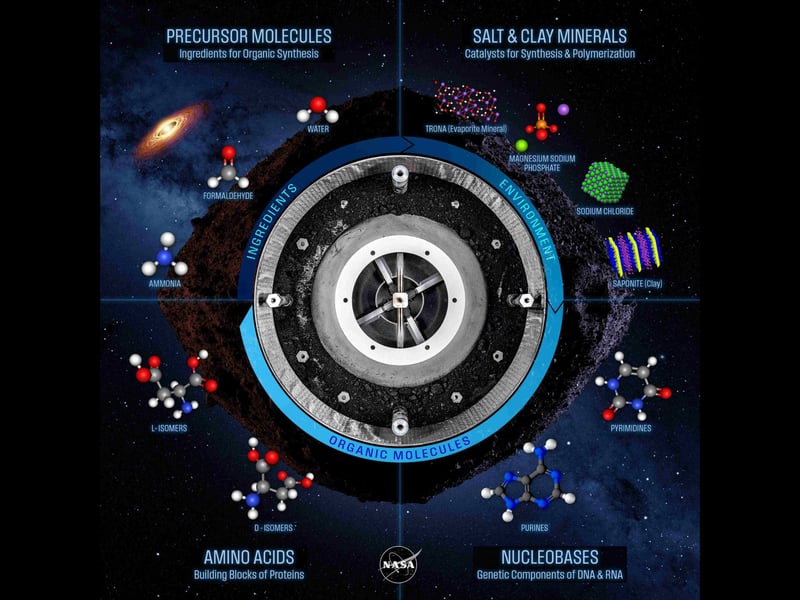
(CN) — Samples from the near-Earth asteroid Bennu contain the building blocks of life, including 14 of the 20 protein amino acids found in life forms on this planet, according to two studies published Wednesday.
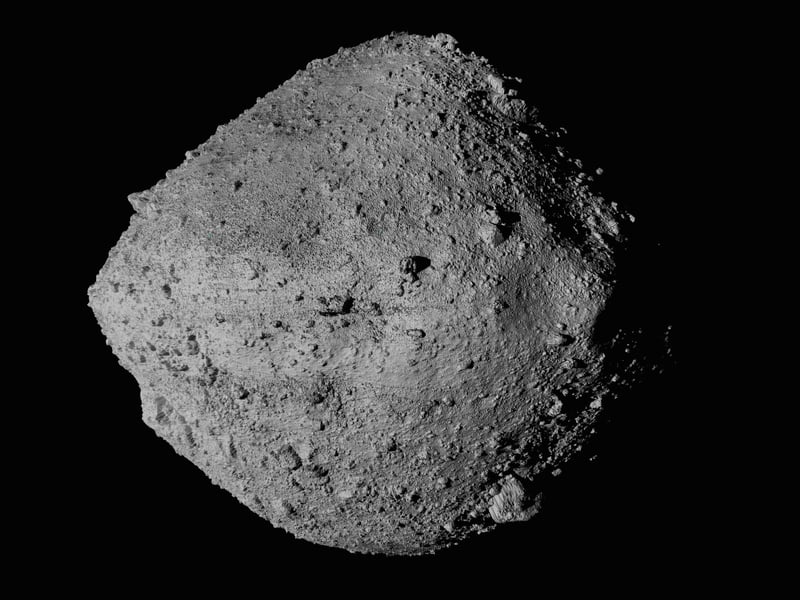
In 2019, the OSIRIS-REx mission arrived at the B-type asteroid Bennu, the rubble pile left behind from a much larger body millions of years ago. The craft collected samples from Bennu and sent them to Earth, where they arrived in September 2023. Per two studies in Nature Astronomy and Nature, the samples OSIRIS-REx came back with indicated life-starting chemicals, which Nature study author Tim McCoy said at a media teleconference the team needed for their research.
“Looking for samples is like looking for a needle in a haystack in a field of haystacks, and from orbit you’re just seeing a field,” said McCoy, curator of meteorites at the Smithsonian Institution’s National Museum of Natural History. “Retrieving samples and bringing them back under controlled conditions was the only way we ever found these results, and the only way this paper came to exist.”
Daniel Galvin and the Nature Astronomy team focused on the samples’ organic matter. Their analysis identified 33 amino acids in the Bennu aggregates, and 14 protein amino acids standard in terrestrial biology, which Galvin said connects to one theory of life.
“The exogenous delivery theory suggests that asteroids, comets and their fragments could have delivered organic material to the early Earth and seeded the planet with the raw chemical ingredients for life,” said Galvin, astrobiologist and senior scientist at NASA’s Goddard Space Flight Center, in an email. “The discovery of extraterrestrial organic matter in the Bennu samples — including most of the amino acids used to build proteins in biology and all five nucleobases which are the genetic components of DNA and RNA — certainly helps bolster this theory.”
The ammonia and formaldehyde found in the samples strengthened that theory as well.
“Both ammonia and formaldehyde are indeed key chemical precursors for the synthesis of more complex organic molecules found in life, including amino acids and nucleobases,” Galvin said. “Ammonia and formaldehyde likely reacted together to form the amino acids and nucleobases in Bennu when ice melted and salty liquid water flowed through Bennu’s parent body about 4.5 billion years ago.”
McCoy and the Nature study team studied that salt. They found a variety of salt materials including sodium-bearing phosphates and sodium-rich carbonates, which they theorize formed in the early history of Bennu’s parent body when the brine evaporated.
Along with indicating the presence of water on Bennu’s parent body, McCoy and the team studied brine because it helps the planetary science community understand the internal structure of ice-rich worlds, how prebiotic organics form and preserve themselves, and their astrobiological potential.
“Brines, particularly those rich in sodium like the brine that existed on Bennu’s ancestral asteroid, enable chemical reactions that combine elements into more complex molecules,” said McCoy. “Arguments that prebiotic organics could most easily form in brines make them a prime target to find existing microbial life outside Earth.”
At the media telecon, Nature study co-authors Jason Dworkin and Sara Russell explained why the team was unsure whether life ever formed on Bennu.
“We looked through the Bennu samples at a very fine level, the micron level, and we didn’t see any cellular structures like structural fossils or chemical fossils,” said Russell of London’s Natural History Museum.
Senior NASA scientist Jason Dworkin said, “We found no strong chemical evidence of cellular materials. We can’t prove a negative. We would have to destroy the entire sample to see if there was one cell somewhere.”
Beyond the boundaries of Earth, McCoy said that brines are a target for space exploration.
“NASA’s Europa Clipper mission is currently in route to Jupiter’s moon Europa with a goal of understanding the composition of its subsurface ocean and whether it could support life,” said McCoy via email. “Scientific arguments for future missions to the dwarf planet Ceres and Saturn’s moon Enceladus already exist. Missions such as these are key to understanding modern brines in the outer Solar System.”
Despite their different focuses, both teams are eager for future studies to unveil more about how life begins.
“The finding of evaporites shows that the environment, not just the ingredients, for the first steps in the path to life existed in the earliest history of the solar system more than 4.5 billion years ago and was widespread,” said McCoy via email. “Asteroids colliding with planets throughout the solar system would have seeded those planets and moons with the molecules formed along that path towards life.”
Galvin said via email, “It is also important to note that more than 70% of the returned Bennu sample mass is being saved for future generations of scientists who will no doubt be studying these samples with much more sensitive instrumentation than is available today, including technologies that haven’t even been invented yet.”
 Follow @kndrleon
Subscribe to our free newsletters
Our weekly newsletter Closing Arguments offers the latest about ongoing trials, major litigation and rulings in courthouses around the U.S. and the world, while the monthly Under the Lights dishes the legal dirt from Hollywood, sports, Big Tech and the arts.