
 Search Articles


WASHINGTON (CN) — The government may be shut down, but that hasn’t slowed the Senate Judiciary Committee, which on Wednesday advanced yet another slate of President Donald Trump’s judicial nominees — including one for a key appellate vacancy on the Third Circuit.
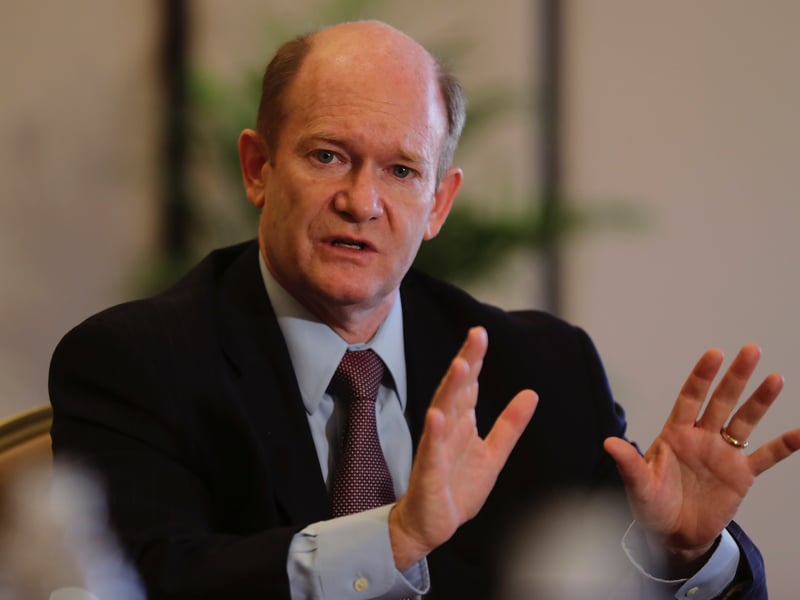
The panel approved Jennifer Mascott, an administration official and law professor tapped for a seat on the circuit court, despite complaints from Delaware Senator Chris Coons that she lacked courtroom experience or sufficient ties to the First State.
Mascott, currently general counsel at the Education Department, has already faced scrutiny over what Democrats have framed as her tenuous connection to the state of Delaware. Lawmakers including Coons have pointed out that she is not a member of the Delaware Bar and has never filed legal briefs there.
And ahead of Wednesday’s vote, the First State senator reiterated his concerns.
“I’m worried she’s not interested in Delaware, and frankly, has conveyed that she just wanted to be nominated to any open seat,” said Coons. “She never sought a position on the Third Circuit specifically but rather expressed an interest in serving in the federal judiciary.”
Though the Third Circuit’s appellate jurisdiction also includes New Jersey and Pennsylvania, the vacancy Mascott hopes to fill has traditionally been held by jurists with legal experience in Delaware. Former Judge Kent Jordan, who retired in January, was previously an assistant U.S. attorney for the District of Delaware. His predecessor, too, was a federal district court judge in the First State before joining the appellate bench.
Mascott, by contrast, has told lawmakers that she is not a Delaware resident, is not registered to vote there and has not practiced law before any Delaware court. She told Coons in a written nomination questionnaire that she owns beachfront property in the state.
“Delaware is a special place and a special bar, and this nomination is norm-shattering,” the senator said.
Coons also blasted the Trump administration for tapping Mascott for the Third Circuit vacancy despite recommendations submitted by him and fellow Delaware Senator Lisa Blunt Rochester that he said were “in keeping with their priorities.” Home state senators have limited options for guiding White House appointments for appellate court vacancies — the Senate’s blue slip tradition for opposing judicial nominees has long been ignored for the circuit courts.
Still, the Delaware lawmaker expressed disappointment that Mascott’s ties to his state had not been considered.
“In a post-blue slip world, I realized state senators didn’t matter, but I guess now home states and ties to the state bench and bar don’t matter either,” he said. “My mother has a beach home in Florida. I visited Florida a couple of times. I suppose now I’m qualified to be nominated for the Florida seat on the 11th Circuit.”
Coons also raised concerns about Mascott’s views, calling them “outside the mainstream,” and warned that she had not committed to recusing herself from adjudicating cases related to her White House work, such as whether the administration can refuse to spend congressionally appropriated funds.
But the Delaware senator acknowledged that he thought Mascott was a “lovely human being” and pointed out that “lots of people” had reached out to vouch for her integrity and character.
“Her lack of ties to Delaware and her practice experience — or lack thereof — and her positions in her confirmation hearing lead me to conclude that I should vote against her confirmation,” Coons concluded.
Dozens of Justice Department officials, as well as constitutional law scholars and members of the George Washington University Law School faculty have submitted letters of support for Mascott’s nomination. The deans of George Mason University’s Antonin Scalia School of Law and Catholic University’s Columbus School of Law have also backed her appointment.
Mascott herself has also defended her record and experience, telling lawmakers during a Judiciary Committee hearing in September that she had filed “dozens” of appellate briefs, including before the Third Circuit where she was admitted in May. And while her work as an “academic and a public servant” has required her to live in Washington, the nominee committed to base her judicial chambers in Wilmington, Delaware, if confirmed.
During last month’s hearing, Judiciary Committee chairman Senator Chuck Grassley also pointed to examples of previous judicial nominees he said were similarly disconnected from their home states.
Mascott, meanwhile, responded to questions from Democrats about supportive comments she made on the Supreme Court’s 2022 ruling in Dobbs v. Jackson Women’s Health Organization , which overturned the constitutional right to abortion.
She told senators that her scholarly work on abortion was consistent with the high court’s decision, adding that she did not believe that the Dobbs ruling would affect possible future cases challenging issues such as interracial marriage or access to contraception.
Before she joined the Trump administration early this year, Mascott taught law at the Catholic University of America in Washington. During Trump’s first term in office, she was deputy assistant attorney general in the Justice Department’s Office of Legal Counsel. She has also clerked for Supreme Court Justice Clarence Thomas as well as Justice Brett Kavanaugh while he was an appellate judge on the D.C. Circuit.
The Judiciary Committee advanced Mascott’s nomination to the full Senate on a 12-10 vote along party lines. The panel also approved a slate of other Trump administration judicial appointments, including nominees for federal district courts in Alabama and David Courcelle, the new U.S. attorney for the Eastern District of Louisiana.
 Follow @BenjaminSWeiss
Subscribe to our free newsletters
Our weekly newsletter Closing Arguments offers the latest about ongoing trials, major litigation and rulings in courthouses around the U.S. and the world, while the monthly Under the Lights dishes the legal dirt from Hollywood, sports, Big Tech and the arts.