
 Search Articles


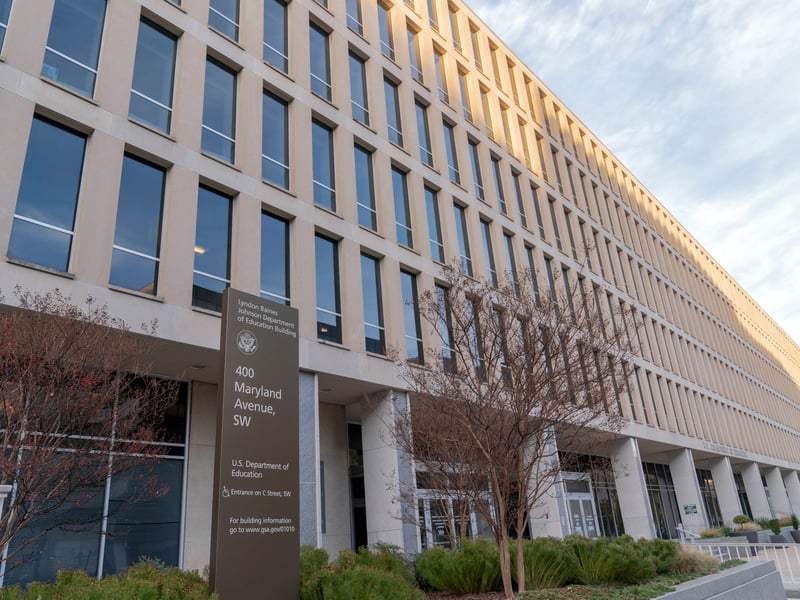
WASHINGTON (CN) — President Donald Trump on Thursday followed through on his campaign promise to shutter the Department of Education, signing an executive order to eliminate an agency which he said “entrenched” bureaucracy in U.S. education policy.
But the Education Department, created by an act of Congress in 1979, cannot be closed without lawmaker approval — a fact that has already prompted Republicans to swoop in and rubber-stamp the president’s decree.
Trump and his allies have long criticized federal education regulation, arguing that power over schooling should be left to the states. And in his Thursday executive order, the president doubled down on those contentions.
“[T]he Department of Education has entrenched the education bureaucracy and sought to convince America that Federal control over education is beneficial,” the order read, adding that the agency “does not educate anyone” but has instead siphoned billions of dollars in taxpayer money.
“Ultimately, the Department of Education’s main functions can, and should, be returned to the states,” the White House said.
The presidential order directed Education Secretary Linda McMahon to facilitate the closure of her agency while ensuring the smooth transition of Education Department programs over to state agencies. The action also requires McMahon to review federal funding for education programs and terminate spending related to diversity, equity and inclusion.
On Capitol Hill, meanwhile, congressional Republicans signaled that they would take the necessary steps to pass a law eliminating the Education Department — which the president cannot do unilaterally despite the wording of his executive order.
“I agree with President Trump that the Department of Education has failed its mission,” Louisiana Senator Bill Cassidy wrote Thursday evening in a post on X, formerly Twitter. “Since the Department can only be shut down with Congressional approval, I will support the President’s goals by submitting legislation to accomplish this as soon as possible.”
So far, it’s unclear how closely the Louisiana Republican’s proposed bill would mirror Trump’s executive order.
House Speaker Mike Johnson lauded Trump’s action, saying that the White House was keeping its promise to return education to the states.
“Education is best administered by parents and teachers and those closest to students, not bureaucrats in Washington, DC,” he said.
Johnson has previously been cagey about whether he thought Congress should pass legislation affirming an executive order shuttering the Education Department. During a news conference last month, he would not answer that question directly but suggested that there could be support for such a measure if the need were to arise.
Democrats, on the other hand, slammed the president’s move.
“This. Will. Hurt. Kids,” said Senate Minority Leader Chuck Schumer in a statement. “This horrible decision by Donald Trump will be felt by teachers, parents, school leaders and in the quality of education our children receive.”
Schumer called on federal courts to intervene and halt the president’s “tyrannical power grab.” A court could theoretically block the White House order until Congress passes legislation granting it legitimacy.
Senate Minority Whip Dick Durbin called Trump’s move “dangerous demagoguery.”
“Trump’s formula for American greatness: Eliminate federal aid to schools and cut medical research,” he said. “What a fool.”
In addition to its role in crafting national education policy and regulation, the Education Department provides billions of dollars in grants to schools nationwide for academic enrichment, workforce development and programs supporting low-income students and students with disabilities — among other things.
The department also manages more than $1 trillion in student loans for higher education. It’s unclear where that student loan debt would land if the agency were to close and if states could afford to take it on. Federal student loan debt could be sold to private companies, which may not be legally bound to honor loan repayment programs currently offered by the Education Department.
 Follow @BenjaminSWeiss
Subscribe to our free newsletters
Our weekly newsletter Closing Arguments offers the latest about ongoing trials, major litigation and rulings in courthouses around the U.S. and the world, while the monthly Under the Lights dishes the legal dirt from Hollywood, sports, Big Tech and the arts.