
 Search Articles


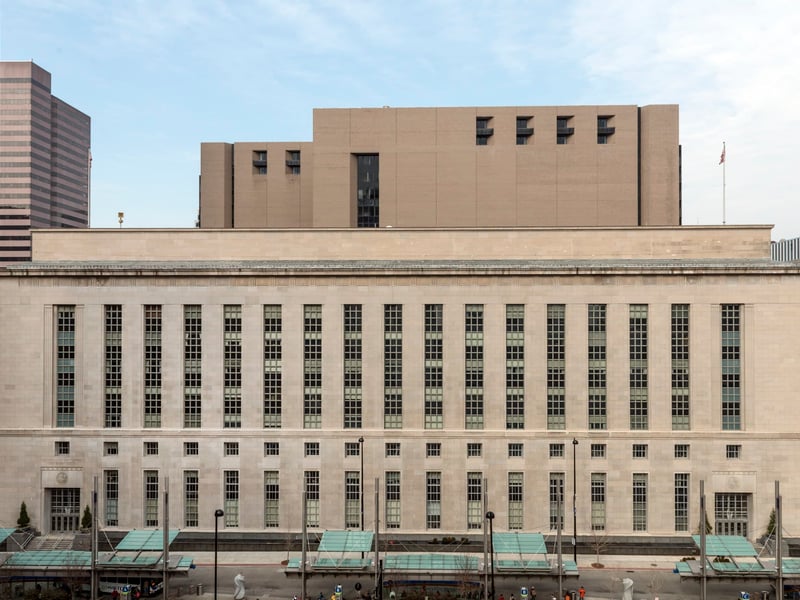
CINCINNATI (CN) — A federal appeals panel on Thursday upheld the conviction of Jaquan Bridges for possessing an unregistered machine gun, setting the precedent that the weapons are not protected by the Second Amendment.
Bridges, 22, was arrested with a Glock .40 caliber pistol with an attachment that converted the handgun into a machine gun after he nearly struck a police vehicle on a highway in Memphis and shot at the officers while he fled the scene.
A grand jury indicted Bridges on one count of possessing a machine gun in violation of 18 U.S.C. 922(o). Bridges moved unsuccessfully to dismiss the indictment, arguing the statute is unconstitutional. He pleaded guilty to the charge and was sentenced to 108 months’ imprisonment.
He appealed the conviction, arguing that a machine gun falls under the definition of “arms” used in the Second Amendment before a three-judge appellate panel in the Sixth Circuit.
On Thursday, the panel rejected this argument and found the statute is consistent with the historical tradition of prohibiting “dangerous and unusual” weapons and that Bridges’ conviction stands. U.S. Circuit Judge Richard Griffin, a George W. Bush appointee, delivered the 16-page written opinion.
“His facial challenge requires him to establish that no set of circumstances exists under which 922(o) is constitution, yet, as we will explain, the provision is constitutional as applied to the facts of his own case,” Griffin said. “Thus, his as-applied and facial challenges fail together.”
The court found that, both in Bridges’ case and more broadly, machine guns are unusually dangerous weapons most used for criminal activity and mass destruction and have no place in the home for personal use.
Griffin relied on the U.S. Supreme Court’s decision in District of Columbia v. Heller, which involved a ban on handgun possession in the home and established the “dangerous and unusual” test for determining if a firearm is protected by the Second Amendment.
Ultimately, the court found the ban was unconstitutional because it was a commonly used weapon that an ordinary man might utilize in militia service.
Next, in Hamblen v. United States, the Sixth Circuit applied Heller and found that “the Second Amendment does not protect those weapons not typically possessed by law-abiding citizens for lawful purposes” and denied the unlicensed individual the right to possess unregistered machine guns for personal use.
Hamblen alone forecloses Bridges’ facial challenge, according to Griffin. Bridges argued in May that an intervening Supreme Court decision in Bruen supersedes Hamblen , which Griffin explained in his written opinion to be a misunderstanding. Bruen was an endorsement and clarification of Heller , not a reversal, Griffin said.
The oral arguments in this case involved an array of historical examples, case law and assessment of advancing firearm technology. Assistant U.S. Attorney Eileen Kuo, arguing on behalf of the federal government, argued that rapidly evolving technology has turned small arms into “highly destructive and specialized weapons” and asked the court to limit the right to bear arms.
Attorney Greg Gookin, a federal public defender, hit back that the gun recovered from Bridges’ car was a small arm with an attachment made by a 3D printer and bought off the internet, not a sophisticated piece of equipment.
The panel agreed with the government, holding that the historical regulation of firearms in the United States supports the ban on unregistered machine guns for personal use.
Applying the two-part test in Heller and Bruen , Bridges’ homemade machine gun is dangerous in that he shot it at police officers out of a moving car, and it is unusual in that they have a propensity for unlawful use.
“The machine gun’s historical connection to crime in the United States illustrates its lack of connection to lawful purposes,” Griffin said. “As Bianchi explains, after World War I, machine guns became popular ‘with criminals, especially bootleggers’ … exacting a devastating toll.”
Bridgers asserted that there are over 740,000 total registered machine guns in the United States, making it common. The government countered — and the appellate panel agreed — that law enforcement should be excluded from analysis.
Griffin countered in Thursday’s opinion that if the court operated on the assumption that there are around 175,000 registered machine guns in the country, most are owned by those who were grandfathered in before the statute at issue in this case was enacted.
He pointed out that there are an unknown number of these dangerous firearms on the black market, used for one purpose: to shoot as many bullets as possible, as quickly as possible. This, he says, is why the court in Heller wrote that it would be unconscionable that machine guns would be protected by the Constitution.
The U.S. Attorney’s Office could not be immediately reached at the time of filing.
 Follow @desdev5
Subscribe to our free newsletters
Our weekly newsletter Closing Arguments offers the latest about ongoing trials, major litigation and rulings in courthouses around the U.S. and the world, while the monthly Under the Lights dishes the legal dirt from Hollywood, sports, Big Tech and the arts.