
 Search Articles


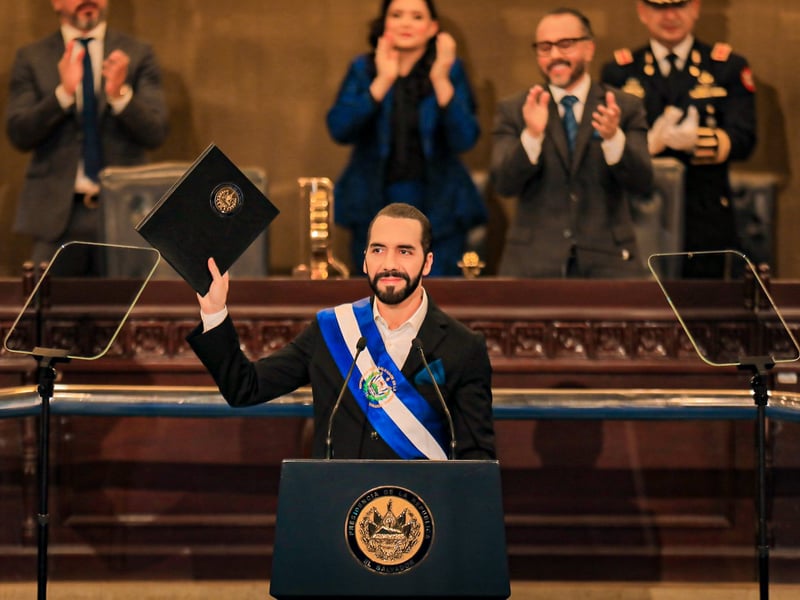
Nayib Bukele, probably the most popular president in the world, reduced El Salvador’s homicide rate by 70% last year. He has turned El Salvador from the homicide capital of the world to the safest country in Central America — reducing emigration to the United States by doing so.
Yet week after week The New York Times portrays him as a dictator, on the lines of Vladimir Putin or Nicolás Maduro, though Bukele’s reelection this year, with 85% of the vote, was authentic, as is his 90% approval rating in polls.
And how did the Times portray him, in a long story on Aug. 29, headlined, “The High Price of Safety in El Salvador”?
The Times called him “part mafia boss … [who is] dropping dead-eyed threats” with a “brutal crackdown” on the gangs who terrorized his country for decades. Gangs who formed in Los Angeles (MS-13 and Barrio 18), and whom we deported to El Salvador, along with our gun culture.
Times reporter Megan K. Stack is a superlative journalist, nominated for a National Book Award for her 2010 book, “Every Man in This Village Is a Liar,” and for a Pulitzer Prize for international reporting in 2007. I have no quarrel with Megan Stack. I do have a quarrel with her editors at the Times, and the way they have sneeringly crafted every single story about El Salvador since Bukele took office in 2019, presenting him as a threat to — what, exactly?
Five of the six presidents before Bukele have been indicted on charges of embezzling hundreds of millions of dollars in public funds, one of them with orchestrating multiple murders.
The Times’ 4,200-word article accuses Bukele of “unproven denunciations, forced disappearances, torture and child imprisonment,” with few named sources to back up the egregious accusations. The Times called Bukele’s years in office “a chilling spectacle of totalitarian oppression,” and calls him “capricious [and] cruel.”
The Times claims that the 80,000 now-imprisoned gang members who terrorized the country, demanding daily bribes from shop owners and even street vendors, were not actually arrested, but subjected to “abductions or forced disappearances.”
The New York Times knows as well as I do that to claim that “thousands of children as young as 12 are among the detained, and some of them have been tortured” requires a hell of a lot more sourcing than the Times provides.
Who said so? Who do they work for? Talk about “unproven denunciations.”
I know quite a bit about this. I know hundreds of Salvadorans, in this country and in Salvador. In years doing legal work in U.S. immigration prisons in the 1980s, and as a reporter on the street, I’ve interviewed more than 1,000 Salvadorans, some as political asylum applicants, some as sources for news articles, many just for my own information.
More than 100 of these people were tortured, often savagely, when Nayib Bukele was just a babe in arms. One man, who became a friend, was tortured by his own father, a colonel in the Salvadoran Army, because he gave a hitchhiker a ride.
Now, there are some differences between the CIA- and U.S. Embassy-backed torturers and mass murderers of the Salvadoran civil war and the Salvadoran gang killers whom Bukele has effectively castrated.
The assassins in the Salvadoran Army, Treasury Police, National Police and Air Force tortured and killed for, ostensibly, political reasons. The assassins in M-13 and Barrio 18 kill for money, and control of the few measly blocks the gang leaders allot them. And they rape for their own perverted pleasures.
I offer no opinion on whether murder in the interest of ideology or murder on a whim is worse.
I would, however, like to point out that there are far better ways to reduce immigration, immiseration and peace in our hemisphere than to train torturers at the School of the Americas and send guns and ammunition to the “graduates.” (Yes, I know a policeman who received training at the School of the Americas in Georgia and he told me of the “education” he received in torture.)
The Times article devotes one sentence to El Salvador’s new national library, built under Bukele for $54 million, with substantial aid from China, now open around the clock. It does not mention at all the proposed $1 billion deep-water port Bukele proposes to build, with aid from China.
Pardon me for speaking above my pay grade, but don’t you think both of our countries’ — hell, our hemisphere’s — problems could have been eased considerably had the United States offered El Salvador economic opportunities, infrastructure and libraries, instead of guns, ammunition and guides to torture?
Just asking.
Why would the State Department give all those gangsters a pass, but pile up on Bukele?
Could it be because this president of a small but finally proud country refused to take a call from U.S. Secretary of State Anthony Blinken?
Just asking.
Here is a brief history of El Salvador’s presidents before Bukele, and their party and terms of office.
Alfredo Cristiani 1989-1994 ARENA. ARENA was known, correctly, as the party of the death squads. In 2008, human rights organizations filed a lawsuit in Spain charging Cristiani and 14 members of the Salvadoran military with the 1989 murders of Jesuit priests at the University of Central America. Cristiani’s whereabouts are unknown. He is also facing charges in El Salvador for the 1989 murders of the Jesuits.
Armando Calderon Sol 1994-1999 ARENA. Died in Houston of lung cancer in 2017. The only Salvadoran ex-president of this century not charged with multiple felonies.
Francisco Flores Pérez 1999-2004 ARENA. Charged with embezzlement and illicit enrichment for misappropriating more than $15 million donated by Taiwan after 2001 earthquakes. Died on Jan. 30, 2016, while under house arrest, of cerebral hemorrhage.
Antonio Saca 2004-2009 ARENA. Arrested in 2016 and charged with embezzling more than $300 million in public funds. He pleaded guilty and is serving a 10-year sentence.
Mauricio Funes Cartagena 2009-2014 FMLN. Sentenced to 14 years in prison on corruption charges in 2023. Hiding in Nicaragua from corruption charges, including pacts with gangs.
Salvador Sanchez Cerén 2014-2019 FMLN. Hiding in Nicaragua from charges of money laundering and illegal enrichment. The U.S. State Department sanctioned him in July 2023 for “significant corruption by laundering money.”
I shall not trouble you with a list of the corrupt murderers who ran El Salvador in the 60 years before Cristiani murdered his way to the throne, all of them with U.S. backing.
And as for The New York Times’ accusation that Bukele ordered teenagers thrown into prison, a longtime human rights lawyer in El Salvador told me: “Yeah, he jailed 14-year-old murderers. So what?”
Subscribe to our free newsletters
Our weekly newsletter Closing Arguments offers the latest about ongoing trials, major litigation and rulings in courthouses around the U.S. and the world, while the monthly Under the Lights dishes the legal dirt from Hollywood, sports, Big Tech and the arts.