
 Search Articles


SAN JOSE, Calif. (CN) — The Stanford University student newspaper told a federal judge Tuesday she should block the Trump administration from revoking visas over protected speech, citing international writers and editors who quit the paper and censored themselves in fear of retaliation.
Conor Fitzpatrick, a Foundation for Individual Rights and Expression attorney representing The Stanford Daily and two unnamed plaintiffs, said a provision in the Immigration and Nationality Act allows the secretary of state full authority — without judicial review — to deport any noncitizen whose protected speech they determine compromises foreign policy interests.
He said noncitizens have very few protections if the provision is invoked. It is the core reason the student paper filed the lawsuit — challenging the text of the statute as beyond the boundaries of executive authority.
The paper and students urged U.S. District Judge Noël Wise to find that the First Amendment prohibits the Trump administration from deporting the two unnamed plaintiffs for expressing protected speech, and to issue preliminary and permanent injunctions stopping those removals.
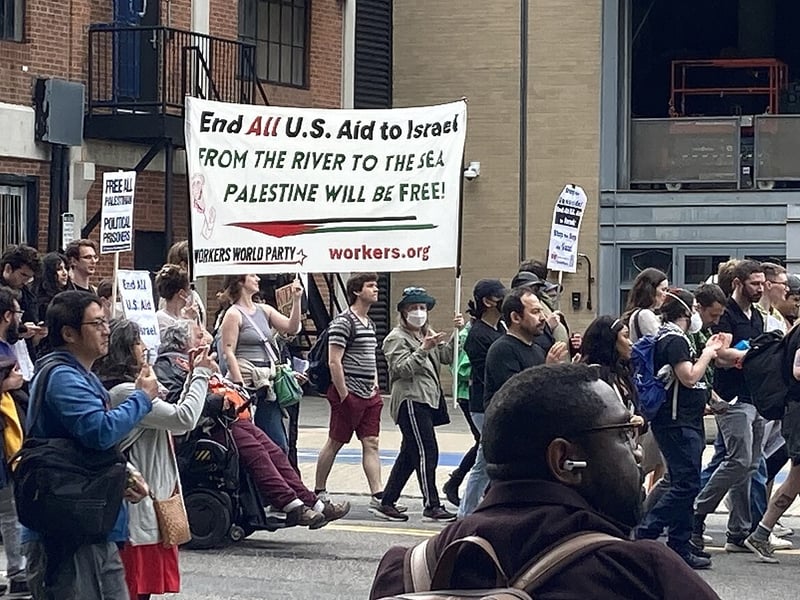
Fitzpatrick brought up the high-profile cases of Columbia University graduate student Mahmoud Khalil, who was detained for three months after protesting for Palestinian rights, and Turkish Tufts University student Rümeysa Öztürk, who was detained and had her visa revoked after writing an op-ed critical of the school’s response to the Israel-Hamas war.
“The government cannot throw someone out of the country simply because they don’t like what they say,” said Fitzpatrick.
The plaintiffs also pointed to statements made by President Donald Trump and allies before and after the November 2024 election as reason for an injunction.
In October 2023, Trump — then a presidential candidate — said he’d revoke the visas of foreign students deemed radical, anti-American and antisemitic. It wasn’t the only time he made such comments.
“On May 14, 2024, Mr. Trump said at a campaign event, ‘One thing I do is, any student that protests, I throw them out of the country,’” the plaintiffs said in their original complaint. “’You know, there are a lot of foreign students. As soon as they hear that, they’re going to behave.’”
Wise, a Joe Biden appointee, also heard the federal government’s arguments to dismiss the case for lack of standing.
Assistant U.S. Attorney Kelsey Helland, representing Secretary of State Marco Rubio and Secretary of Homeland Security Kristi Noem, said the paper did not meet the standing the plaintiffs claim, as it would need to be an advocate for its members in order to bring the lawsuit — something the student paper, an organization conducting journalism and giving students journalism experience, does not do.
Wise asked both attorneys if the government is still revoking visas now that there are not as many protests related to the Israel-Hamas war. While Helland said “there are not as many,” Fitzpatrick said the lawsuit had credible pre-enforcement standing because it applies to all protected speech.
He told the court an injunction would be overly broad, and would need to be decided on a case-by-case basis because protected speech includes “the nature of the speech and speaker depending on a sliding scale of rights, based on the speaker’s relationship with the U.S.”
Additionally, Helland argued under current enforcement strategies, the claims included only “pure speech” that would not be enforceable, as it didn’t include other actions that would be flagged by Immigration and Customs Enforcement and the State Department, such as supporting terrorism or violence.
Fitzpatrick countered Helland’s argument saying just because the government acted in some “noblesse oblige” by slowing down visa revocations doesn’t mean there isn’t any risk for noncitizens speaking out.
“The threat is latent in the statute,” he said.
Wise did not hint at what her ruling on the motion to dismiss would be, but told both parties an undisputed statement of facts may be needed for a future motion on summary judgment.
“I have some things to think about,” the judge said.
Subscribe to our free newsletters
Our weekly newsletter Closing Arguments offers the latest about ongoing trials, major litigation and rulings in courthouses around the U.S. and the world, while the monthly Under the Lights dishes the legal dirt from Hollywood, sports, Big Tech and the arts.