
 Search Articles


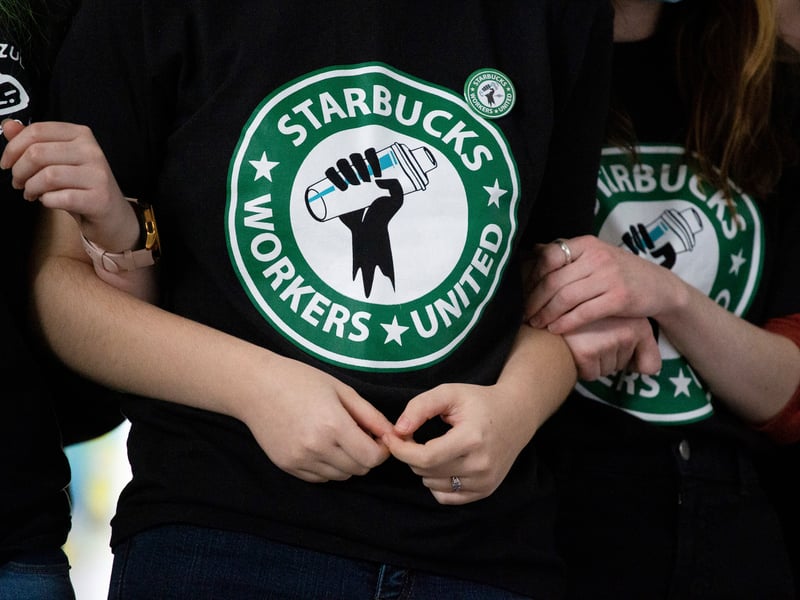
MANHATTAN (CN) — Global coffee giant Starbucks urged a federal appeals court on Wednesday to overturn a National Labor Relations Board ruling that concluded the dress code at its New York City Roastery Reserve café violated its workers’ labor law rights.
The Seattle-headquartered company’s dispute with the board stems from the dress code for employees at Starbucks’ NYC Roastery Reserve, a location of the boutique Starbucks spinoff that former CEO Howard Schultz once compared it to “if Willy Wonka had built the ultimate coffee shop instead of a chocolate factory.”
On appeal before the Second Circuit Court of Appeals in Lower Manhattan is the National Labor Relations Board’s 2024 finding that Starbucks’ dress code for its Roastery Reserve employees, which bans union insignia on T-shirts or more than one button on employees’ aprons, is in violation of Section 7 of the National Labor Relations Act.
Starbucks argues that it carefully designed the Roastery Reserve with dramatic large copper roasting equipment, interactive coffee bars and artisanal food offerings, as part an overall “steampunk, hipster chic design aesthetic” industrial aesthetic, and that the dress code for its public-facing employees is “part and parcel of this unique, immersive experience.”
Represented by Williams Connolly attorney Amy Saharia, Starbucks urged the Second Circuit to follow the Fifth Circuit’s ruling in Tesla v. National Labor Relations Board , which held that the act does not give the board authority to declare all employer dress codes in this country presumptively unlawful.
“What the board did in Tesla is it took that presumption that has typically applied in pieces of complete bans on union insignia, and it applied it across the board in a one-size-fits all way to any employer rule that has any incidental consequence on an employee’s ability to display union insignia, like the shirt rule here, and as the Fifth Circuit explained in Tesla , one irrational aspect of that of that extension is that it takes no account of the extent of interference with employees’ Section 7 rights,” Saharia said.
U.S. Circuit Judge Susan Carney opined that Starbucks’ carefully curated aesthetic argument did not entirely cohere with the dress code’s carveouts that allowed for a dozen specific Starbucks-issued shirts promoting Starbucks-sponsored events or promotions, like the pumpkin spice latte, and buttons for select company-approved social causes like World AIDS Day and Black Lives Matter.
“But it’s kind of inconsistent with the notion that no personal or cause oriented messages can be displayed because of the steam punk hip vibe when there’s, in fact, a lot of other kinds of social issue messaging that Starbucks is allowing,” Carney, a Barrack Obama appointee said.
“There’s a lot of other social messaging that’s happening, and it’s a large and, you know, kind of very active business place where it’s just not so purely limited to the public image hipster vibe that Starbucks describes to think it’s prerogative to control," she said.
Starbucks argues on appeal that the Second Circuit should reject the NLRB’s defiance of precedent and extension of the “special circumstances” test, and should deny enforcement of the board’s order.
“If the board’s decision is enforced, commonplace and longstanding workplace dress codes and uniform policies may become a thing of the past, to the detriment of employers, employees, and customers alike,” the company wrote in an appeals brief.
The National Labor Relations Board argued that Starbucks’ asserted public image does not justify its outright ban on union shirts and that its no-advocacy-pins policy is overly broad and illegal.
NRLB attorney Jared Cantor made his appearance at oral arguments on Wednesday remotely due to the continuing federal government shutdown.
The board said that Starbucks failed to prove its asserted public-image justification for the single-union-pin policy, and produced no evidence as to how the Roastery’s public image would be affected if employees wore more than one union pin.
“The question is: is there a curtailment of an employee’s right to wear protected insignia? And if there is, it’s presumptively unlawful,” Cantor told the Second Circuit.
The NLRB asked the Second Circuit to affirm and enforce the board’s order issued in November 2024.
“Where an employer infringes on its employees’ right to wear union or other protected paraphernalia, the question whether the employer has proven special circumstances to justify that infringement is, by its very nature, a fact-dependent, case-specific determination,” the NLRB wrote in an appeals brief.
U.S. Circuit Judge Carney was joined on the panel by U.S. Circuit Judges John Walker, a George H. W. Bush appointee; and William Nardini, a Donald Trump appointee.
The three-judge panel did not immediately issue a ruling from the bench on Wednesday.
 Follow @jruss_jruss
Subscribe to our free newsletters
Our weekly newsletter Closing Arguments offers the latest about ongoing trials, major litigation and rulings in courthouses around the U.S. and the world, while the monthly Under the Lights dishes the legal dirt from Hollywood, sports, Big Tech and the arts.