
 Search Articles


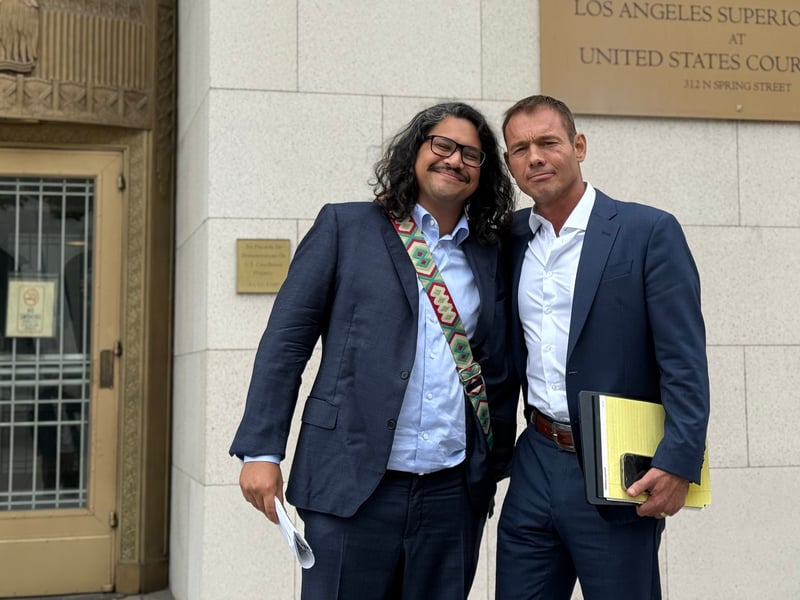
LOS ANGELES (CN) — A Los Angeles judge rejected on Wednesday a motion by Starbucks to reduce or invalidate a $50 million jury award leveled at the coffee giant earlier this year over a spilled cup of tea that left a Postmates driver’s penis scalded and permanently disfigured.
Starbucks attorney Rich Moore, a partner at Williams & Connelly, called the jury’s verdict “grossly excessive” and “wildly disproportionate” to the injuries suffered by the plaintiff, Michael Garcia. He added that the award for damages was “exponentially higher than any verdict in American history for a case like this.”
Los Angeles Superior Court Judge Frederick Shaller had little sympathy for the coffee giant.
“I think, basically, the damage award was not a surprise,” Shaller said. “This is just part and parcel of trying cases in downtown Los Angeles. I don’t think it was unreasonable. Maybe the Court of Appeals will see it differently.”
As to comparing the award to other cases, the judge said: “There is nothing like this case. To me, it’s outrageous that it ever came to court,” suggesting that Starbucks should have settled the case long ago. He added: “You asked for this verdict.”
In 2020, then-25-year-old Garcia was picking up an order of three venti-sized “medicine balls” — secret menu items made from a mix of steamed lemonade and two different teas — from a drive-thru Starbucks window in South LA. One of the drinks, he said, was “negligently” unsecured in its cardboard drink carrier, causing it to spill in his lap after he brought it inside his car.
Garcia said he “suffered severe burns, disfigurement and debilitating nerve damage to his genitals” as a result of the spill. The injury left his penis permanently discolored and disfigured, and he says that both sex and masturbation are painful experiences.
A key piece of evidence during the two-week trial was video footage taken from inside the coffee shop. Garcia’s lawyers said the footage clearly showed one of the drinks pushed down into the carrier only partway, leaving it loose, causing it to spill seconds after Garcia took it.
According to the Expert Institute, Garcia’s $50 million verdict was the third-highest personal injury payout of 2025, ranking behind two cases with severe brain and spine injuries.
The judgment also brought to mind the infamous 1992 McDonald’s “hot coffee” lawsuit, in which a 79-year-old woman was awarded nearly $3 million for a spill that left the woman in a hospital for more than a week.
In that case, the jury found that McDonald’s was only 80% at fault, and most of the award was for punitive damages — punishing the fast food giant for its neglect, rather than reimbursing the woman for pain and suffering. A judge later reduced the award to $480,000 and the parties settled for a confidential sum reported to be less than $500,000.
Starbucks, meanwhile, was found to be 100% liable for the spill on Garcia’s lap. And Garcia’s attorneys had not asked for punitive damages.
On Wednesday, Starbucks lawyers questioned that verdict, and faulted the judge for excluding from trial a report that suggested Garcia was tending to his dog as he brought the hot teas into his car. Moore said that it was “contrary to the weight of evidence to say that the plaintiff wasn’t at least somewhat negligent.”
Moore argued that Garcia’s attorney, Nick Rowley, the founder of Trial Lawyers for Justice, delivered a closing argument that was “designed to encourage verdict based on passion and prejudice.”
In his closing statement, Rowley made reference to the then-recent shooting of United Healthcare CEO Brian Thompson. The shooting, Rowley said, was one way to send a message to corporate America — the wrong way. Handing down a large judgment against Starbucks, he said, was the right way.
“That’s beyond the pale,” Moore said. “This is not a case about corporate greed. Interjecting that type of anti-corporate rhetoric was highly prejudicial.”
He also said the judge erred when he didn’t allow Garcia’s medical bills into evidence during the second phase of the trial, which determined damages. He said that the $50 million award was reached incorrectly — that the jury came to that number by giving Garcia $1 million per year for 50 years.
“There’s no evidence of that,” Shaller interjected. “I don’t think that’s a valid argument.”
Rowley pointed out that Starbucks had been willing to settle the case, after the company had been found liable but before the damages had been determined, for $30 million, and said some of the jurors had pushed for an award that was closer to the $120 million Rowley had asked for.
“This verdict is reasonable any way you look at it,” Rowley said. “The defense is lucky the verdict wasn’t much larger.”
Shaller declined motions from Starbucks to grant a new trial or to reduce the judgment. A Starbucks spokesperson indicated the company intends to appeal those decisions.
On top of the $50 million judgment, Starbucks will also have to pay interest and attorney fees. The total bill, Rowley said, would be around $61.7 million — rising higher if Starbucks appeals the ruling and loses.
“If they want to jerk around with appeal, then they’ll owe another $12 million in interest,” Rowley said after the hearing. “I’m a thousand percent sure that this verdict will stand on appeal. It would be frivolous and stupid to appeal in this case.”
In an email, Starbucks spokesperson Jaci Anderson said: “We respectfully disagree with this ruling and believe the verdict is contrary to the evidence and the law. We have always been committed to the highest safety standards in our stores, including the handling of hot drinks and are considering our next steps in the legal process.”
 Follow @hillelaron
Subscribe to our free newsletters
Our weekly newsletter Closing Arguments offers the latest about ongoing trials, major litigation and rulings in courthouses around the U.S. and the world, while the monthly Under the Lights dishes the legal dirt from Hollywood, sports, Big Tech and the arts.