
 Search Articles


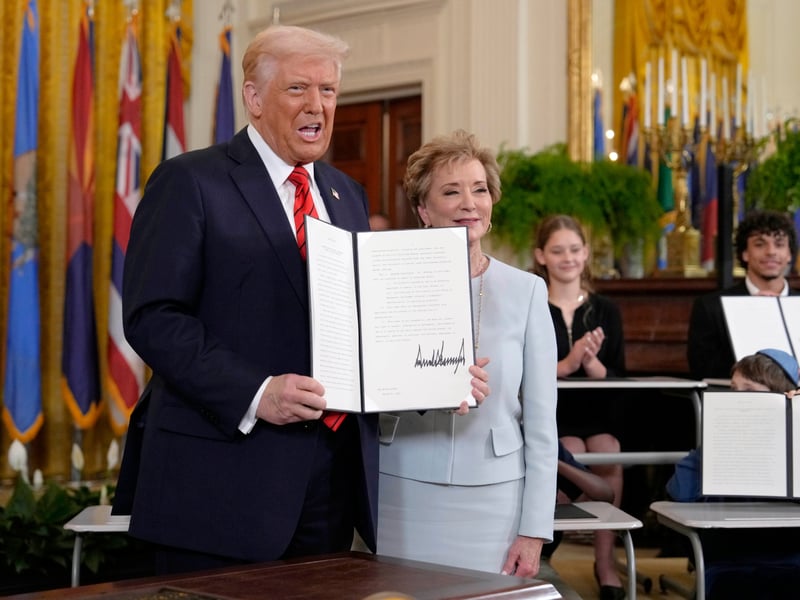
(CN) — A batch of nonprofits, four cities and more than 20 Democratic states accuse the Department of Education of stripping the Public Service Loan Forgiveness student debt relief program to punish public servants the administration disfavors in a pair of lawsuits filed Monday in Massachusetts federal court.
Last week, the Trump administration announced a rule change that said those who engage in “unlawful activities” won’t receive debt relief under the PSLF program, which forgives student debt for public servants who paid down their loans for 10 years. The department suggested those activities could include supporting gender transition for minors, “supporting terrorism and aiding and abetting illegal immigration.”
California Attorney General Rob Bonta said the change is an attempt to “weaponize the Public Service Loan Forgiveness program to target Trump’s political enemies” and noted that the so-called “unlawful activities” are not actually illegal.
“They can’t cherry-pick which public service employers qualify or which don’t,” Bonta said at a press conference Monday. “The vague rule issued by the Department of Education opens the door for Trump to target any government or nonprofit organization it sees fit.”
Bonta co-led one of Monday’s lawsuits, the 46th such complaint to be brought by a coalition of Democratic states against the Trump administration this year. In the lawsuit, the 21 states, plus the District of Columbia, accuse the Department of Education of seeking to “chill the activities of public service employers by discouraging their employees from what it deems objectionable forms of public service.”
“And it does so openly: the department admits that the rule ‘is focused on specific illegal conduct that’ President Trump ‘has determined that the department should focus on’ and that he ‘has identified as being of greatest concern,’” the states argue in a 47-page suit.
They worry the rule would be used to target entire classes of public employees, like teachers in states with inclusive curricula, health care workers providing gender-affirming care or legal aid attorneys representing immigrants.
Over the past two decades, the Public Service Loan Forgiveness program has been used to provide more than $85 billion in federal student loan forgiveness to more than 1 million public service workers, including police officers, firefighters, military personnel, teachers, nurses and social workers, according to the states.
Greenlighting the department’s new rule, set to take effect next July, would discourage potential employees from joining public service by stoking uncertainty about the benefits they’d receive, the states claim.
“We should be applauding and rewarding those who dedicate their careers to serving their communities,” Bonta said. “We should do everything we can to open the path to public service for all, no matter how much money they have.”
A second lawsuit challenging the rule was also filed in Massachusetts federal court on Monday. Brought by the cities of Boston, Albuquerque, Chicago and San Francisco, along with several nonprofit organizations, the plaintiffs in that claim similarly accuse the administration of unlawfully using the loan relief program to punish those who defy the president.
“In an attempt to target organizations and jurisdictions whose missions and policies do not align with its political positions on immigration, race, gender, free speech, and public protest, the Trump-Vance administration has weaponized the PSLF program in a way that defies how Congress designed it,” the cities and organizations claim in a 78-page complaint.
The Public Service Loan Forgiveness program was enacted in 2007 after being approved by a bipartisan Congress to address a shortage of workers in public service jobs, which tend to earn less than their private sector counterparts. The cities and nonprofit groups claim that adding a new stipulation to the program will kneecap their ability to retain quality employees.
Additionally, Congress never gave Education Secretary Linda McMahon the authority to disqualify recipients “based on a partisan or political litmus test.”
Both lawsuits list McMahon and the Department of Education as defendants. A department spokesperson didn’t immediately return requests for comment.
 Follow @Uebey
 Follow @uebey.bsky.social
Subscribe to our free newsletters
Our weekly newsletter Closing Arguments offers the latest about ongoing trials, major litigation and rulings in courthouses around the U.S. and the world, while the monthly Under the Lights dishes the legal dirt from Hollywood, sports, Big Tech and the arts.