
 Search Articles


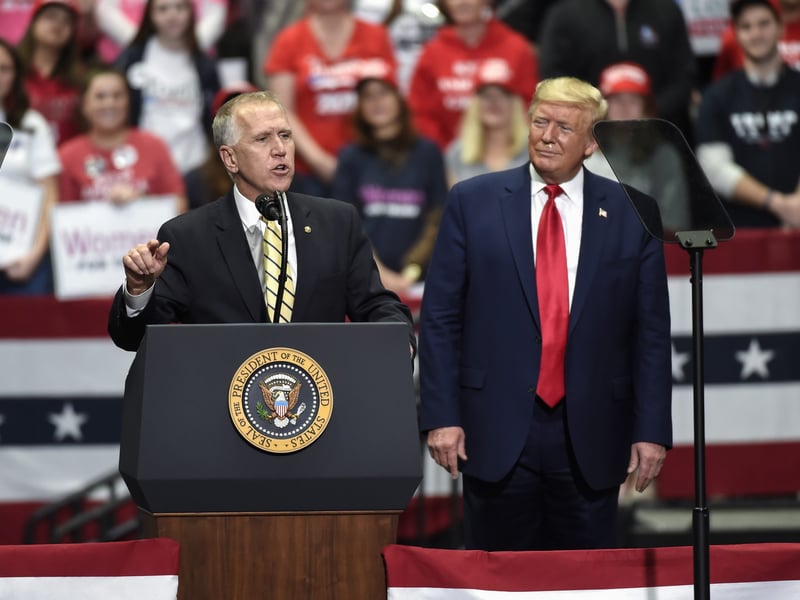
WASHINGTON (CN) — After North Carolina Senator Thom Tillis announced over the weekend that he would not seek reelection as he weathered attacks from President Donald Trump, questions swirled about how the outgoing lawmaker would approach Republicans’ effort to advance the president’s political agenda.
Tillis, for a decade the Tar Heel state’s senior senator, made public his plans to retire amid his opposition to Trump’s “Big, Beautiful Bill.” His vote against the measure this week drew the president’s ire and earned him plaudits from Senate Democrats.
But the outgoing lawmaker, with more than a year left in his final term, may find himself with a few more chances to break with the Trump administration — particularly when it comes to the president’s often-controversial nominees for the federal judiciary.
Tillis is a senior member of the Senate Judiciary Committee, the upper chamber’s influential panel charged with reviewing the White House’s picks for federal judgeships and other positions within the judiciary and the Justice Department. In his time on the committee, the North Carolina Republican has fashioned himself as a sober barometer of judicial competence willing to reach across the aisle and support even nominees offered by Democratic administrations.
Under former President Joe Biden, Tillis often thumped his bipartisan record — most notably as the Judiciary Committee considered a Fourth Circuit nominee whose jurisdiction would include the lawmaker’s home state.
Tillis, furious about what he said was a lack of consultation from the White House, refused to back the nominee but said he was “ashamed” to do so. The Biden administration, for its part, long contested the senator’s version of events.
And in Trump’s second term, Tillis has demonstrated on at least one occasion that he could depart from his Republican colleagues on some of the president’s judicial nominees.
The North Carolina lawmaker earlier this year was the sole GOP vote against Ed Martin, the White House’s pick to become U.S. attorney for D.C. Tillis said at the time that he was skeptical of Martin’s views on the Jan. 6, 2021, Capitol riot — the nominee defended rioters who breached the Capitol and, as D.C.’s acting U.S. attorney, opened an investigation into his office’s handling of Jan. 6 cases.
“None of that stuff resonates with me,” Tillis told reporters at the time. He later informed the Trump administration that he would not support Martin’s nomination, singlehandedly tanking his chances of surviving a vote on the closely divided Judiciary Committee.
Alex Aronson, director of reform-minded advocacy group Court Accountability and a former senior staffer on the Judiciary Committee, observed that Tillis has tried to strike a careful balance in his approach to the president’s nominees.
“Tillis was trying to walk a line here: Be loyal to the Republican party and be loyal to Trump and, to the extent he is still able, to uphold his oath to the Constitution,” Aronson told Courthouse News in an interview. “As we’re seeing, that’s an increasingly untenable position.”
Aronson acknowledged that the senator had some capacity for bipartisanship. “I think on some level, his record suggests that he — at least relative to some other Republicans in that caucus — is acting in better faith,” he said.
But he added that Tillis’ claims that he’d regularly reached across the aisle were “a little self-serving.” Aronson compared Tillis’ commitment to bipartisanship with that of former Nevada Senator Jeff Flake.
“When push comes to shove, they aren’t going to upset the party if they can avoid it,” he said.
So far, Tillis has largely voted in lockstep with his Republican colleagues on the handful of federal judicial nominees Trump has placed before the Senate’s judiciary panel, save for his prominent defection on Martin.
But now, in the twilight of his Senate career, Tillis has signaled that he may be willing to stake out a more maverick position. “I look forward to having the pure freedom to call the balls and strikes as I see fit,” he wrote in a statement over the weekend announcing his retirement.
Whether that means the North Carolina senator will position himself as a Republican bulwark against Trump’s more controversial judicial nominees — or toe the party line — remains untested, said Carl Tobias, chair of the University of Richmond School of Law.
“I’m cautiously optimistic that we might see more of that from him on the committee, but we haven’t so far, at least with judicial selection,” Tobias said. Under the Biden administration, he recalled, Tillis had voted for nominees that he thought were “well qualified and mainstream,” and Tobias added that the senator’s opposition to the Martin nomination was “courageous.”
Tillis, though, told reporters this week that his approach to judicial nominees was “not going to be different either way.”
“I don’t know of any now that would be problematic,” he said, adding that his vote against Martin was an “outlier.”
Anyone hopeful that the senator will use his lame-duck status to oppose controversial Trump nominees should pay attention to his stance on Third Circuit nominee Emil Bove, Tobias said.
“I think Bove will be the acid test,” he said. “If he votes for that nominee, then I don’t know where he’s going.”
Bove, a Justice Department official and former lawyer for the president, has proven to be one of the Trump administration’s most controversial court nominees to date. As acting deputy attorney general, Bove penned a letter pressuring the Southern District of New York to drop its charges against New York City Mayor Eric Adams and was involved in efforts to fire Justice Department officials tied to Jan. 6 prosecutions.
Ahead of his nomination hearing last week, Bove was also implicated in a whistleblower report that said he had expressed intent to defy a federal court order — something he and the Justice Department have fervently denied.
Aronson agreed that Tillis’ approach to Bove would be important in determining how the outgoing senator may position himself on White House judicial nominees for the remainder of his term.
“I think if we see Tillis respond to the very concerning public record of misconduct and abuse of power allegations against Bove, that would be a real indication that things could be different in the committee than they were in the last go around,” he said.
Meanwhile, Tillis’ departure may also open the door for legal advocacy groups who oppose Trump nominees to engage with the senator — who they may now view as a possible swing vote on the Judiciary Committee.
Rachel Rossi, president of progressive judicial advocacy organization Alliance for Justice, told Courthouse News in a statement that her group hoped Tillis would be willing to block nominees “hand-selected for their loyalty to Trump” whether or not he had decided to run for reelection.
“This moment requires all senators to stand bravely in defense of the rule of law,” she said. “Senator Tillis rightly recognized that January 6 was an attack on our democracy, which should make it simple to oppose nominees like Emil Bove, who, like Ed Martin, worked to protect the insurrectionists.”
Lena Zwarensteyn, senior director of the Leadership Conference on Civil and Human Rights’ fair courts program, called on Tillis and other senators to give Trump nominees their due diligence.
“Our expectation is that every senator — no matter where they’re from or their party — will evaluate every single judicial nominee to ensure they meet the highest ethical standards, are fair-minded, possess a commitment to the civil and human rights of all people and have the personal and professional experience that enhances the administration of justice,” she said in a statement.
Aronson, himself at the helm of a judicial advocacy group, said that organizations had to “tread carefully” when approaching Tillis as a potential ally on the Judiciary Committee.
“In this climate of intense polarization around the courts, we should acknowledge that aggressively courting Tillis to oppose Trump’s nominees could hurt more than it helps,” he said.
 Follow @BenjaminSWeiss
Subscribe to our free newsletters
Our weekly newsletter Closing Arguments offers the latest about ongoing trials, major litigation and rulings in courthouses around the U.S. and the world, while the monthly Under the Lights dishes the legal dirt from Hollywood, sports, Big Tech and the arts.