
 Search Articles


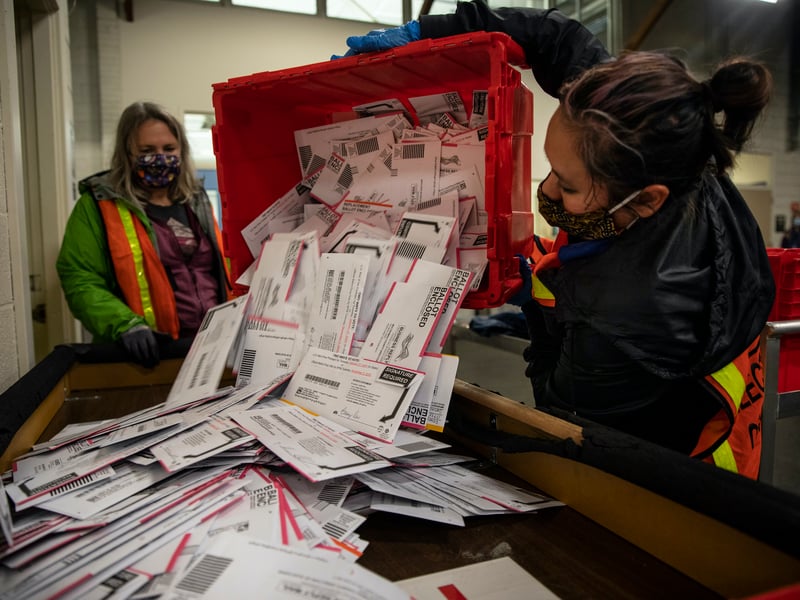
WASHINGTON (CN) — Republicans are taking their election integrity message to the Supreme Court next week in a long-awaited duel over mail-in ballot deadlines, putting one of President Donald Trump’s frequent election fraud conspiracies on the high court steps.
Two days after the 2020 election, Trump infamously declared, “STOP THE COUNT,” casting climbing absentee ballot tallies as fraudulent. Much to the president’s chagrin, the Supreme Court refused to review post-election ballot receipt deadlines nearly six years ago. But the sentiment remains pertinent across the Republican party, with Speaker of the House Mike Johnson suggesting last month the delayed deadline raised suspicions of foul play.
“We had three House Republican candidates who were ahead on Election Day in the last election cycle, and every time a new tranche of ballots came in, they just magically whittled away until their leads were lost, and no series of ballots that were counted after Election Day were our candidates ahead on any of those counts,” Johnson said. “It just looks on its face to be fraudulent.”
Johnson conceded that he had no evidence of any fraud. An analysis of the 2016, 2018, 2020 and 2022 general elections from the Brookings Institution found an average voting fraud percentage of only 0.000043%, or about four cases of mail voting fraud out of every 10 million mail votes.
Nevertheless, the Supreme Court could decide to finally grant Republicans’ wish ahead of the 2026 midterms. At issue before the court next week is a Mississippi law allowing absentee ballots to be counted after Election Day if they are postmarked on or before the date of the election.
The Republican National Committee, supported by the Trump administration, urged the justices to find the statute unconstitutional, stating that Congress designated a single day for the election, not five.
“Elections have consequences. They also have a definition,” U.S. Solicitor General John Sauer wrote for the government. “And from the dawn of America, Election Day has meant the day the ballot box closes — and when election officials must be in receipt of all ballots.”
Defining Election Day
Nearly 200 years ago, Congress mandated federal elections be held uniformly on one Tuesday in November every other year. Accordingly, all states require ballots to be cast by federal Election Day.
But since states have authority over the time, manner and places of such elections, nearly 30 states and the District of Columbia allow at least some ballots that are cast by Election Day to be counted if they are received soon after that.
In 2020, Mississippi’s Legislature enacted one such law, permitting absentee ballots to be counted as long as they were postmarked on or before the date of the election and received by the registrar no more than five business days after the election.
Mississippi argued that federal election-day statutes dictate that ballots be cast — not received — by Election Day.
“An ‘election’ is the conclusive choice of an officer,” the state wrote. “The voters make that choice by casting their ballots. So federal law requires only that voters cast their ballots by Election Day. The election has then occurred, even if state officials do not receive all ballots by that day.”
The state says its law ensures ballots are not rejected because of minor mail delivery delays. Republicans argue election officials’ convenience comes at the cost of the Constitution.
“The election-day statutes tell states when they must conclude the public process — not when voters must make their choices,” the RNC wrote. “The secretary can’t avoid that statutory text and context by reframing the issue around ‘ballot casting’ in whatever way state law chooses.”
Election officials on edge
Facing high turnover and low cashflow, officials worried additional changes to election administration risked nullifying lawfully cast ballots. Further, they warned that implementing an Election Day deadline for processing and adjudicating all mail-in ballots would be unworkable for many election administrators nationwide.
Even if absentee ballots are received before Election Day, Mississippi election officials can only begin processing — including checking names, addresses, precincts and signature matches — when polls open. Then the ballot must be deposited in the ballot box and the voter’s name entered into the pollbook.
To comply with Republicans preferred theory, for the 2024 general election, local officials said Mississippi would have had to process and adjudicate nearly 200,000 mail-in ballots physically received before Election Day, along with the likely thousands of mail-in ballots physically received on Election Day itself, by 11:59 p.m. on Election Day for these ballots to be considered lawfully cast.
Over 13 million Californians and nearly 700,000 Nevadans voted by mail in 2024. Officials said it would be impossible for those states to process all lawfully cast ballots by the end of Election Day.
“Local election officials would need to process thousands of ballots in an extremely short timeframe,” a group of local election officials told the court. “Simultaneously, they would need to contend with longer lines at in-person voting sites when voters who realize that (or are simply concerned that) their mail-in ballots will not be received by election officials on Election Day flock to the polls to vote in person.”
Officials said those hurdles couldn’t be overcome by hiring additional staff members, noting that election workers in some counties already do double and triple shifts during critical election periods.
If the court invalidated Mississippi’s law and others like it on the federal level, the post-election deadline would still apply for local races, setting up the potential for nonuniform ballot-receipt deadlines.
“[It] will lead to a voting system that is more expensive, more confusing, more chaotic, and, ultimately, less reliable,” a different group of former election administrators told the court. “Elections will be subject to greater uncertainty and litigation, and, in turn, the public’s faith in the American electoral system will suffer.”
Big picture
In 2020, the high court split over a similar Pennsylvania statute that counted absentee ballots received within three days after Election Day, even if they were not postmarked. That statue featured in Texas’ lawsuit seeking to overturn the election results — which the Supreme Court rejected.
Trump was still railing against the justices’ ruling as recently as Sunday night, issuing a lengthy critique on his social media site.
“[The Supreme Court] wouldn’t even call out The Rigged Presidential Election of 2020, because they said that I, as President of the United States, did not have ‘standing’ to challenge it, and now, with time, it has been conclusively proven to be stolen,” Trump wrote. “And look what happened to our wonderful Nation by allowing a grossly incompetent man, Sleepy Joe Biden, to be our ‘President.’ This completely inept and embarrassing Court was not what the Supreme Court of the United States was set up by our wonderful Founders to be.”
Upon returning to office in 2025, Trump issued an executive order seeking to invalidate absentee or mail-in ballots received after Election Day. The president has also ratcheted up pressure on Congress to pass legislation — coined the SAVE America Act — ending the use of nearly all mail-in ballots. The bill would also make it harder for many Americans to vote by requiring additional identification documents such as a passport or birth certificate.
House Republicans narrowly passed Trump’s SAVE America Act last month, but the legislation would require major rule changes to pass the Senate. Nonetheless, lawmakers are pushing through procedural hurdles this week to put the bill up for a final vote.
The Supreme Court is scheduled to hear arguments over Mississippi’s law on Monday.
 Follow @KelseyReichmann
 Follow @kelseyreichmann.bsky.social
Subscribe to our free newsletters
Our weekly newsletter Closing Arguments offers the latest about ongoing trials, major litigation and rulings in courthouses around the U.S. and the world, while the monthly Under the Lights dishes the legal dirt from Hollywood, sports, Big Tech and the arts.