
 Search Articles



PARIS (CN) — On Monday morning at the Louvre — the world’s most visited museum — velvet ropes blocked off the glass pyramid that usually leads roughly 30,000 people a day into its walls. Workers unions waved flags in front of the structure as dismayed tourists were turned away.
The strike adds to the museum’s list of ongoing woes.
Sara, who asked to use only her first name, was one of the workers standing guard outside. She has been working at the Louvre’s welcome desk since 2018 and was striking alongside the CGT, France’s largest workers union.
“Today, we’re all mobilizing — not just front-of-house staff, but truly all Louvre departments, including curators, administrative staff and security,” she said, speaking across the rope. “We want more resources — more human resources, adequate staffing levels and more financial resources — and these would allow us to have proper equipment, tools and facilities where we are safe and that actually function.”
A few hours prior, museum employees gathered for a general assembly to decide on a strike. According to the CGT and the CFDT, the other dominant French workers union, roughly 400 employees voted unanimously for a “renewable strike” to denounce deteriorating working conditions.
“We feel the understaffing; there are fewer of us in the galleries, but we have to cover more areas and do more tasks,” she explained. “They want us to exceed 12 million visitors, but there are fewer and fewer of us to do the same work, so inevitably, working conditions keep getting worse and worse.”
One woman protesting alongside her wore a poster around her neck. Its text read “ANGRY tour guides,” written above the image of a fist in a gold-gilded frame.

The closure was announced just a few minutes after the museum was scheduled to open, which left many tourists in the dark.
After the announcement on Line 1 of the metro, which zips through the center of the city and stops at the Louvre, three American women were chatting about where to store their bags in the museum, hoping they could use lockers.
On site, while numerous people looked shocked that they wouldn’t get to go inside, some carried on with business as usual — standing on slabs of concrete and posing for pictures, trying to capture the illusion of holding the top of the iconic glass pyramid between thumbs and forefingers.
Outside of the entrance, Emily and James — a married couple from Arizona, who asked to go by their first names — were gazing at the entrance of the museum, confused why it was closed.
“I’ve never been in the Louvre, and I wanted to see one sculpture in particular,” James said. “There’s a lady wearing a veil and it’s all sculpted in marble, it’s supposed to be incredible — I got a glimpse of it through the window but won’t get to see it today. That’s a drag.”
The Louvre is always closed on Tuesdays, and since the couple will be leaving the country that day, this was their last shot. But for Emma, the disruption isn’t surprising.
“It’s sort of like the country of revolutions, so I’m disappointed but not surprised,” she said. “Viva la France, we’ll go look at something else.”
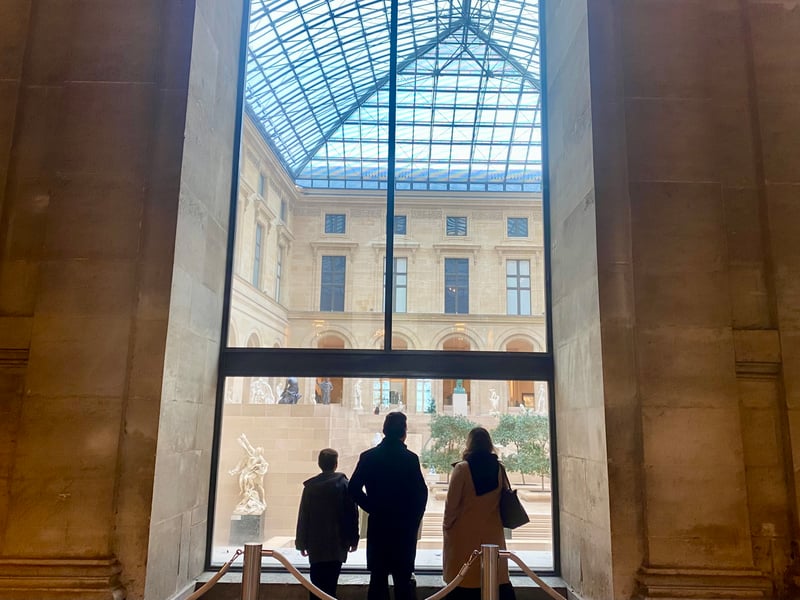
Monday’s strike is bringing even more negative attention to the Louvre, which is facing a reputational crisis after a roughly $103 million jewel heistand growing reports of crippled infrastructure.
In October, four robbers broke into a window of the museum in broad daylight — using a construction apparatus common for moving furniture in Paris — and fled with crown jewels dripping in pearls, emeralds and sapphires. Although the four suspected members of the group have been charged and are in custody, the precious gems have not yet been recovered — an ongoing source of humiliation for the museum and French intelligence forces.
This was a case in point for numerous investigators. In 2018, the jeweler Val Cleef & Arpels conducted a security audit on the museum and identified that particular window as a location for a potential break-in. One year earlier, the National Institute for Advanced Studies in Security and Justice published a report detailing the museum’s security shortcomings. After the heist in October, the French media outlet Libération verified that in 2014 — and potentially until the robbery — the password to enter the museum’s video surveillance server was “Louvre.”
The vulnerable security reports coincide with investigations over the museum’s fragile infrastructure, which endangers its roughly 500,000 objects.
On Tuesday, warnings materialized when a leak damaged roughly 400 documents in the Louvre’s Egyptian antiquities department. The documents are now being dried one page at a time according to Francis Steinbock, the museum’s deputy administrator.

For Sara, Monday’s strike represents a cumulation of all of these elements.
“We’re here as part of a strike notice that was filed with the Ministry of Culture, and it follows all the demands we’ve been raising for years now, but which have reached a breaking point today,” she said. “Especially with recent events, including the theft, and with the building becoming increasingly dilapidated.”
Some tourists are throwing their support behind the employees. Polly and Isla, a mother and daughter who asked to go by their first names, were traveling from England to visit the museum. Isla hoped to show her mother around as part of a “bucket list” trip. But they took the closure in stride.
“You know, I think it would be very rude to comment on the social actions of people from another country because it’s not my place to take judgment on that at all,” Polly said. “And if people feel that their work conditions are being compromised, then they have a right to protest. … It’s sad for us when we’re trying to visit, but you know, it’s more about people’s rights and people’s conditions.”
 Follow @lilyradz
Subscribe to our free newsletters
Our weekly newsletter Closing Arguments offers the latest about ongoing trials, major litigation and rulings in courthouses around the U.S. and the world, while the monthly Under the Lights dishes the legal dirt from Hollywood, sports, Big Tech and the arts.