
 Search Articles


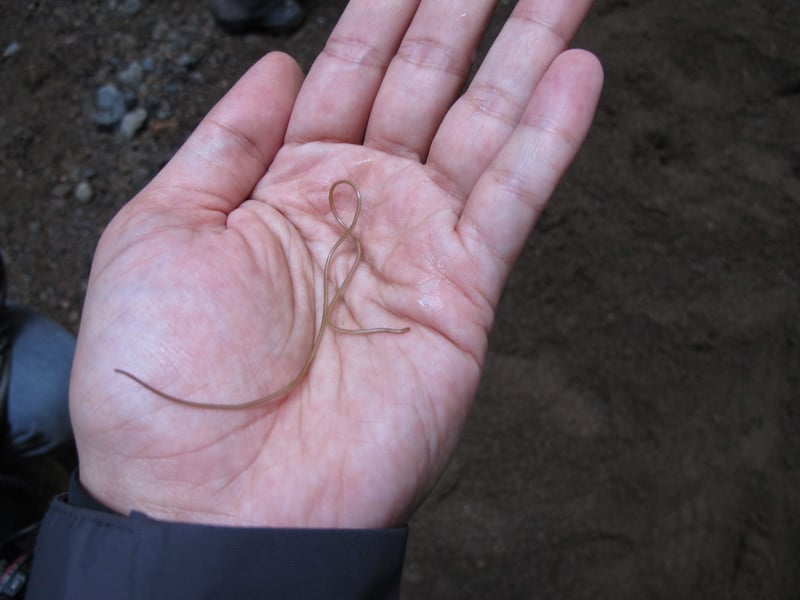
(CN) — Hairworms are the stuff of nightmares. The parasitic creature worms its way into various animals, sometimes even controlling their behavior, before eventually escaping through their hosts in grotesque knots of slithering sliminess.
But they may be due some sympathy. According to a new study, they’re the only creatures on earth that lack the genes to produce cilia.
Cilia are microscopic, threadlike organelles in cells that exist in all animals, and even some plants and fungi. They’re mainly involved in sensory perception and cell movement.
The tail on the end of sperm cells? That’s cilium.
Hairworms, though, lack the “generic machinery to make those cell structures,” according to Tauana Cunha, a postdoctoral researcher at Chicago’s Field Museum and the lead author of the study on the hairworms and their lack of cilia producing abilities, which was published in the journal Current Biology on Tuesday.
Cunha is an expert on marine snails and slugs, but she collaborated with a group of researchers to sequence the genomes of the hairworm, which had never been sequenced before.
There are hundreds of species of hairworms living all over the world in both freshwater, or near freshwater, and in the ocean.
The freshwater hairworms hatch their eggs in water, like swamps, streams, and even pools and dog bowls. The eggs turn into larvae, which are eventually eaten by tiny insects, which are then eaten by larger insects, like crickets, which grow into, on average, foot-long, spindly, adult worms inside their host’s bodies, feeding on their fat.
After a couple of months the worm manipulates crickets to mindlessly travel in search of water. Once they find it, the worm makes the cricket jump into the water, which crickets normally avoid doing. Once in the water, the worm bursts out of their hosts to find a mate, sometimes killing the cricket, sometimes leaving them alive and on their own to fend off fish, birds, or a current that could drown them.
Marine hairworms attach themselves to lobsters, shrimps, and crabs, but they don’t manipulate those creatures in similar ways to a cricket, since they already live in water, where the worms want to be.
Cunha and her colleagues took DNA samples from two different hairworm species, a freshwater one from Australia, and a marine one from Norway. Once they were sequenced, they compared them with other creatures’ genomes. They found that the hairworms were missing the genes to produce cilia and about 30% of genes that they expected them to have.
“We demonstrate extensive chromosomal rearrangement, a large number of lineage-specific orthologs of unknown function, and pervasive loss of universal metazoan genes, providing the molecular foundation that explains their lack of ciliary structures,” the study states. “These genomic resources will serve as an atlas of nematomorph gene repertoire, opening new avenues for investigating the genomic mechanisms underlying parasitism, control of host behavior, and genome reduction.”
The study doesn’t explain exactly why hairworms don’t have the genes to produce cilia, while other parasites do have the genes, but it opens the door for researchers and scientists to ask more questions and do more research on the worms.
“For example, given that these animals are missing cilia,” the organelles involved in sensory perception, Cunha said. “I’m kind of interested in how they sense their environment.”
Hairworms could have a “completely new mechanism” to sense such things, Cunha said, as well as a bevy of other genes that scientists haven’t yet.
In the future, Cunha said she wants to study those hairworm genes and continue working on sequencing the genes for marine snails and slugs.
Subscribe to our free newsletters
Our weekly newsletter Closing Arguments offers the latest about ongoing trials, major litigation and rulings in courthouses around the U.S. and the world, while the monthly Under the Lights dishes the legal dirt from Hollywood, sports, Big Tech and the arts.