
 Search Articles


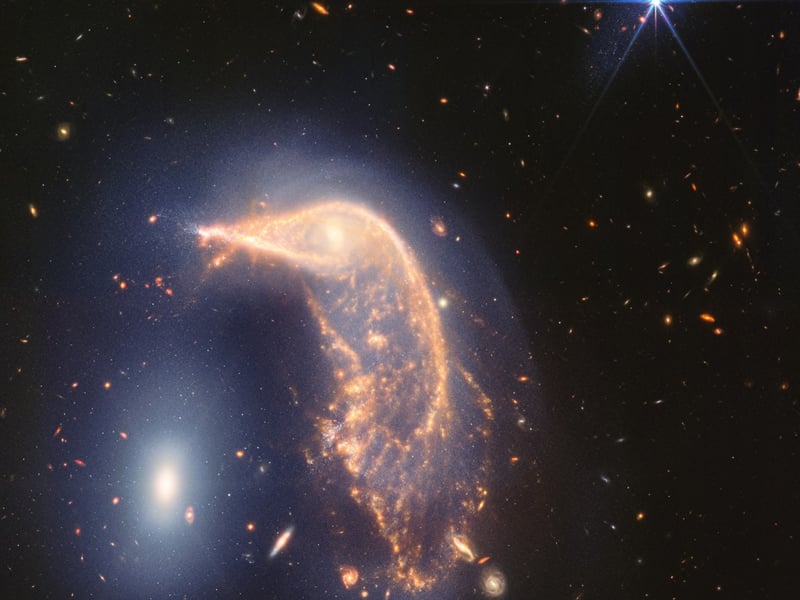
(CN) — NASA has released new images captured by the James Webb Space Telescope of two interacting galaxies dubbed by the space agency as the “Penguin and Egg.”
The pair of galaxies known collectively as Arp 142 are 326 million light-years from Earth, but only 100,000 light-years from one another.
Despite the vast distance, the two galaxies are close enough that they have begun a long interaction, or dance, which will result in them merging into a single galaxy hundreds of millions of years in the future.
“In just two years, Webb has transformed our view of the universe, enabling the kind of world-class science that drove NASA to make this mission a reality,” said Mark Clampin, director of the astrophysics division at NASA headquarters in Washington. “Webb is providing insights into longstanding mysteries about the early universe and ushering in a new era of studying distant worlds, while returning images that inspire people around the world and posing exciting new questions to answer. It has never been more possible to explore every facet of the universe.”
The Penguin is a spiral galaxy containing large amounts of gas and dust, and owes its unique shape to the gravitational pull of its neighbor.
On the other hand, the Egg is an elliptical galaxy that contains aging stars with far less gas and dust that gravity can pull away.
Additionally, the two galaxies have approximately the same mass, which is why the small-looking Egg galaxy has an undistorted appearance, and why it was not consumed by the Penguin.
Previous images of Arp 142 lacked the detail of the Webb Telescope’s images because of the telescope’s ability to detect infrared wavelengths that cannot be seen by humans, which is one of the reasons how the Webb obtained a clearer picture of the merging galaxies.
Purdue University associate professor of physics and astronomy Danny Milisavljevic explained why infrared helps the NASA team get such better pictures of the Penguin and Egg galaxies.
“In this case, we are benefiting from being able to avoid dust contained within the merging galaxies and our own Milky Way galaxy. Space can be a dirty place, and the dust between us and astronomical sources can obscure our ability to observe distant stars and gas. Infrared light is less susceptible to this absorption, and hence by observing in infrared JWST can peer more deeply into galaxies, especially ones that are interacting as we see here,” said Milisavljevic.
The JWST’s advanced infrared technology and giant mirror have allowed the telescope to better understand supernovas, exoplanets, and star formation.
“Key discoveries by JWST are also being enabled by infrared light’s ability to more easily access the most of distant galaxies. The universe is expanding, and the expansion stretches the wavelength of light as it travels through space. So what may begin as optical light in a distant galaxy becomes ‘redshifted’ to infrared light as it travels the vast distances of space. The further away the galaxy, the more it gets shifted towards infrared light,” said Milisavljevic.
In a statement celebrating both the new findings and the two-year anniversary of the telescope’s launch, NASA Administrator Bill Nelson championed its success.
“Since President Biden and Vice President Harris unveiled the first image from the James Webb Space Telescope two years ago, Webb has continued to unlock the mysteries of the universe. With remarkable images from the corners of the cosmos, going back nearly to the beginning of time, Webb’s capabilities are shedding new light on our celestial surroundings and inspiring future generations of scientists, astronomers, and explorers,” Nelson said.
Subscribe to our free newsletters
Our weekly newsletter Closing Arguments offers the latest about ongoing trials, major litigation and rulings in courthouses around the U.S. and the world, while the monthly Under the Lights dishes the legal dirt from Hollywood, sports, Big Tech and the arts.