
 Search Articles


WASHINGTON (CN) — In two unanimous rulings on Monday, the Supreme Court rebutted trial court decisions where the justices determined that judges had strayed too far from precedent.
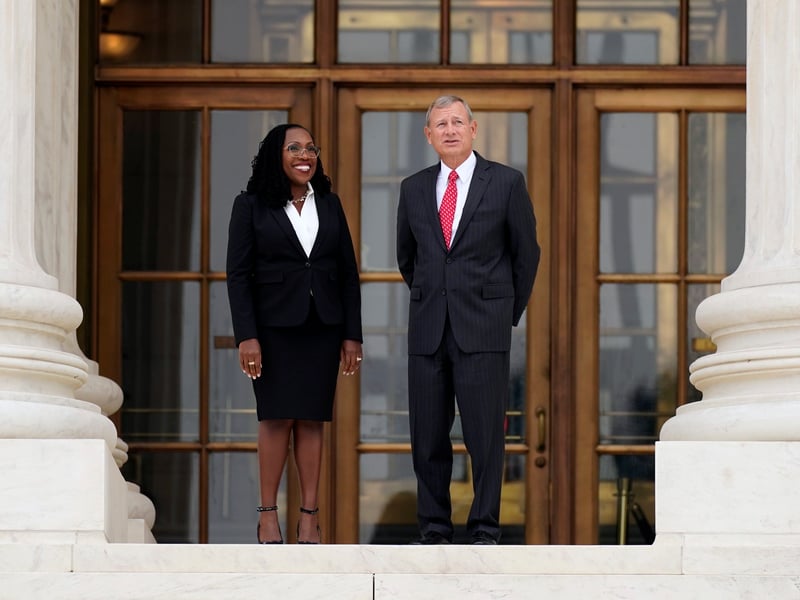
“To put it plainly, courts ‘call balls and strikes’; they don’t get a turn at bat,” the court wrote in a per curiam ruling — using a metaphor that Chief Justice John Roberts famously made during his confirmation hearings.
An appeals court had abused its discretion, the justices wrote, by turning a claim of ineffective assistance into a wholesale critique of the jury, judge and attorneys that participated in a Maryland murder trial.
Jeremiah Sweeney was found guilty of second-degree murder and other crimes after an argument over stolen drugs turned deadly in 2010. Sweeney opened fire on his neighbors for stealing marijuana, but it was a bystander, Robert Anderson, who was struck and killed by the assault.
At trial, Sweeney argued he couldn’t have been the shooter because of the location and angle of the bullet wound. While law enforcement officers linked Sweeney to the shot that killed Anderson, the firearm was never recovered. However, officers recovered weapons from others at the scene.
A curious juror took an unauthorized field trip to the crime scene, resulting in his dismissal. The rest of the jury was allowed to remain, issuing a guilty verdict.
Sweeney cited the incident on appeal, arguing that his attorneys provided an inadequate defense by not exploring whether other jurors were tainted by the unauthorized visit to the crime scene.
The Fourth Circuit went beyond Sweeney’s claim, however, ruling that the entire trial was marred by extraordinary failures — not just his defense.
The Supreme Court scolded the appeals court for not acting as a neutral arbiter of matters the parties present as required by precedent.
“The Fourth Circuit’s ‘radical transformation’ of Sweeney’s simple ineffective-assistance claim ‘departed so drastically from the principle of party presentation as to constitute an abuse of discretion,’” the court wrote.
Reversing the appeals court’s decision, the justices called for a new review based solely on Sweeney’s claim of ineffective assistance.
Mississippi’s high court also received a reprimand from the justices for putting a state statue over a defendant’s Sixth Amendment rights. The state Supreme Court tried to distinguish two U.S. Supreme Court precedents — Coy v. Iowa and Maryland v. Craig — to uphold a trial court’s use of a screen to separate a child witness from the defendant.
Child abuse cases can sometimes be an exception to the confrontation clause’s guarantee that a defendant gets a face-to-face meeting with a trial witness. However, the U.S. Supreme Court determined that Mississippi’s high court flouted the requirements necessary to make such a determination.
“The Mississippi Supreme Court attempted to avoid these constraints by distinguishing Coy and Craig in various ways,” the court wrote. “But none of the court’s distinctions persuades.”
While critical of the lower court error, the justices noted that a new trial is not the automatic solution. The justices said the state high court could consider the trial court’s mistake a harmless error, offering a path to uphold the conviction.
“Just because a constitutional error took place at trial does not necessarily mean a new one must be held,” the court wrote. “Even constitutional errors are sometimes subject to a ‘harmless-error’ rule and do not require a new trial if the prosecution can show ‘beyond a reasonable doubt that the error complained of did not contribute to the verdict obtained.’”
No clarity on government immunity
Unlike the two per curiam rulings, the justices divided over a controversial precedent protecting the government from lawsuits involving military service members. Justice Clarence Thomas reiterated a call to overrule Feres v. United States in a dissenting opinion on Monday.
“The Feres doctrine has been ‘almost universally condemned by judges and scholars,’” the George H.W. Bush appointee wrote.
Thomas’ dissent stemmed from the Supreme Court’s refusal to review whether the widow of a service member could sue the government under the Federal Tort Claims Act, which waives the government’s immunity in certain instances.
Air Force Staff Sergeant Cameron Beck was killed in a car accident after being struck by a civilian government employee driving a government vehicle. Lower courts rejected Beck’s widow’s case based on Feres, which created an exception to the FTCA that immunizes the government from injuries incident to military service.
Thomas said the court should have reviewed the widow’s appeal to revisit Feres, noting disagreement between the lower courts over its holdings.
Justice Neil Gorsuch, a Donald Trump appointee, indicated that he would have granted the petition but did not join Thomas’ dissent.
In a separate opinion, Justice Sonia Sotomayor added that the doctrine has caused significant confusion and prevented families from remedying serious harms. The Barack Obama appointee, however, stated that the court was right to reject the widow’s appeal.
“[Feres] has, for example, barred recovery for claims arising from medical malpractice, sexual assault, and (as here) car accidents, even when those harms occur on U. S. soil, bear little relation to the military itself, and just as easily could have befallen any American civilian,” Sotomayor wrote. “Even so, out of respect for the court’s rules of stare decisis, and in recognition of the reliance interests that Feres has generated, I vote to deny this petition for a writ of certiorari.”
Unlike constitutional questions, Sotomayor said, the widow’s appeal concerned statutory interpretation, which is firmly in Congress’ purview.
“Congress … is ‘undoubtedly aware of’ the problems posed by Feres and ‘can change [Feres] if it likes,’” Sotomayor wrote. “‘[U]ntil and unless it does, statutory stare decisis counsels our staying the course.’”
Sotomayor called for congressional action to prevent deeply unfair results like the one in the present case from continuing.
 Follow @KelseyReichmann
 Follow @kelseyreichmann.bsky.social
Subscribe to our free newsletters
Our weekly newsletter Closing Arguments offers the latest about ongoing trials, major litigation and rulings in courthouses around the U.S. and the world, while the monthly Under the Lights dishes the legal dirt from Hollywood, sports, Big Tech and the arts.