Search Articles



WASHINGTON (CN) — The Supreme Court ruled against Republicans’ attack on mail-in ballots on Monday, shoring up election rules in over a dozen states ahead of the midterms.
Nearly 200 years ago, Congress mandated federal elections be held uniformly on one Tuesday in November every other year. Accordingly, all states require ballots to be cast by federal Election Day. But since states have authority over the time, manner and places of such elections, nearly 30 states and the District of Columbia allow at least some ballots that are cast by Election Day to be counted if they are received soon after that.
In 2020, the Mississippi Legislature enacted one such law, permitting absentee ballots to be counted as long as they were postmarked on or before the date of the election and received by the registrar no more than five business days after the election.
The Republican National Committee argued that in practice, Mississippi’s law meant the election no longer ended on Election Day.
But in a 5-4 opinion, the high court majority held the committee’s argument conflicts with the Uniformed and Overseas Citizens Absentee Voting Act, which requires states to let absent military and overseas voters cast absentee ballots in federal elections — and, as a backup, establishes a federal absentee voting system.
The justices held that federal statutes do not prevent Mississippi from counting absentee ballots postmarked by Election Day but received up to five days afterward. They also affirmed that nothing in the federal statutes requires ballots to be received by Election Day.
“In sum, the Election Day statutes require the electorate’s choice to be made on Election Day. That occurs so long as Election Day is the deadline for individuals to vote — as it is in Mississippi,” Justice Amy Coney Barrett wrote for the majority.
“But the Election Day statutes do not set a deadline for ballot receipt, so they do not prevent Mississippi from counting ballots postmarked before Election Day yet received afterward,” the Donald Trump appointee added.
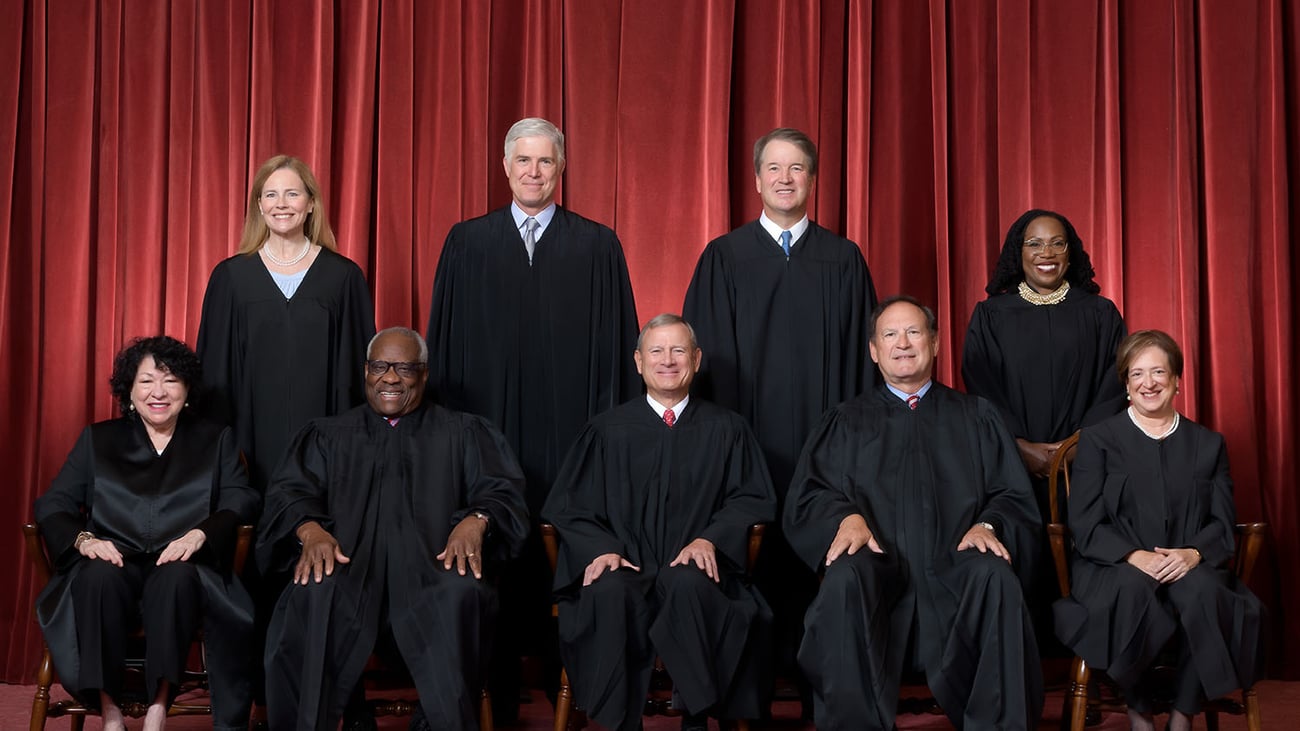
Chief Justice John Roberts joined the opinion, along with justices Sonia Sotomayor, Elena Kagan and Ketanji Brown Jackson. Roberts was appointed by George W. Bush, Sotomayor and Kagan by Barack Obama, and Jackson by Joe Biden.
When the Supreme Court heard oral arguments in March, the conservative justices worried that without finality on Election Day, the public would lose trust in the electoral process. However, the liberal justices balked at their conservative colleagues’ policy concerns, noting the question before them was whether federal election statutes barred states from making such laws.
Ultimately, the majority concluded that state law governs when ballots must be received.
While the justices agreed the Constitution requires the day in which votes are cast to be the same throughout the country, they found it says nothing about the day for receipt.
“The Constitution thus envisions a system in which receipt of votes is necessarily divorced from voting. And it sets the crucial, uniform day as the day of voting while leaving receipt to happen later,” Barrett wrote.
“The federal Election Day statutes follow the same pattern,” she added.
But Justice Samuel Alito issued a dissenting opinion, warning the ruling leaves open opportunities for voter fraud that may further undermine Americans’ faith in the integrity of the country’s elections.
He was joined by justices Clarence Thomas, Neil Gorsuch and in part by Brett Kavanaugh.
In their view, if ballots received after Election Day are added to the set of ballots that dictate the election’s outcome, the electorate’s choice is postponed beyond Election Day.
Alito, a George W. Bush appointee, said two centuries of historical practice reinforce the proposition that holding an “election” on a particular day means poll workers had to receive the ballots by that date.
“For state legislatures trying to understand what the Election Day statutes allow, the majority’s decision opens Pandora’s box,” Alito wrote.
Thomas is a George H.W. Bush appointee; Gorsuch and Kavanaugh are Trump appointees.
The state says its law ensures ballots are not rejected because of minor mail delivery delays. Republicans argued election officials’ convenience comes at the cost of the Constitution.
Facing high turnover and low cash flow, officials worried additional changes to election administration risked nullifying lawfully cast ballots. Further, they warned implementing an Election Day deadline for processing and adjudicating all mail-in ballots would be unworkable for many election administrators nationwide.
Even if absentee ballots are received before Election Day, Mississippi election officials can only begin processing — including checking names, addresses, precincts and signature matches — when polls open. Then the ballot must be deposited in the ballot box and the voter’s name entered into the pollbook.
To comply with Republicans’ preferred theory, for the 2024 general election, local officials said Mississippi would have had to process and adjudicate nearly 200,000 mail-in ballots physically received before Election Day, along with the likely thousands of mail-in ballots physically received on Election Day itself, by 11:59 p.m. on Election Day for these ballots to be considered lawfully cast.
Upon returning to office in 2025, Trump issued an executive order seeking to invalidate absentee or mail-in ballots received after Election Day. The president has also ratcheted up pressure on Congress to pass legislation — coined the SAVE America Act — ending the use of nearly all mail-in ballots. The bill would also make it harder for many Americans to vote by requiring additional identification documents, such as a passport or birth certificate.
In response to the Supreme Court’s decision, Mississippi’s Republican Attorney General Lynn Fitch said she hopes the Legislature will amend the law and require absentee ballots be received on the same day ballots are cast at the polling place.
“President Trump is right to prioritize improving public trust in our elections,” Fitch said in a statement.
RNC Chairman Joe Gruters said the decision made it even more imperative that Congress pass the SAVE America Act.
“Democrats are inviting chaos at the ballot box by allowing elections to drag on for days and weeks after voters cast their ballots,” Gruters said in a statement. “Republicans are not going to be deterred by this decision, and the RNC will keep fighting to have elections end on Election Day as Americans want.”
 Follow @KelseyReichmann
 Follow @kelseyreichmann.bsky.social
Subscribe to our free newsletters
Our weekly newsletter Closing Arguments offers the latest about ongoing trials, major litigation and rulings in courthouses around the U.S. and the world, while the monthly Under the Lights dishes the legal dirt from Hollywood, sports, Big Tech and the arts.