
 Search Articles


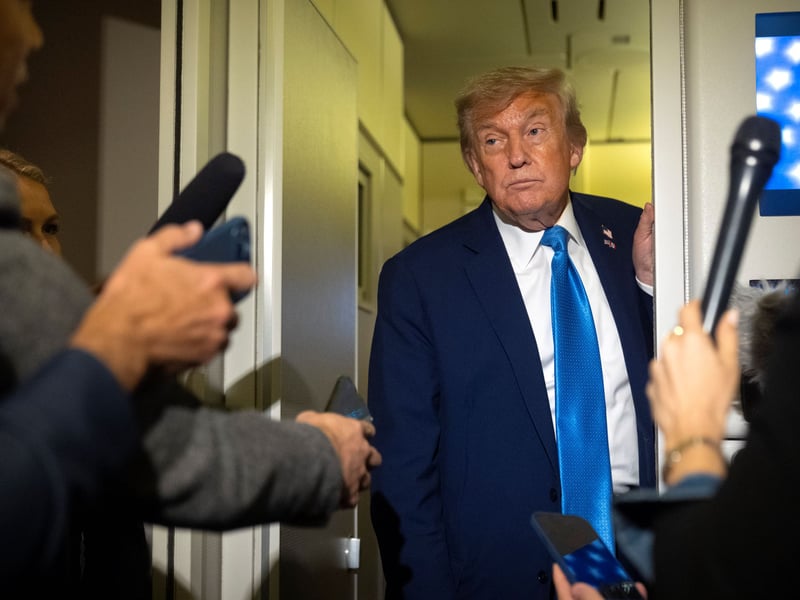
WASHINGTON (CN) — The Supreme Court agreed Wednesday to let President Donald Trump remove Democratic appointees from the Consumer Product Safety Commission, once again curtailing protections for independent regulators.
A lower court reinstated the product safety commissioners based on decades of precedent, but the conservative majority said an emergency order from this year should have held precedence.
“Although our interim orders are not conclusive as to the merits, they inform how a court should exercise its equitable discretion in like cases,” the apparent 6-3 majority said. “The stay we issued in Wilcox reflected ‘our judgment that the government faces greater risk of harm from an order allowing a removed officer to continue exercising the executive power than a wrongfully removed officer faces from being unable to perform her statutory duty.’”
In May, the high court issued an emergency order in Trump v. Wilcox allowing Trump to terminate labor regulators despite nearly a century of precedent shielding independent commissioners from political interference. The administration pushed the justices to take similar action for appointees on the product safety board.
In a short unsigned statement, the justices said this appeal did not differ from Wilcox in any pertinent respect.
Led by Justice Elena Kagan, the three liberal justices lamented the court’s continued inflation of executive power at the expense of legislative authority. Kagan was further incensed that those actions have come on the shadow docket.
“Once again, this court uses its emergency docket to destroy the independence of an independent agency, as established by Congress,” the Barack Obama appointee wrote.
Trump asked the justices to overturn a federal judge’s order reinstating Mary Boyle, Richard Trumka Jr. and Alexander Hoehn-Saric after they were fired from the agency. As with over a dozen other appeals on the high court’s docket, Trump claimed that that lower court judges were interfering with his complete control over the executive branch.
However, the Democratic regulators said Trump’s complaints would be better addressed by Congress.
“Although the government claims that the president’s inability to assert total ‘control of the agency’ is an irreparable harm, that consequence flows from Congress’s lawful decision to establish the CPSC as an independent agency,” the regulators wrote.
Under the Supreme Court’s landmark ruling Humphrey’s Executor v. United States , presidents can’t terminate independent board members at will. The president appoints board members, who the Senate confirms. Members then maintain for-cause removal protections, creating limited circumstances for their termination, such as misconduct. For-cause removal protections shield independent board members from political interference.
Trump, however, claims presidents need unrestricted removal power over the executive branch, embracing a broader version of the Constitution’s Article II called the unitary executive theory.
After chipping away at Humphrey’s Executor over the last decade, the Roberts court allowed Trump to ignore the 90-year-old precedent to terminate independent officials heading the National Labor Relations Board and the Merit Systems Protection Board.
The dissenting justices said Wednesday’s order all but overturned Humphrey’s Executor .
“On the court’s emergency docket — which means ‘on a short fuse without benefit of full briefing and oral argument’ — the majority has effectively expunged Humphrey’s from the U. S. Reports,” Kagan wrote.
Emergency docket appeals do not typically create precedent, but Trump argued that the justices’ order in the labor board case Trump v. Wilcox should govern the result in this appeal as well.
“Wilcox did not definitively resolve the merits, but it is a binding precedent on the application of the stay factors,” U.S. Solicitor General John Sauer wrote. “This court should step in to stop lower courts from treating Wilcox like the proverbial excursion ticket — good for one day and trip only.”
The majority agreed. Kagan noted, however, that the majority has only provided a few sentences to explain its decision to effectively erase decades of precedent.
“Next time, though, the majority will have two (if still under-reasoned) orders to cite,” Kagan wrote. “‘Truly, this is ‘turtles all the way down.’’”
Justice Brett Kavanaugh, a Donald Trump appointee, appeared somewhat uncomfortable with the court’s decision to act solely on the emergency docket. Kavanaugh suggested that the court should have scheduled arguments to fully flush out the appeal.
“If we grant a stay but do not also grant certiorari before judgment, we may leave the lower courts and affected parties with extended uncertainty and confusion about the status of the precedent in question,” Kavanaugh wrote in a concurrence.
Boyle, Hoehn-Saric and Trumka were Biden appointees to the Consumer Product Safety Commission; their terms were set to end in October 2025. However, in May, the White House began early terminations. The regulators said they were targeted because they voted against importing poorly made lithium-ion batteries and objected to staffing cuts.
The Democratic commissioners sued the administration for wrongful termination. U.S. District Judge Matthew Maddox in Maryland found that the regulators were protected by Humphrey’s Executor and reinstated them.
At the Supreme Court, the regulators argued that Maddox’s order was well within the bounds of established remedies typically offered by judges and justices alike.
“Courts, including this court, have long exercised their equitable powers to enjoin the president’s subordinates from carrying out unlawful presidential commands, and the government offers no principled reason why that established remedy cannot apply in the context of an unlawful termination,” the regulators wrote. “Indeed, any other conclusion would nullify lawful tenure protections for independent agency heads by allowing the president to flout those statutory provisions at will.”
Boyle, Hoehn-Saric and Trumka moved to quickly undo regulatory changes in their absence once back on the commission. The commissioners acted to bar the implementation of any reduction-in-force orders, continue work on projects and draft final rules for new product regulations.
Trump said these actions illustrate why they need to be removed from the commission. However, the regulators argued that the administration’s claims only amounted to a description of their official functions. The commissioners noted that upon reinstatement they took action to remedy unlawful actions that were taken in their absence.
The regulators pushed the justices to maintain the status quo while litigation over their termination continued.
“The potential uncertainty that hangs over actions taken by an independent commission while the status of its leadership remains legally contested is surely why this court warned against ‘the disruptive effect of the repeated removal and reinstatement of officers during the pendency of … litigation,” the regulators warned.
The conservative majority has consistently upended Congress’ intent to give Trump executive power at the expense of legislative authority, Kagan said. She warned that the transfer of power may be irreversible.
“The majority has acted on the emergency docket — with ‘little time, scant briefing, and no argument’ — to override Congress’ decisions about how to structure administrative agencies so that they can perform their prescribed duties,” Kagan wrote. “By means of such actions, this court may facilitate the permanent transfer of authority, piece by piece by piece, from one branch of government to another.”
 Follow @KelseyReichmann
 Follow @kelseyreichmann.bsky.social
Subscribe to our free newsletters
Our weekly newsletter Closing Arguments offers the latest about ongoing trials, major litigation and rulings in courthouses around the U.S. and the world, while the monthly Under the Lights dishes the legal dirt from Hollywood, sports, Big Tech and the arts.