Search Articles


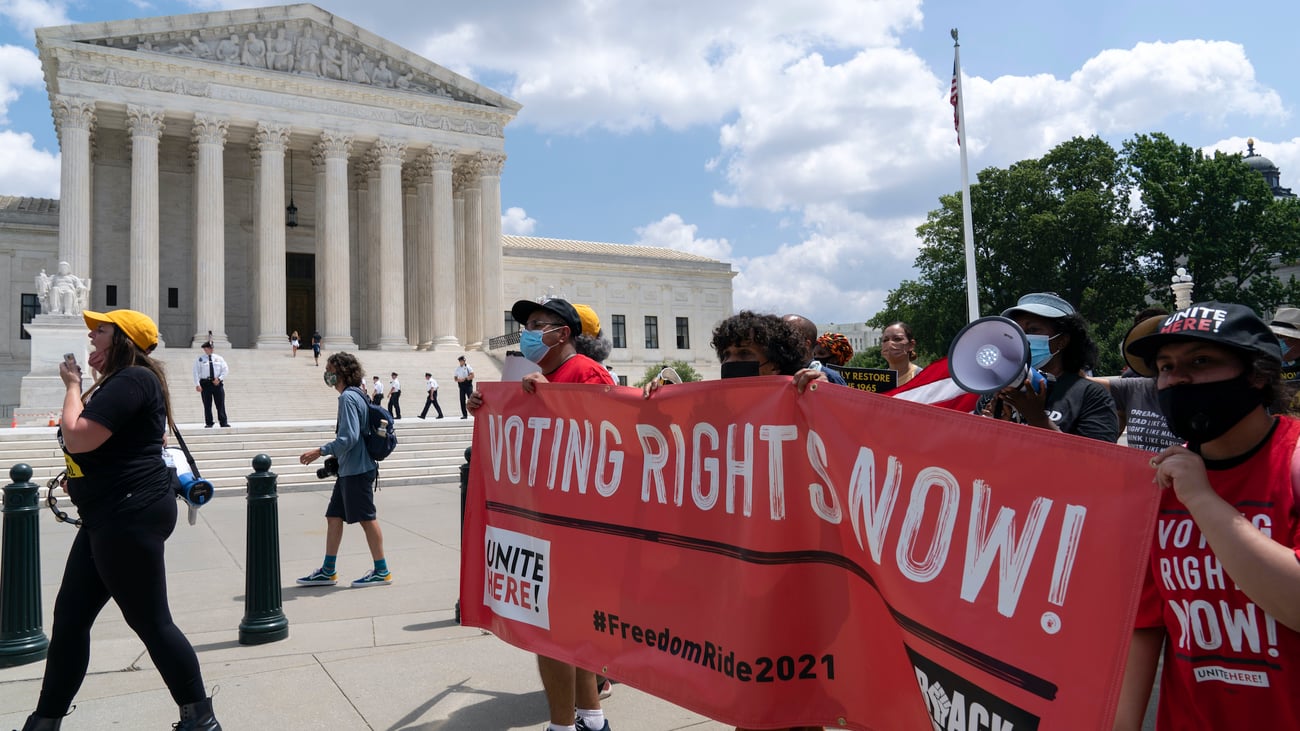
WASHINGTON (CN) — The Supreme Court cleared the way Monday for Republicans in Louisiana to redraw favorable congressional districts using the justices’ landmark ruling ahead of quickly approaching primary elections.
In an unsigned order, the high court said it would allow its decision to take immediate effect because Black voters and civil rights groups hadn’t asked the court to reconsider its judgment.
Justice Ketanji Brown, a Joe Biden appointee, penned a blistering dissent, admonishing her colleagues for jumping into the partisan battle over redistricting.
“To avoid the appearance of partiality here, we could, as per usual, opt to stay on the sidelines and take no position by applying our default procedures,” Jackson wrote. “But, today, the court chooses the opposite.”
By taking steps to influence the ruling’s implementation, Jackson said, was “tantamount to an approval of Louisiana’s rush to pause the ongoing election in order to pass a new map.” She said her colleagues were abandoning restraints that have previously been applied to avoid the appearance of influencing an election.
“The court unshackles itself from both constraints today and dives into the fray,” Jackson said. “And just like that, those principles give way to power. Because this abandon is unwarranted and unwise, respectfully, I dissent.”
Justice Samuel Alito, a George W. Bush appointee, said that claim was “groundless and utterly irresponsible” in a concurring opinion joined by Justices Clarence Thomas and Neil Gorsuch. He said Jackson leveled charges that cannot go unanswered, characterizing her reasons for delaying as “trivial at best” and “baseless and insulting.”
“The dissent accuses the court of ‘unshackl[ing]’ itself from ‘constraints,’” Alito wrote. “It is the dissent’s rhetoric that lacks restraint.”
The plaintiffs in Louisiana v. Callais — a group of “non-African American voters” — asked the high court to fast-track the procedural process formalizing their win. Under court practice, the clerk issues a certified judgment about 32 days after a ruling.
State officials took a different approach. Louisiana Governor Jeff Landry issued an executive order Thursday, delaying the state’s May 16 primary elections until July to give lawmakers time to draw a new map.
“Allowing elections to proceed under an unconstitutional map would undermine the integrity of our system and violate the rights of our voters,” Landry said in a X post. “This executive order ensures we uphold the rule of law while giving the Legislature the time it needs to pass a fair and lawful congressional map.”
A different group of Louisiana voters and a Democratic primary candidate filed a lawsuitchallenging Landry’s order, arguing that absentee ballots had already been sent out and that early voting was scheduled to begin Saturday.
Black voters in the Callais litigation issued a similar warning to the Supreme Court.
“Enjoining the primary after ballots have already been cast would cause chaos in the election process and leave voters and candidates hopelessly confused,” the Black voters wrote.
Black voters and civil rights groups sued Louisiana over its 2022 voting maps, which included one majority-Black district despite Black voters making up 30% of the voting-age population in the state. The Supreme Court approved the map for the 2022 midterms, citing Purcell v. Gonzalez, which limits federal-court interference in the run-up to elections.
After a lengthy legal fight and a federal ruling, lawmakers approved a new map in 2024 with a second majority-Black district. A group of “non-African American voters” then sued, saying the map is unconstitutional. The court again paused changes for the 2024 election under Purcellbut left the new map in place.
The Supreme Court heard two argument sessions in 2025 on whether adding the second majority-Black district under Section 2 of the Voting Rights Act was unconstitutional. In a 6-3 ruling Wednesday, the court held that it was.
Louisiana’s secretary of state claimed the court’s 2024 stay order during the presidential election terminated automatically on judgment of the appeal. Therefore, the justices’ Wednesday ruling, the secretary said, was enough for the state to begin redrawing maps for the 2026 election.
“[State officials] do not view their ability to do so as contingent upon when this court transmits its opinion and judgment,” Louisiana wrote. “Nor do they see any injunctive role for the district court upon the state’s adoption of a new map and process.”
 Follow @KelseyReichmann
 Follow @kelseyreichmann.bsky.social
Subscribe to our free newsletters
Our weekly newsletter Closing Arguments offers the latest about ongoing trials, major litigation and rulings in courthouses around the U.S. and the world, while the monthly Under the Lights dishes the legal dirt from Hollywood, sports, Big Tech and the arts.