
 Search Articles


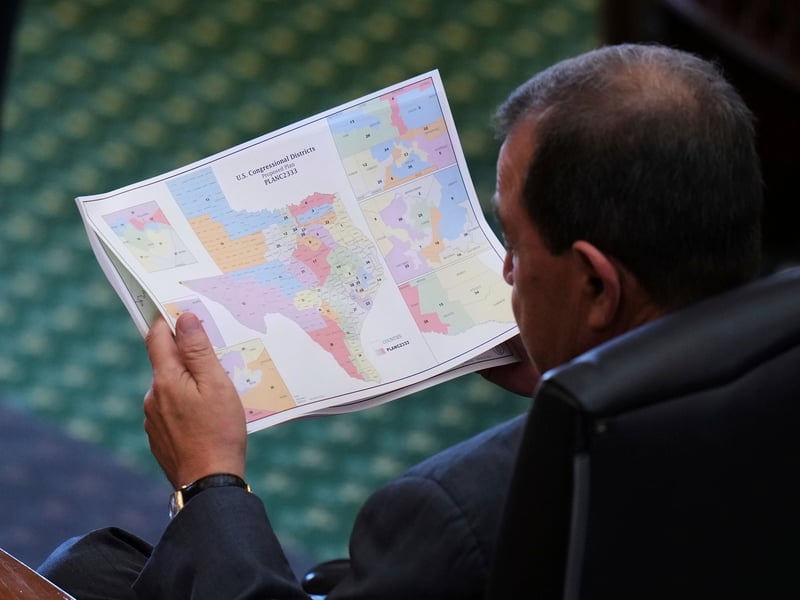
WASHINGTON (CN) — The Supreme Court boosted President Donald Trump’s redistricting war for the House majority Thursday, allowing a Republican-drawn congressional map in next year’s elections despite racial gerrymandering concerns.
Over the dissents of the three liberal justices, the conservative majority reprimanded a lower court for throwing out Texas’ newly minted map “on the eve of an election.”
“The district court improperly inserted itself into an active primary campaign, causing much confusion and upsetting the delicate federal-state balance in elections,” the court wrote in an unsigned order.
Justice Elena Kagan lamented her colleagues’ dismissal of the lower court’s review “based on its perusal, over a holiday weekend, of a cold paper record.”
“Today’s order disrespects the work of a district court that did everything one could ask to carry out its charge — that put aside every consideration except getting the issue before it right,” the Barack Obama appointee wrote in a dissent joined by Justices Sonia Sotomayor and Ketanji Brown Jackson. “And today’s order disserves the millions of Texans whom the district court found were assigned to their new districts based on their race.”
Trump called for five additional Republican seats in the Lone Star State’s U.S. House map, but his Justice Department’s demand to break up majority-minority districts threatened to sink the party’s shot at any advantage.
A panel of federal judges threw out the 2025 map in November, citing the Justice Department letter to state officials in July threatening legal action if Texas didn’t immediately dismantle four majority-non-white districts. Texas urged the Supreme Courtto overrule the panel, claiming the judges allowed civil rights groups to use the court as a “weapon of political warfare."
Justice Samuel Alito, a George W. Bush appointee, issued an administrative stay, temporarily reinstating Texas’ 2025 maps while the Supreme Court considered whether they could be used in the 2026 elections.
Voters and civil rights groups pushed the justices to hold Texas accountable for choosing to draw new maps outside of the typical redistricting cycle.
“Weighed against the rights of the voters subject to racial gerrymandering, returning to the status quo is not a substantial imposition,” the civil rights groups wrote. “The state, moreover, could have avoided even that minimal imposition simply by following the law and not embracing DOJ’s directive to target minority voters of Texas in a mid-decade redistricting mere months before the deadlines, within its control, which it complains are too close or cannot be extended.”
Governor Greg Abbott called a special legislative session days after receiving the Justice Department letter, directing lawmakers to resolve the federal government’s concerns. Democratic lawmakers fled the state to temporarily halt the legislation, but the Republican-controlled legislature prevailed and enacted its 2025 map in August.
The Texas NAACP challenged the 2025 map as an illegal racial gerrymander. According to the Lawyers’ Committee for Civil Rights Under Law, which represented the group, the 2025 map gave white voters control of 70% of Texas’ congressional districts despite only accounting for 40% of the population.
U.S. District Judge Jeffrey Brown, a Trump appointee, issued a preliminary injunction ordering the state to revert back to its 2021 map as litigation continued. He cited Abbott’s explicit direction to create new majority-Hispanic districts and lawmakers’ statements celebrating the elimination of coalition districts.
Texas argued that Brown’s decision was not only incorrect but also violated the Purcellprinciple — a judicial rule stemming from Purcell v. Gonzalez barring last-minute changes to election rules. The Supreme Court has cited Purcell to pause voting map changes in Alabama and Louisiana in recent years.
The sheer size of its territory and number of counties, districts and voters affected put Texas in a far worse position, the state argued. Texas’ candidate filing period closes on Dec. 8. The state said that there is not enough time to restart the campaign season under a repealed map where 37 of the 38 districts are different.
Civil rights groups argued that Texas has no right to engage in racial gerrymandering, but voters have a right to an election under a constitutional map.
“Requiring Black and Brown Texans to vote under an illegally racially gerrymandered plan in the upcoming election cycle would send the message that courts are powerless to protect the rights of impacted voters and the Constitution’s protections are meaningless,” the groups wrote. “That outcome gravely disserves the public interest.”
Kagan noted that the lower court’s 160-page opinion “marched methodically” through the trial record and the evidence on both sides, providing detailed explanations of its credibility judgments of witness testimony. In contrast, Kagan said the Supreme Court provided no evidence to substitute its understanding of the evidence for the district court to side with Texas.
She refuted the majority’s claim that the ruling came too close to an election, stating that the court’s reasoning opened up the use of unlawful maps in every state as long as the new maps were implemented a year out from any election.
“Were judicial review so broadly foreclosed, then to implement even a ‘blatantly unconstitutional map,’ the ‘Legislature would need only to pass’ it on a schedule like this one,” Kagan wrote. “That cannot be the law — except of course that today it is.”
Although the majority’s ruling is preliminary, Kagan said the results won’t be.
“This court’s stay guarantees that Texas’ new map, with all its enhanced partisan advantage, will govern next year’s elections for the House of Representatives,” Kagan wrote. “And this court’s stay ensures that many Texas citizens, for no good reason, will be placed in electoral districts because of their race.”
Alito wrote no one disputed that the impetus for the adoption of Texas’s new map was “partisan advantage pure and simple.”
“Texas needs certainty on which map will govern the 2026 midterm elections, so I will not delay the court’s order by writing a detailed response to each of the dissent’s arguments,” Alito wrote in a concurring opinion joined by Justices Clarence Thomas and Neil Gorsuch.
Alito said the lower court applied the wrong standard, stating that an alternative map needed to be presented to demonstrate that the political goals could have been accomplished without racial gerrymandering.
“Although respondents’ experts could have easily produced such a map if that were possible, they did not, giving rise to a strong inference that the state’s map was indeed based on partisanship, not race,” Alito wrote. “Neither the duration of the district court’s hearing nor the length of its majority opinion provides an excuse for failing to apply the correct legal standards as set out clearly in our case law.”
 Follow @KelseyReichmann
 Follow @kelseyreichmann.bsky.social
Subscribe to our free newsletters
Our weekly newsletter Closing Arguments offers the latest about ongoing trials, major litigation and rulings in courthouses around the U.S. and the world, while the monthly Under the Lights dishes the legal dirt from Hollywood, sports, Big Tech and the arts.