
 Search Articles


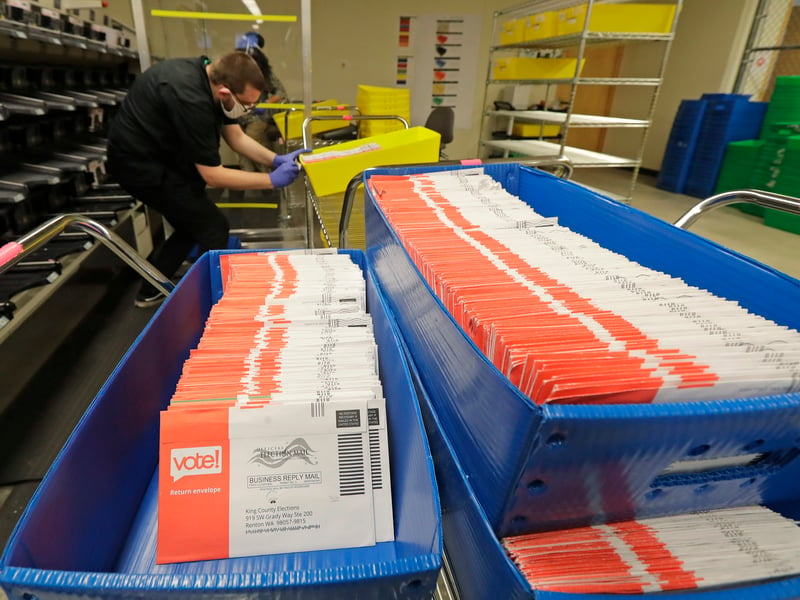
WASHINGTON (CN) — The Supreme Court seemed poised Monday to put new limits on mail-in ballots, upending election rules in over two dozen states ahead of the midterm elections.
“We don’t have Election Day anymore,” Justice Samuel Alito, Justice Samuel Alito, a George W. Bush appointee, said. “We have election month.”
Nearly 200 years ago, Congress mandated federal elections be held uniformly on one Tuesday in November every other year. Accordingly, all states require ballots to be cast by federal Election Day. But since states have authority over the time, manner and places of such elections, nearly 30 states and the District of Columbia allow at least some ballots that are cast by Election Day to be counted if they are received soon after that.
In 2020, the Mississippi Legislature enacted one such law, permitting absentee ballots to be counted as long as they were postmarked on or before the date of the election and received by the registrar no more than five business days after the election.
The Republican National Committee argued that in practice, Mississippi’s law meant the election no longer ended on Election Day.
“If somebody in Gulfport the day after the election asks is the election over, the common sense answer is no, it’s not, the ballots are still coming in,” Paul Clement, an attorney with Clement & Murphy representing the party, said. “And if somebody asks who won, the truthful answer is we don’t know yet, the ballots are still coming in.”
The conservative justices seemed concerned that without finality on Election Day, the public would lose trust in the electoral process. At key concern during the high court’s two-hour argument session Monday was whether voters could recall ballots submitted to the postal service.
Justice Neil Gorsuch, a Donald Trump appointee, presented a recall hypothetical where a story exposed a lead candidate’s inappropriate sexual escapade or collusion with a foreign power — which he described as not far-fetched.
“The competing candidate immediately goes on the airwaves and urges voters to recall their ballots and tell the common carriers not to deliver them,” Gorsuch said. “FedEx, you just call them up and say I want it back. In that hypothetical, did the election happen on Election Day? Oh, by the way, it swings the election.”
Mississippi said such a circumstance was impossible because the state doesn’t allow ballot recalls. Gorsuch and his colleagues were seemingly unconvinced, expressing concerns that post-election deadlines allowed for vote manipulation.
The liberal justices balked at their conservative colleagues’ policy concerns, noting that the question before them was whether federal election statutes barred states from making such laws.
Absent a federal law about the timing of absentee ballot receipts, Justice Sonia Sotomayor, a Barack Obama appointee, said the court had no reason to strike down Mississippi’s law.
“People who should decide this issue are not the courts but Congress,” Sotomayor said.
Justice Ketanji Brown Jackson, a Joe Biden appointee, noted lawmakers are currently considering mail-in ballot legislation.
“The Make Elections Great Again Act, specifically addresses the idea of preempting state post-Election Day ballot deadlines,” Jackson said, seemingly referring to Trump’s SAVE America Act. “It seems as though Congress doesn’t believe that its current legislation has done this work.”
The RNC said lawmakers are pushing the legislation not knowing how the court would act. But Jackson was concerned the high court would act as a loophole if such efforts failed.
“The worry is that you want this court to decide the case rather than have Congress do it,” Jackson said.
As they explored letting the RNC take the judicial route, several conservative justices looked to historical precedent surrounding mail-in ballot deadlines. Both the Trump administration and RNC argued that proxy voting during the Civil War was analogous to absentee ballots today. Despite the inconvenience, they said states required ballots to be received by election officials by Election Day.
“Mississippi’s theory of election is so general and permissive that it would authorize statutes that Congress could not possibly have approved in the 19th century,” U.S. Solicitor General John Sauer said.
This similarly caused an ideological split on the court, with the liberal justices lamenting the attempt to “Bruenize” the inquiry — referring to NYSRPA v. Bruen which set a history test for gun regulations.
“If you said to Congress, do you think that the Civil War provides a precedent for early voting generally among the civilian population, I think they would have laughed at you,” Justice Elena Kagan, an Obama appointee, said.
Kagan worried that a ruling favoring the RNC and Trump would have a domino effect. If the casting and receipt of votes must happen on Election Day, Kagan said early voting would be unlawful as well.
“It just seems inconceivable that on the basis of this kind of evidence, we would reject these practices that are so entrenched in 30 states,” Kagan said.
The high court will issue a ruling in the coming months.
 Follow @KelseyReichmann
 Follow @kelseyreichmann.bsky.social
Subscribe to our free newsletters
Our weekly newsletter Closing Arguments offers the latest about ongoing trials, major litigation and rulings in courthouses around the U.S. and the world, while the monthly Under the Lights dishes the legal dirt from Hollywood, sports, Big Tech and the arts.