Search Articles


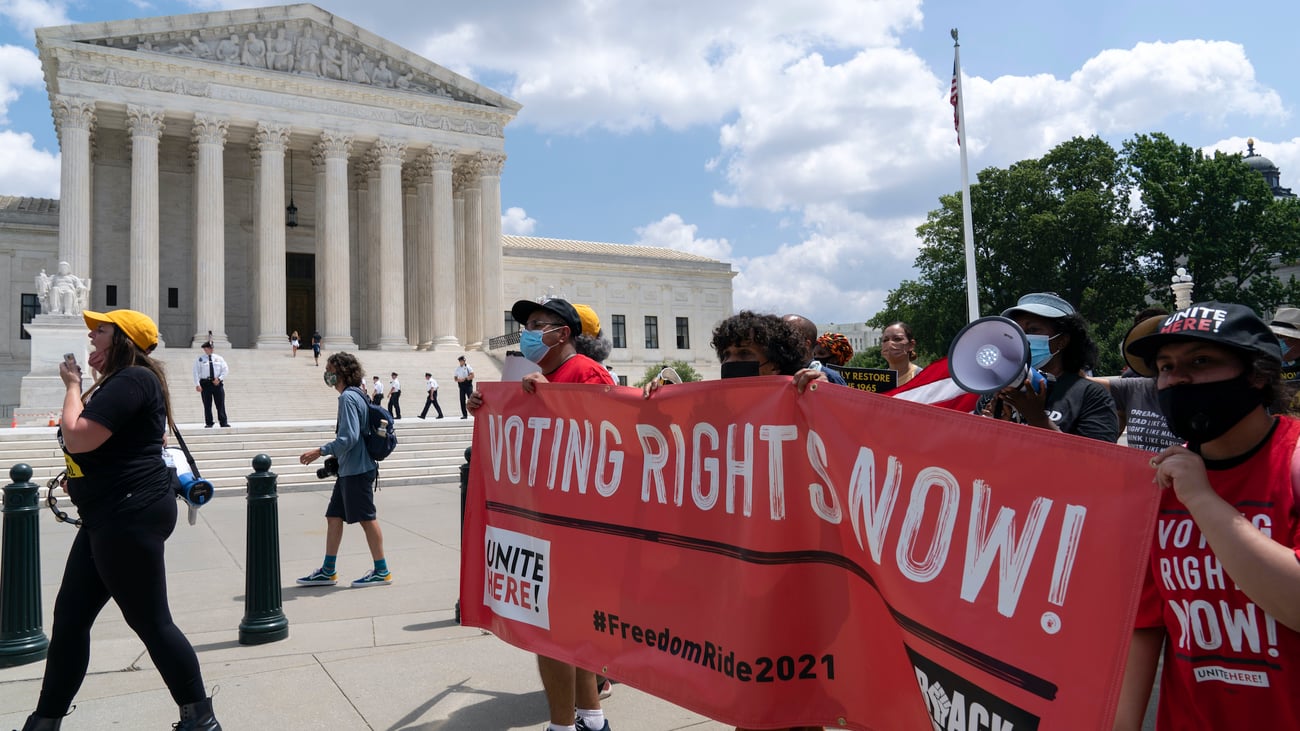
WASHINGTON (CN) — The Supreme Court further eroded the Voting Rights Act on Wednesday, strictly limiting how racial discrimination can be remedied in redistricting maps.
In a 37-page opinion, the majority held that “because the Voting Rights Act did not require Louisiana to create an additional majority-minority district, no compelling interest justified the state’s use of race in creating SB8, and that map is an unconstitutional racial gerrymander.”
Section 2 of the Voting Rights Act established a violation when political processes are not equally open to participation by members of a certain race, who have less opportunity than other members of the electorate to participate in the political process and to elect representatives of their choice. It stems from the 15th Amendment’s prohibition on racial discrimination in voting.
But under the Supreme Court’s renewed interpretation, the opportunity that any given group of voters has to elect their candidate of choice depends on the voting preferences of other voters in the district, not race.
“For example, in a district where most voters prefer Democratic candidates, a Republican voter in that district will have a low chance of securing the election of his or her preferred candidate,” Justice Samuel Alito wrote for the majority opinion.
“The roster of voters who end up in a given district depends, in turn, on the districting criteria the state uses to draw a legislative map,” the George W. Bush appointee added.
In the majority’s view, the act only imposes liability when there is a strong inference that a state intentionally drew its districts to afford minority voters less opportunity because of their race.
Under the act, “a minority voter is entitled to nothing less and nothing more,” Alito wrote.
They added the act should not intrude on states’ prerogative to draw districts based on nonracial factors, including to achieve partisan advantage.
While they noted the long-standing disapproval of partisan gerrymandering, they wrote that it is permissible for states to do and can’t be challenged in federal courts.
Because the plaintiffs failed to show sufficient evidence of intentional discrimination and instead relied on “historical evidence and evidence that failed to disentangle race from politics,” the lower court’s decision was affirmed and the case was remanded.
In a concurring opinion, Justice Clarence Thomas wrote the high court never should have interpreted the Voting Rights Act “to effectively give racial groups an entitlement to roughly proportional representation.”
Wednesday’s decision should put an end to what he called a “disastrous misadventure” in voting rights jurisprudence, the George H. W. Bush appointee wrote, as many cases posing the same question have arisen across the country.
Justice Neil Gorsuch, a Donald Trump appointee, joined in his opinion.
But not all of the justices were on board with the ruling, drawing a troubled dissent from Justice Elena Kagan.
The Barack Obama appointee wrote that under this new precedent, a state can, without legal consequence, systematically dilute minority citizens’ voting power.
She explained that states still facing residential segregation, political division and other effects of long histories of racial discrimination, can split any minority community that is cohesive in its geography and politics so that it loses all electoral influence.
“Members of the racial minority can still go to the polls and cast a ballot. But given the state’s racially polarized voting, they cannot hope — in the way the state’s white citizens can — to elect a person whom they think will well represent their interests,” Kagan wrote.
“Their votes matter less than others do; they translate into less political voice,” she added.
Kagan was joined by Justice Sonia Sotomayor, a fellow Obama appointee and Justice Ketanji Brown Jackson, who was appointed by Joe Biden.
They criticized the court’s actions over the past decade as slowly chipping away at the Voting Rights Act, allowing a flood of discriminatory voting laws to follow.
“I dissent, then, from this latest chapter in the majority’s now-completed demolition of the Voting Rights Act,” Kagan wrote.
In their view, the Voting Rights Act of 1965 represented Congress’s most determined effort to counter voting discrimination and stop the cycle of states finding ways to minimize minorities’ voting power.
Hinging only on the partisan ambitions of state legislatures could destroy most of the majority-minority districts that were created over the past 40 years, Kagan wrote, laying the groundwork for the largest reduction in minority representation since the Jim Crow era.
She wrote if other states follow Louisiana’s lead, the minority citizens residing there will no longer have an equal opportunity to elect candidates of their choice. And minority representation in government institutions will sharply decline.
“The consequences are likely to be far-reaching and grave,” Kagan wrote.
Louisiana added a second majority-Black district after multiple courts concluded that its congressional maps likely violated Section 2 of the Voting Rights Act, which prohibits discriminatory vote dilution. But the justices were concerned about how race played into Louisiana’s new maps, questioning whether they violated the 14th and 15th Amendments.
Just an hour after the opinion’s release, Florida House lawmakers approved a new congressional map that would give Republicans a leg up in four more U.S. House seats and increase their chances of keeping control of the chamber.
Louisiana’s first set of new maps only included one majority-Black district despite Black voters making up 30% of the adult population in the state. Civil rights groups sued Louisiana for diluting the votes of Black voters, and after a protracted legal battle and federal court ruling, the Legislature drew new maps in 2024 with a second majority-Black district.
Litigation continued, however, after a group of “non-African American voters” sued the state — so far unsuccessfully — claiming the new maps are unconstitutional because they considered race.
Early last year, the Supreme Court heard arguments over whether the Legislature relied too heavily on race when redrawing Louisiana’s maps. Instead of issuing a decision in June 2025, the justices delayed a decision and scheduled an additional argument this term.
Scheduling reargument is rare — putting Louisiana’s case in the same bucket as blockbusters like Brown v. Board, Roe v. Wade and Citizens United v. Federal Election Commission.
The high court raised the stakes of Louisiana’s already consequential case, asking whether the intentional creation of a second majority-Black congressional district — as courts ruled was required by the Voting Rights Act — violates the 14th and 15th Amendments.
While Louisiana initially defended its second majority-Black district, the state abandoned that position, stating there is no safe harbor for racial discrimination.
A group of voters stood by Louisiana’s maps, stating that Section 2 is only relevant where racial discrimination is present. The voters said a limited consideration of race is necessary to remedy that discrimination.
A report from voting advocacy groups found that a ruling in favor of Louisiana could secure an additional 19 safe seats for Republicans in the House of Representatives and cement GOP control for at least a generation.
 Follow @KelseyReichmann
 Follow @kelseyreichmann.bsky.social
Subscribe to our free newsletters
Our weekly newsletter Closing Arguments offers the latest about ongoing trials, major litigation and rulings in courthouses around the U.S. and the world, while the monthly Under the Lights dishes the legal dirt from Hollywood, sports, Big Tech and the arts.