
 Search Articles


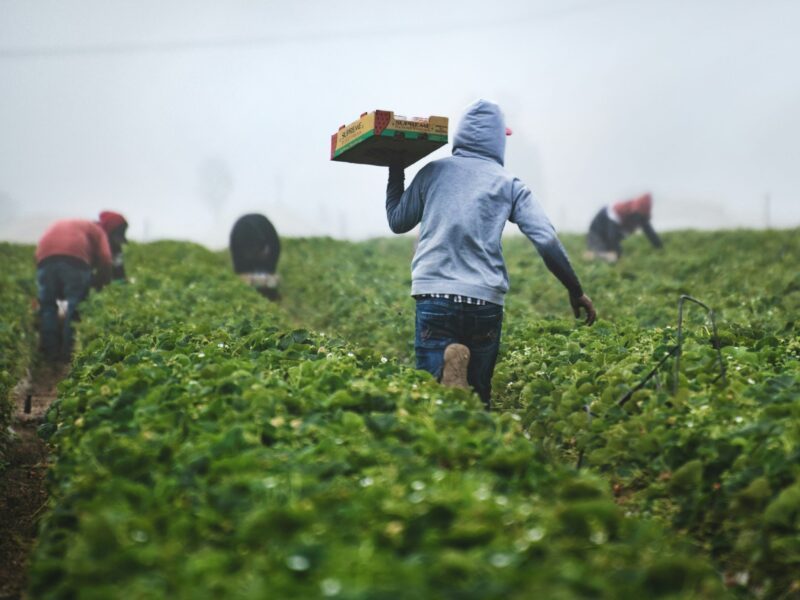
(CN) — The Supreme Court agreed Monday to determine whether the Department of Labor can continue to assess monetary penalties against employers that violate employment conditions of migrant workers.
Under the H–2A visa program, American employers can hire immigrant workers for temporary or seasonal agricultural work.
As a condition of granting petitions to import foreign workers, federal law requires an employer to comply with statutory and regulatory requirements governing workers’ living and working conditions.
In its petition for review, the Department of Labor argues Congress has empowered the secretary of labor to penalize employers to help ensure their compliance with those terms and conditions — otherwise, importing foreign workers might hurt the wages and conditions of the domestic workforce.
The case focuses on a decadelong dispute with a family farm in Swedesboro, New Jersey, which says it has now been shuttered.
Sun Valley Orchards relied on the H–2A program to hire 96 foreign workers, alongside 51 U.S. workers, to pick asparagus and peppers in 2015.
In 2016, the feds accused the farm of failing to provide adequate housing, meal plans, transportation and work hours for H-2A employees.
According to the agency’s findings, the workers’ shifts lasted 12 hours each day, workers lacked consistent access to drinking water and clean bathrooms while they worked in the fields and meal plans cost $75 to $80 per week despite promises of free cooking facilities and free transportation to a nearby grocery store.
The Department of Labor imposed thousands of dollars in liabilities for violations at the farm. Sun Valley sued in 2021 after an in-house administrative judge affirmed the agency’s findings and finalized the amounts at $211,800 in civil penalties and $344,946 in back wages.
A New Jersey federal judge denied relief. But in July 2025, the Third Circuit vacated the decision on appeal, ruling the fines were unconstitutionally assessed by the Department of Labor.
The panel held that the department’s enforcement of wage and facilities requirements under an H-2A job order was akin to a breach of contract involving core “private rights” and determined an independent federal court was the proper venue for this dispute.
“This is an important opportunity for the Supreme Court to affirm the right to a real judge and jury,” said Rob Johnson, a senior attorney at the Institute for Justice who represents Sun Valley Orchards. “Small businesses targeted for fines have the right to defend themselves in a real court, with a real judge and jury, rather than an agency court where the only judge is an agency bureaucrat.”
“It’s fundamentally unfair to try a business in a court where everybody involved is employed by the same administrative agency,” he added.
In the department’s view, the decision deprives the government of an important tool for ensuring that employers comply with the conditions of employing H-2A workers, estimated to make up one-sixth of the country’s agricultural workforce.
The Third Circuit’s decision was based on a Supreme Court ruling from two years ago in a case that challenged a similar administrative court system. In its ruling, thejustices held that the Securities and Exchange Commission was required to press its fraud charges against George Jarkesy in a federal court and in front of a jury. Sun Valley’s owners, Joe and Russell Marino, filed an amicus brief in support of Jarkesy in that case.
 Follow @Megwiththenews
Subscribe to our free newsletters
Our weekly newsletter Closing Arguments offers the latest about ongoing trials, major litigation and rulings in courthouses around the U.S. and the world, while the monthly Under the Lights dishes the legal dirt from Hollywood, sports, Big Tech and the arts.
Additional Reads

 Fifth Circuit unblocks Texas immigration law April 24, 2026
 Feds yet to return vehicle Renee Good was shot and killed in April 24, 2026