
 Search Articles


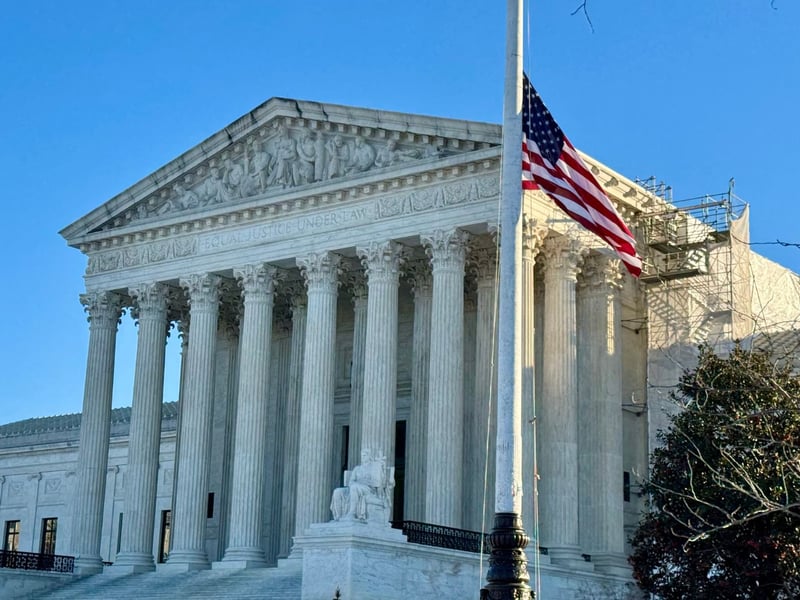
(CN) — The Supreme Court on Wednesday threw out a nearly $43 million award granted in a fiery dispute between two real estate companies seeking a solution to a decadeslong trademark dispute.
In a unanimous opinion, the justices wrote that Dewberry Group is the only entity named in Dewberry Engineers’ complaint as liable for infringing the “Dewberry” trademark, and therefore the group’s property-owning affiliates should not have been considered when calculating the award amount.
When awarding the defendant’s profits to the prevailing plaintiff in a Lanham Act lawsuit, a court can only award profits that can be traced to the named defendants, the justices wrote, and the lower courts erred in combining the profits of Dewberry Group with those of its separately incorporated affiliates that were not parties to the suit.
“All we hold today is that the courts below were wrong to treat Dewberry Group and its affiliates as a single entity in calculating the ‘defendant’s profits.’ Dewberry Group is the sole defendant here, and under that language only its own profits are recoverable,” wrote Justice Elena Kagan, a Barack Obama appointee.
Under U.S. corporate law, those organizations are separate units with distinct legal rights and obligations, even if the entities are affiliated, the justices wrote.
The court remanded the case, which involves two unrelated real estate companies that use the word “Dewberry” in their names, for new award proceedings.
Double Dewberry
For nearly two decades Dewberry Engineers, a national commercial developer that focuses its work in several southeastern states, has sought to defend its trademark rights against Dewberry Group — another commercial real estate company operating in the southeast.
The latter company, owned by developer John Dewberry, works solely with about 30 other, separately incorporated companies. Each own a piece of commercial property for lease, but none has employees to carry out business functions.
A lower court found Dewberry Group liable for breaching a 2007 settlement between the groups limiting its use of the word “Dewberry,” and awarded Dewberry Engineers nearly $43 million in disgorgement profits. However, in coming up with that award, the court looked to the affiliates’ profits — because Dewberry Group’s tax returns showed it had been operating at a loss for decades, surviving only through millions in cash added by John Dewberry himself.
The court found that any revenue generated through Dewberry Group was added only to the affiliates’ books, which had racked up tens of millions of dollars in profit, in part from its trademark infringement. So the court opted to treat the group and its affiliates “as a single corporate entity” in the award phase.
A divided Fourth Circuit panel affirmed that outcome, reiterating the “‘economic reality’ of Dewberry Group’s relationship with its affiliates,” and the fear that “corporate formalities” otherwise would insulate infringing conduct from any penalty.
On Wednesday, Justice Sonia Sotomayor addressed that point in a concurring opinion.
“I write separately to underscore that principles of corporate separateness do not blind courts to economic realities. Nor do they force courts to accept clever accounting, including efforts to obscure a defendant’s true financial gain through arrangements with affiliates,” the Barack Obama appointee wrote. “To the contrary, there are myriad ways in which courts might consider accounting arrangements between a defendant and its affiliates in calculating a ‘defendant’s profits.’”
Dewberry Engineers argued to the Supreme Court that the award was justified under a provision of the Lanham Act’s remedies section that says, “if the amount of the recovery based on profits is either inadequate or excessive, the court may in its discretion enter judgment for such sum as the court shall find to be just, according to the circumstances.”
But the justices said the lower court did not properly follow that provision; it relied only on the amount of Dewberry entities’ real estate profits for the relevant years, instead of identifying which of the affiliates’ profits were attributable to Dewberry Group.
Kagan declined to give an opinion on whether or how the court could have rightfully used the provision. Sotomayor suggested taking account of whether a company’s share earnings were assigned to its affiliate in advance, or if a company indirectly received compensation for infringing services through related corporate entities, when calculating the company’s profits.
The high court also refused to give a view on the government’s question of when courts, even without relying on the just-sum provision, can look behind a defendant’s tax or accounting records to consider “the economic realities of a transaction” and identify the defendant’s “true financial gain.”
Neither did the justices say whether, as raised during oral argument, corporate veil-piercing is an option on remand.
While a court may in select circumstances “pierce the corporate veil,” to prevent corporate formalities from shielding fraudulent conduct, Dewberry Engineers admitted that it never tried to make the showing needed for veil-piercing, the justices wrote.
 Follow @Megwiththenews
Subscribe to our free newsletters
Our weekly newsletter Closing Arguments offers the latest about ongoing trials, major litigation and rulings in courthouses around the U.S. and the world, while the monthly Under the Lights dishes the legal dirt from Hollywood, sports, Big Tech and the arts.