
 Search Articles


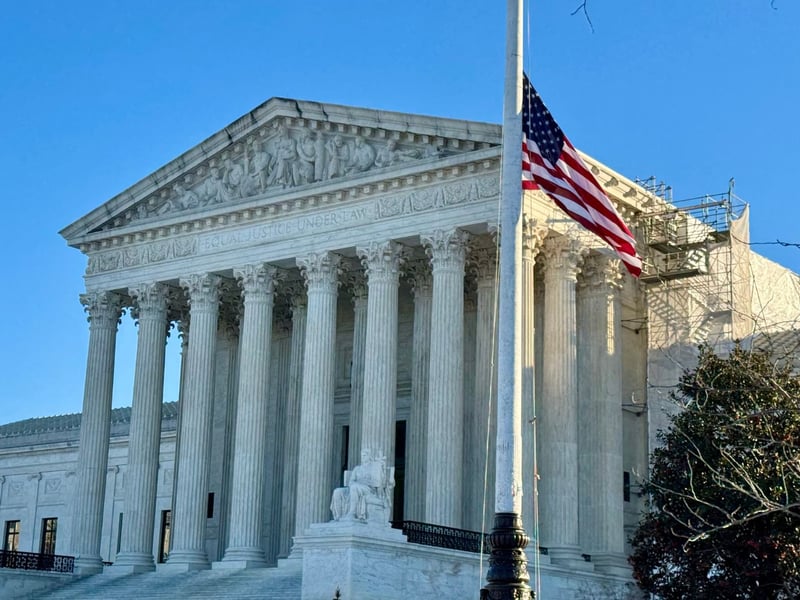
WASHINGTON (CN) — Louisiana can move forward with its first nitrogen gas execution, a divided Supreme Court ruled on Tuesday, clearing the way for the state to end its 15-year execution pause.
In an apparent 5-4 decision, the justices refused to block Jessie Hoffman’s nitrogen hypoxia execution scheduled for Tuesday evening. Justices Sonia Sotomayor and Elena Kagan, both Barack Obama appointees, and Justice Ketanji Brown Jackson, a Joe Biden appointee, would have granted the application.
Justice Neil Gorsuch, a Donald Trump appointee, dissented, stating that the court disregarded whether Hoffman’s religious rights would be violated by his method of execution.
Nitrogen hypoxia executions pump nitrogen into a mask, depriving the inmate of oxygen and suffocating them to death. Hoffman, who’s a Buddhist, says the process violates his rights under the Religious Land Use and Institutionalized Persons Act by interfering with his meditative breathing as he dies.
“In other words, one cannot breathe normally — much less practice meditative breathing — when being gassed,” Hoffman wrote.
A lower court rejected Hoffman’s claim based on its own findings about his faith. Gorsuch said courts do not have authority over religious exercise.
“That finding contravened the fundamental principle that courts have ‘no license to declare . . . whether an adherent has ‘correctly perceived’ the commands of his religion,’” Gorsuch wrote.
Hoffman was sentenced to death for the 1996 murder of Mary “Molly” Elliot. Prosecutors said Hoffman kidnapped Elliot, robbed her, raped her and then shot her in the back of the head “execution style.”
Louisiana said Hoffman would be the state’s first inmate to undergo a nitrogen hypoxia execution. However, Hoffman argued that the relatively new execution method is cruel and unusual punishment because it forces inmates to go through severe emotional suffering.
He said the justices needed to review the method’s constitutionality, asking that the high court pause his execution until a ruling was issued.
Alabama became the first state to execute inmates by nitrogen hypoxia last year. Sotomayor, Kagan and Jackson dissented from the Supreme Court’s decision to let Alabama move forward with the execution, stating that the justices were permitting the state to “experiment with a human life.”
Louisiana dismissed Hoffman’s concerns about nitrogen gas executions, stating that the method is “tried and tested.” The state turned to nitrogen hypoxia — a method that deprives the inmate of oxygen — after struggling to obtain lethal injection drugs.
During the execution, the inmate is fitted in a full-face silicon mask with a plexiglass screen known as a “source respirator.” According to the state, the respirator is industrial-grade and superior to medical-grade equipment.
Using an airtight seal, the mask delivers ambient air and nitrogen to the inmate. Louisiana said that within 40 seconds, the air within the mask is only 1.8% oxygen.
While the state disputed Hoffman’s concerns, Louisiana also declared his arguments irrelevant.
“Hoffman is unlikely to prove that nitrogen hypoxia — a painless way to die — is ‘inhumane and barbarous,’ akin to ‘torture,’ because it allegedly risks some emotional distress in the seconds before unconsciousness,” the state wrote. “The condemned is not entitled to a ‘peaceful[] … state of relaxation’ when he faces the ultimate punishment, even if the state could provide it.”
However, Hoffman said the Eighth Amendment does bar forms of execution that intensify a death sentence with terror, pain or disgrace. He distinguishes his execution from Alabama’s, claiming that Louisiana would be the first to force an inmate to undergo the controversial procedure.
Hoffman is scheduled for execution between 6 p.m. and 9 p.m.
 Follow @KelseyReichmann
 Follow @kelseyreichmann.bsky.social
Subscribe to our free newsletters
Our weekly newsletter Closing Arguments offers the latest about ongoing trials, major litigation and rulings in courthouses around the U.S. and the world, while the monthly Under the Lights dishes the legal dirt from Hollywood, sports, Big Tech and the arts.