
 Search Articles


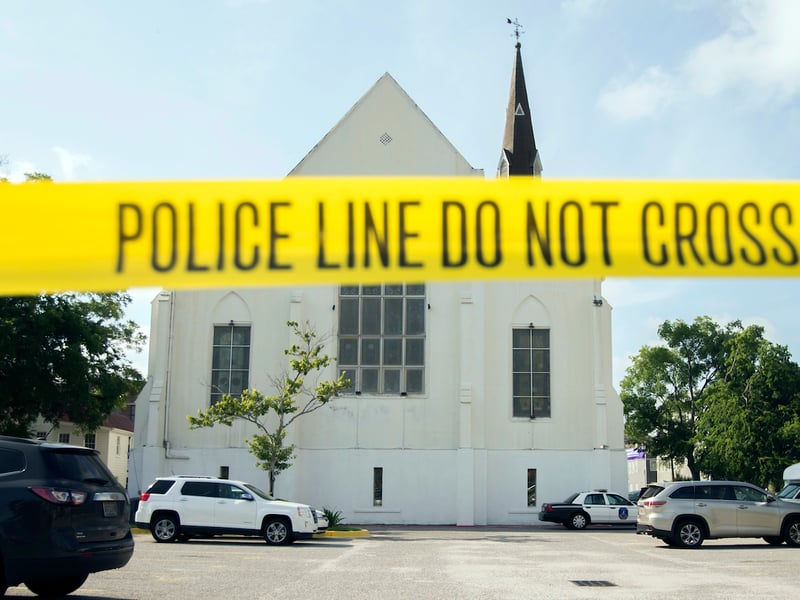
(CN) — Surviving victims of a racist massacre at a South Carolina church argued on appeal Thursday that the parent company of Facebook should not be shielded from liability for its supposed role in radicalizing the gunman.
A panel for the Fourth Circuit Court of Appeals weighed whether Meta Platforms was protected from liability under Section 230 of the Communications Decency Act, a 1996 law that shields online platforms from civil liability for content published by its users, over claims it published content that influenced Dylann Roof.
Jennifer Pinckney and her minor daughter filed suit in 2022 in the District Court of South Carolina claiming Roof, who killed nine people in 2015 at Charleston’s Emanuel AME Church, was radicalized online by white supremacist propaganda fed to him by Facebook.
The plaintiffs also sued several Russian companies and individuals linked to efforts to sow discord in the United States, accusing them of exploiting “defective algorithms” to spread hate-filled propaganda online.
U.S. District Judge Richard Gergel dismissed the suit in July 2023. Gergel, a Barack Obama appointee, wrote in a nine-page opinion that the courts have considered a mountain of lawsuits seeking to overcome the broad protections afforded online platforms under Section 230 and none have succeeded.
“The balancing of the broad societal benefits of a robust internet against the social harm associated with bad actors utilizing these services is quintessentially the function of Congress, not the courts,” Gergel wrote.
Plaintiffs’ attorney Francois Blaudeau from Southern Med Law of Homewood, Alabama, told the appeals court Thursday that the nearly 30-year-old law was intended to protect “traditional editorial functions,” not the sophisticated social media platforms built today.
Facebook tracks its users, creates a profile of them and then feeds them materials using an algorithm that “psychologically manipulates the biochemistry of your brain,” Blaudeau said.
“The issue is so far beyond any kind of traditional editorial function that the Communications Decency Act, when it was passed, even thought of,” he said. “They couldn’t even imagine where we are today.”
U.S. Chief Circuit Judge Albert Diaz called it a “reasonable argument,” but he asked why it was a problem that should be addressed by the courts instead of legislative action.
“Congress hasn’t been living in a cave,” noted Diaz, a Barack Obama appointee.
U.S. Senior Circuit Judge Barbara Milano Keenan echoed the concern.
“I think a lot of cases are expressing the frustration of the courts, because it’s a square peg in a round hole,” Keenan, another Obama appointee, said. “Maybe Congress never contemplated the reach of Section 230 when they enacted it, but if there are going to be restrictions, don’t they have to come from Congress?”
Blaudeau said he believed the Fourth Circuit made the right decision in Zeran v. America Online , a 1997 challenge to the liability law, but subsequent decisions went too far, providing “blanket immunity” to platforms.
“What this court is really about today — do we need to pull some of that back?” he asked.
The Third Circuit Court of Appeals has already taken that step. Earlier this year, the court ruled in Anderson v. TikTok that Section 230 did not protect the social media platform from liability after its algorithm promoted a video that purportedly led a minor to kill herself.
Meta attorney Jacob Spencer from Gibson, Dunn & Crutcher of Washington argued this case was different from Anderson , which dealt with the “targeted recommendation” of content. In this case, there was only a “speculative and minimal link” between Facebook’s conduct and Roof, he argued.
U.S. Circuit Judge Allison Jones Rushing pointed out the complaint appears to contain at least one claim that Facebook engaged in “targeted recommendation.” Specifically, the survivors of the shooting claim that Facebook’s algorithms directed Roof toward hate-based groups and communities that contributed to his radicalization.
Jones Rushing, an appointee of Donald Trump, questioned whether the protections afforded platforms in Section 230 extended to recommendations or if it was limited to third-party content.
Spencer argued that the Second and Ninth circuits have both found that recommendations — where a platform displays and promotes third-party content — fall within traditional editorial functions protected by Section 230.
“Recommending groups means recommending third-party content,” Spencer said.
Plaintiffs’ attorney Marc Mandich, also of Southern Med Law, said there was a clear difference between promoting third-party content among similar users and creating a group for them.
If a friend recommended you meet a mutual acquaintance who reads similar articles on the internet, you might call the friend a matchmaker, but not a publisher, Mandich argued.
“Have we ever known publishing, in the traditional sense of the word, to include such targeted direction of content?” he asked.
 Follow @SteveGarrisonPC
Subscribe to our free newsletters
Our weekly newsletter Closing Arguments offers the latest about ongoing trials, major litigation and rulings in courthouses around the U.S. and the world, while the monthly Under the Lights dishes the legal dirt from Hollywood, sports, Big Tech and the arts.